The Jain temples of Dilwara, located in the hill station of Mount Abu in Rajasthan, are world-famous for their use of marble. Built between the 11th and 13th centuries AD, these temples are situated approximately two kilometers from Mount Abu. The temple complex offers a truly satisfying experience for any devotee, with green mango trees and deep forested hills providing a picturesque backdrop. The Dilwara Jain temples are renowned for their architectural perfection, which is unmatched in Rajasthan.
In total, there are five temples, each with its own distinct identity.

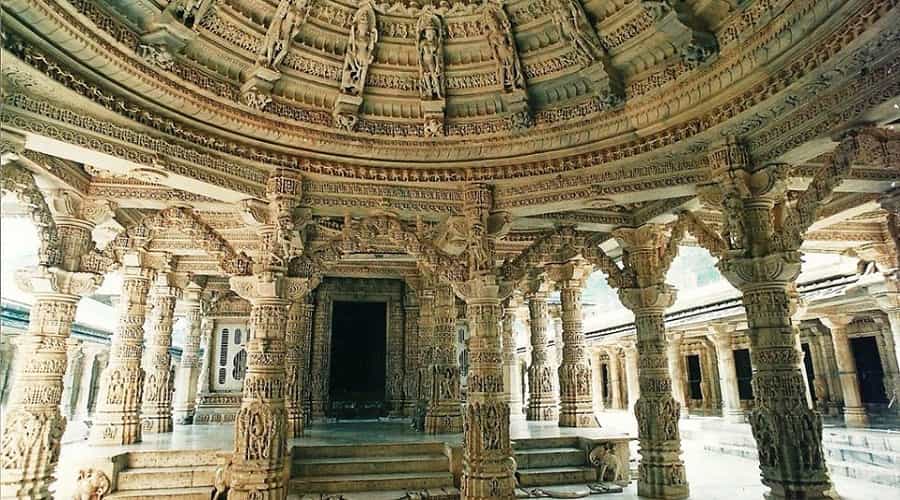
Vimal Vasahi
- Built by Vimal Shah, a minister of Raja Bhimdeo.
- Dedicated to the first Tirthankara, Adi Nath.
- Known for its intricately carved ceilings with flowers and lotus motifs.
- Houses a large idol of Adi Nath in the Gudh Mandap.
One of the most famous temples among the five is Vimal Vasahi, also known as Shri Adi Nathji Temple. This temple was built by Vimal Shah, a minister under Raja Bhimdeo. It is dedicated to the first Tirthankara, Adi Nath. The ceilings of this temple feature beautiful motifs of flowers and lotus, and are adorned with scenes from Hindu and Jain mythology. A large idol of Adi Nath is located in the Gudh Mandap (main hall) of the temple.
- Also Read: 15 Famous Jain Temples of India
Luna Vasahi Temple
- Built in 1230 AD by ministers Vastupala and Tejpal.
- Dedicated to the twenty-second Tirthankara, Nemi Nath.
- Features a beautiful Navchowki (ornate ceiling) and a black marble idol of Nemi Nath.
- Contains the Kirti Stambha, a black stone pillar erected by Maharana Kumbha.
Luna Vasahi is another well-known temple among the five. Dedicated to Shri Nemi Nathji, the twenty-second Tirthankara, it is also referred to as Shri Nemi Nathji Temple. The temple was constructed in 1230 AD by Vastupala and Tejpal, two ministers of a local ruler, in memory of their late brother, Luna. The Navchowki, or the ornate ceiling, is considered one of the finest features of this temple. The Gudh Mandap houses an idol of Nemi Nathji, made of black marble, which was crafted with exceptional skill. Additionally, the temple features a black stone pillar, known as Kirti Stambha, located on the left side. This pillar was erected by Maharana Kumbha.
- Further to Read: Best Places To Visit In Mount Abu
Pittalhar Temple
- Built by Bhima Shah, a minister in the Sultan Begada’s administration.
- Known for its large metal statue of Adi Nath made from five metals, predominantly brass.
- The name “Pittalhar” comes from the brass used in the statue.
- Features a Gudh Mandap and Navchowki.
The Pittalhar Temple is smaller compared to the Vimal Vasahi and Luna Vasahi temples. It was constructed by Bhima Shah, a minister in the Sultan Begada’s administration of Ahmedabad. The temple is known for its large metal statue of Adi Nath (Rishab Dev), which is cast in five metals, with brass being the predominant one. This is why it is called Pittalhar, which means “made of brass.” The temple complex also features a Gudh Mandap and Navchowki.
Parshwanath Temple
- Built by Mandlik in the 15th century AD.
- Dedicated to Lord Parshwanath, the 23rd Tirthankara.
- The tallest of the Dilwara temples, consisting of three storeys.
- Also known as Khartar Vasahi.
The fourth important temple is the Parshwanath Temple, dedicated to Lord Parshwanath. This temple was built by Mandlik in the 15th century AD. It is the tallest of all the Dilwara temples, as it consists of a three-story building. The temple is also known as Khartar Vasahi.
Mahaveer Swami Temple
- Built in 1582.
- Dedicated to the twenty-fourth Tirthankara, Lord Mahaveer.
- The smallest of all the Dilwara temples.
- Known as Shri Mahaveer Swami Temple.
The Mahaveer Swami Temple is the smallest of all the Dilwara temples. Built in 1582, it is dedicated to the twenty-fourth Tirthankara, Lord Mahaveer, and is therefore also known as Shri Mahaveer Swami Temple.
- Must Read: Popular Temples in Rajasthan