
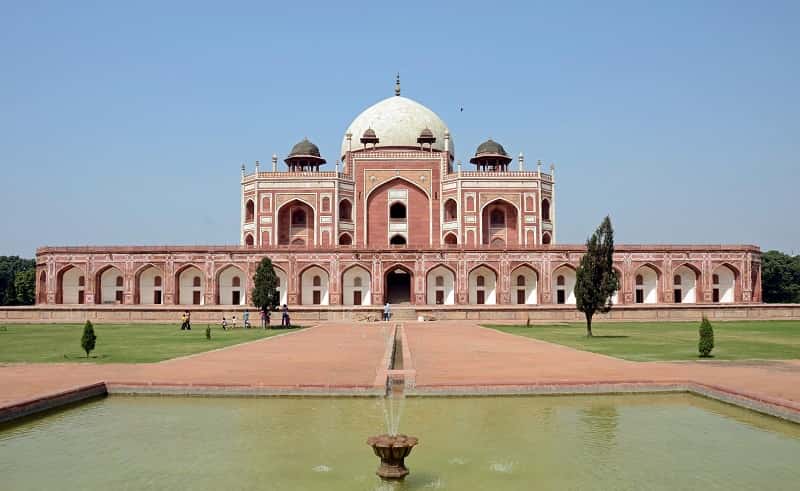
Humans have always been interested in exploring things and places that connect us with the past. Historians, archaeologists, researchers, philosophers, students, and all other curious people have found that historical sites offer many insights to us. The debate on how these things and places came into existence and what purpose they served the people in the past continues with ongoing research and studies conducted by experts. However, a common person, possessed by the spirit of a wanderer, is not concerned with the “what,” “how,” “why,” or “when” of these places. All they care about is a place worth visiting and exploring at least once in a lifetime. Humayun’s Tomb in Delhi is among such popular destinations frequented by tourists, researchers, students, and others who either want to spend their vacations or learn more about this site that has existed for centuries.

Location
Humayun’s Tomb was constructed in Delhi, which now serves as the capital of India. It is located at Bharat Scouts and Guides Marg, off Mathura Road, Nizamuddin, New Delhi.
History
The site where the tomb is constructed is not exactly where Humayun was buried after he died in 1556. His body was first buried at Purana Qila. After Hemu defeated the Mughal kingdom and took over the fort, his tomb was moved to a city in Punjab. This step was taken to avoid any damage that Hemu could cause to the tomb after becoming the ruler of the region.
The construction of the tomb began in 1565 on the instructions of Humayun’s widow, Hamida Banu Begum. The design of the tomb was created by a Persian architect named Mirak Mirza Ghiyath. Built out of red sandstone, a common material in several structures of that period, the tomb complex houses the graves of Hamida Begum and several Mughal emperors as well.
The tomb complex is built on the banks of the Yamuna River, close to the Nizamuddin Dargah, where Nizamuddin Auliya, a revered Sufi saint, is buried.
- Also Read: Historical Places to Visit in Delhi
Structure
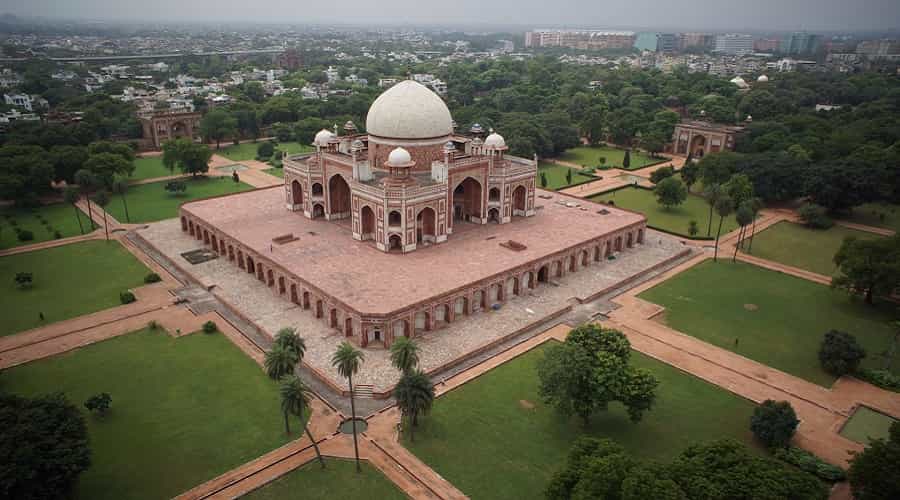
The historical tomb stands tall at a height of 47 meters and measures 300 meters in width. The Persian architect brought with him Persian architectural patterns and infused those with Mughal architecture, thus creating a combination that was praised by many historians and visitors.
The double dome is one of the distinguishing characteristics of the tomb, along with Charbagh, the Persian gardens that used to surround it and spread over 30 acres. Built with the intent to beautify the tomb, these gardens were later neglected due to the shift in the capital and the high maintenance costs. During the eighteenth century, these gardens became farmland for villagers who cultivated vegetables there.
After the British took over Delhi, they decided to change the structure of the gardens and give them an English-style appearance.
Several other tombs and monuments are located near Humayun’s Tomb, including:
- Barber’s Tomb: Built in 1591 for a barber who served the royal family, there are no inscriptions or records that provide the name or details of the barber.
- Bu Halima’s Tomb and Garden: Little information is available regarding this tomb, which is located towards the west entrance to the complex.
- Tomb and Mosque of Isa Khan: Built around two decades before the construction of Humayun’s Tomb, the tomb complex honors Isa Khan, who served in Sher Shah Suri’s court. His family members were also buried here.
- Afsarwala Tomb and Mosque: Built in 1566-67, this tomb was constructed for an afsar (officer) who worked in Akbar’s court.
- Arab Sarai: Arab Sarai, or the Arab rest house, was built for craftsmen employed in the construction of the tomb.
- Nila Gumbad (Blue Dome): The dome gets its name from the blue-glazed tiles and was built for a servant working for a courtier in Akbar’s court.
What to See
The various monuments and gardens are open to the public. Visitors can get a magnificent view of the gardens and the nearby area from the roof of the tomb. One can enjoy exploring the tomb complex and other monuments and then head to the gardens to rest in the shade of trees or play games with companions.
Eat, Drink, and Shop
There are many restaurants and outlets located close to Humayun’s Tomb. You can visit places like El Dorado Restaurant, Eatopia Restaurant, Travertino, Baci Bar, Concept Restaurant, Deez, Barbeque Nation, The All American Diner, or any other outlet. There is an option for every mood and budget; you just need to decide which one suits you best.
You can buy almost anything of your choice in the streets and malls of Delhi. Famous shopping destinations include Chandni Chowk, Palika Bazaar, Connaught Place, Paharganj Market, etc. Don’t forget to bargain with the sellers for better prices.
Best Time to Visit
The tomb remains open from sunrise to sunset every day. All you need to do is spare around two hours to explore the monuments and the garden.
The best time to visit Humayun’s Tomb is during the months of October to March. The temperature during this period makes it comfortable for tourists to explore the city during the day.
Visitors from India, SAARC, and BIMSTEC countries are required to pay an entrance fee of Rs.40 per person. Visitors from other countries are charged Rs.600 per person for admission.
How to Reach
To reach Humayun’s Tomb, you can find a number of public and private transportation options. The residents of Delhi largely rely on local buses and metro trains that are available in plenty. The nearest railway station and metro station from Humayun’s Tomb are the Hazrat Nizamuddin Railway Station and JLN Stadium Metro Station.