River Shyok is a major tributary of the River Indus, located in Ladakh. The major stream of this river originates from the vast plains of Depsang, located in the northern part of Ladakh, within the Karakoram mountain ranges.
Fast Facts
- Location: Ladakh, Jammu and Kashmir, India
- Tributary of: River Indus
- Direction: Flows westward, then southeast
- Origin: Depsang Plains, northern Ladakh, Karakoram range
- Human Settlements: Khapalu, Shukpa, Shyok, Siari, Kunzang
- Vegetation: Largely barren, minimal plant life due to harsh conditions
The direction of River Shyok is initially westward, after which it gradually turns southeast and stops near the town of Shyok.
Some of the major tributaries of this river include:
- River Chu
- River Saltoro
- River Chipshap
- River Nubra
- River Galwan
- River Chang Celmo

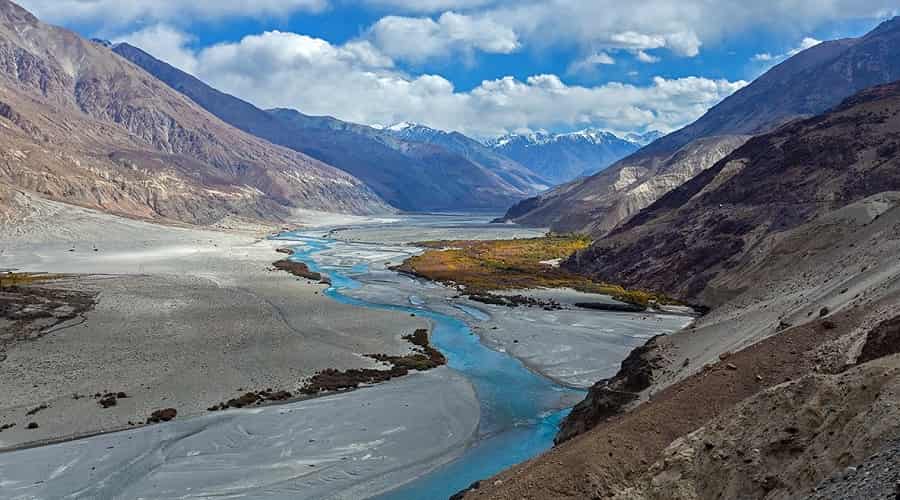
An interesting fact about this river is that it forms a V-shape around the Karakoram ranges. However, a notable negative aspect of this river is that the catchment area is largely devoid of vegetation. Some of the major human settlements around this river include Khapalu, Shukpa, Shyok, Siari, and Kunzang.
River Chang Celmo
- Origin: Lanak La Pass
- Flow: West to Shyok River
- Features: Freezes in winter, melts in summer
- Environment: Remote, minimal vegetation
River Chang Celmo is a tributary of the Shyok River, which joins the River Indus in the Ladakh region. This river originates from a large glacier located on the western slopes of Lanak La Pass. River Chang Celmo flows westward along the northern side of an auxiliary range of the Karakoram, before merging with the Shyok River near Shukpa Kuzang.
The valley of Chang Celmo is enclosed by snow-capped mountains on both sides. The Shyok River flows beside a series of white-water rapids. A wide deposit of alluvial material has been found along the riverbed. During winter, the river completely freezes. In the summer, as the snow melts, the river’s volume gradually increases.
The valley of Chang Celmo is remote and barren, with minimal vegetation. Pamzal is one of the settlements situated along the river. The track from Chushul to Lanak La crosses this gorge.
River Chipshap
- Origin: Despang Plains
- Flow: Along Sasser La, joins Shyok River
- Features: Glaciers, waterfalls, steep slopes
- Vegetation: Almost none
Chipshap River is a stream of the Shyok River, which ultimately joins the River Indus in Ladakh. It originates from a glacier situated in a corrie on the plains of Despang in northeastern Ladakh.
It then flows along the western slopes of the Sasser La pass before merging with the Shyok River near its second confluence with the River Galwan.
Small glaciers within the valleys flow into major glaciers, which in turn feed the Chipshap River at various points. The valley’s base is relatively gentle, but the slopes are steep. River Chipshap descends in a series of rapids and small waterfalls. A significant snow-fed stream joins the river just as it makes a U-turn. The western slopes of Sasser La pass are very steep and extend directly to the valley floor.
There is almost no vegetation in this region. The track from Sasser La to Karakoram Pass passes through the Chipshap valley.
- Suggested to Read: Popular High Altitude Mountain Passes In Ladakh
River Galwan
- Origin: Near Depsang Plain
- Flow: Southwest, joins Chipshap then Shyok
- Features: Snow-fed, rises in summer
- Environment: Frozen, no vegetation
River Galwan is an important upstream tributary of the Shyok River, located in the northeastern part of Ladakh, Jammu and Kashmir. The main source of the river is close to the Depsang Plain at an altitude of over 5,000 meters. The origins of the Chipshap and Galwan rivers are in close proximity.
The Galwan River flows southwest before merging with the Chipshap River. Another branch of the river flows from the east. The river is fed by numerous snow-fed streams originating from glaciers located beyond. These streams form tributary channels before joining the Galwan River, which eventually merges with the Chipshap River.
The entire region around the Shyok River is frozen, with ice flows coming down from the snow-covered mountains. There is no vegetation or human habitation in the area due to its remoteness and harsh environment. In the summer, the river’s water level rises as the snow melts.
Nubra River
- Origin: Snow-fed glaciers
- Flow: Southeast, joins Shyok
- Valley: Nubra Valley, high altitude
- Vegetation: Sparse
River Nubra is a stream of the Shyok River, which also feeds into the River Indus in the Ladakh region, Jammu and Kashmir. It is a snow-fed river that originates from glaciers. The river flows southeast before finally joining the Shyok River.
The Nubra Valley, through which the river flows, is filled with ancient glaciers that have receded over time. The valley’s base is situated at an elevation of over 4,000 meters. The valley is rich in alluvial deposits brought by the river over centuries. Numerous waterfalls are scattered throughout this scenic Nubra Valley.
However, due to its high altitude and lack of rainfall, the valley is devoid of significant vegetation.
River Saltoro
- Origin: Saltoro Kangri Peak
- Flow: From northwest, joins Hushe then Shyok
- Features: Rapid water rise in summer
- Environment: Remote, no habitation
River Saltoro is a stream of the Hushe River, which eventually flows into the Shyok River. This river originates from a glacier located in the middle of the Saltoro Kangri Peak, Ladakh. The main streams flow from the northwestern direction. The river flows for a relatively short time before merging with the Hushe River.
The valley is filled with glaciers that melt rapidly, causing the water level to rise rapidly, especially in the summer months. This increase in water levels has raised concerns among environmentalists. Human habitation is entirely absent in this area due to its remote and isolated location.