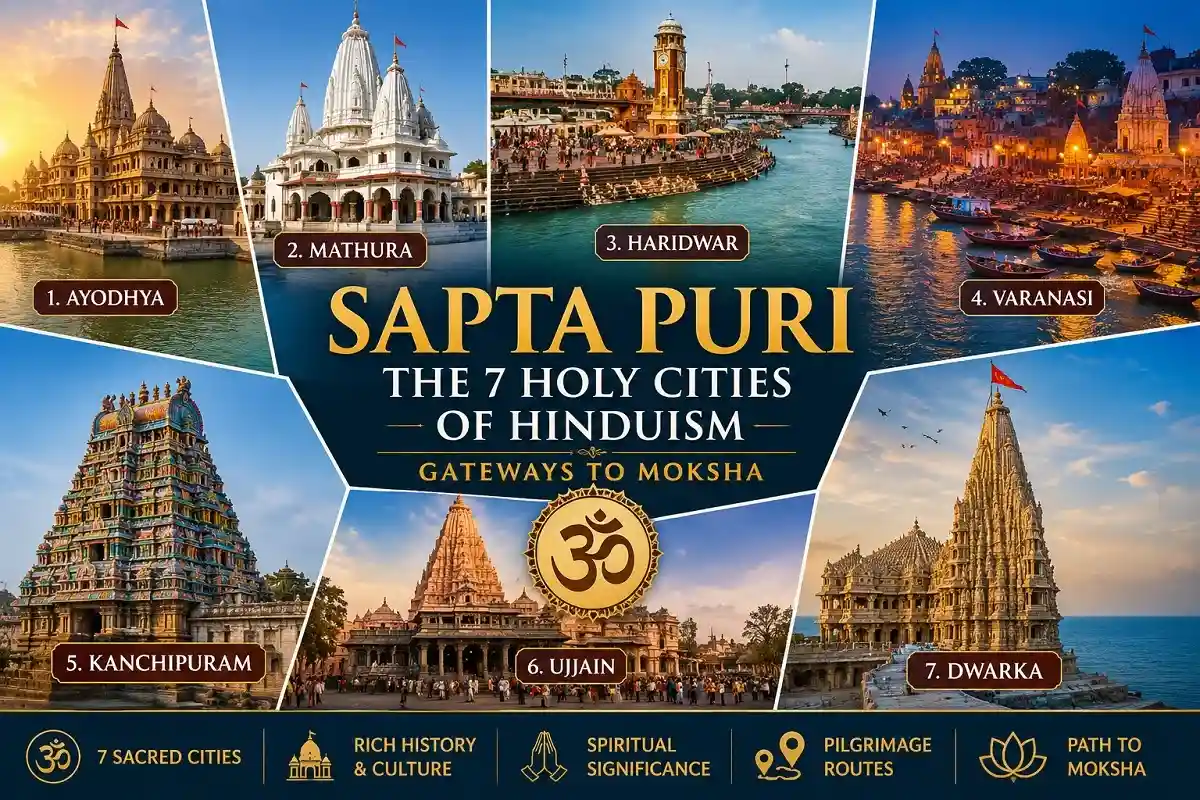
In Hindu tradition, certain cities are not merely places of worship — they are considered gateways to Moksha, liberation from the cycle of birth and death. The Sapta Puri (Sanskrit: seven sacred cities) are the seven pilgrimage centres listed in the Garuda Purana as bestowers of liberation. As the Garuda Purana (Chapter 16, verse 114) records:
अयोध्या मथुरा माया काशी काञ्ची अवन्तिका । पुरी द्वारावती चैव सप्तैताः मोक्षदायिकाः ॥॥
Translation: ‘Ayodhya, Mathura, Maya (Haridwar), Kashi (Varanasi), Kanchipuram, Avantika (Ujjain), and Dwaravati (Dwarka) — these seven cities bestow liberation.’
Important clarification: The word ‘Puri’ in the shloka refers to Dwarka (Dwarkapuri), not Jagannath Puri in Odisha. While Jagannath Puri is deeply sacred, it is part of the Char Dham circuit — not the Sapta Puri as defined in the Garuda Purana.

Sapta Puri vs Char Dham vs Jyotirlinga: What Is the Difference?
| Circuit | Cities / Sites | Scriptural Basis | Purpose |
|---|---|---|---|
| Sapta Puri (7 cities) | Ayodhya, Mathura, Haridwar, Varanasi, Kanchipuram, Ujjain, Dwarka | Garuda Purana (16.114) | Cities that grant Moksha (liberation) |
| Char Dham (4 sites) | Badrinath, Dwarka, Jagannath Puri, Rameswaram | Adi Shankaracharya’s circuit (8th century CE) | Four cardinal pilgrimage sites of India |
| Jyotirlinga (12 shrines) | Somnath, Mallikarjuna, Mahakaleshwar, Omkareshwar, Kedarnath, Bhimashankar, Vishwanath, Trimbakeshwar, Vaidyanath, Aundha Nagnath, Rameshwar, Grishneshwar | Shiva Purana | 12 most sacred Shiva temples in India |
| Pancha Bhuta Stala (5) | Chidambaram (ether), Kanchipuram (earth), Thiruvanaikaval (water), Tiruvannamalai (fire), Kalahasti (wind) | Shaiva Agama texts | 5 Shiva temples representing 5 elements |
Note: Dwarka appears in both Sapta Puri and Char Dham, making it the only city in this dual distinction. Varanasi (Kashi) has a Jyotirlinga (Kashi Vishwanath) and is also Sapta Puri.
Seven Holy Cities of Hinduism: At a Glance
| City | Ancient Name | State | Primary Deity | Known For | 2026 Key Update |
|---|---|---|---|---|---|
| Ayodhya | Ayodhya | Uttar Pradesh | Lord Rama (7th avatar of Vishnu) | Believed birthplace of Rama; Ram Mandir | Temple completed Nov 2025; 135M+ visitors in 2024 |
| Mathura | Mathura Mandala / Braj Bhoomi | Uttar Pradesh | Lord Krishna (8th avatar of Vishnu) | Believed birthplace of Krishna; Vrindavan | Vrindavan Chandrodaya Mandir under construction |
| Haridwar | Maya / Mayapuri | Uttarakhand | Vishnu (Hari) and Shiva (Har) | Ganga enters plains; Kumbh Mela | Last Kumbh 2021; next 2033 |
| Varanasi | Kashi / Benaras | Uttar Pradesh | Lord Shiva (as Vishwanath) | One of world’s oldest cities; Ganga ghats | Kashi Vishwanath Corridor Dec 2021 |
| Kanchipuram | Kanchi | Tamil Nadu | Kamakshi Amman, Shiva, Vishnu | City of 1,000 temples; GI-tagged silk sarees | Temple restoration programs ongoing |
| Ujjain | Avantika / Avanti | Madhya Pradesh | Lord Shiva (as Mahakal) | Mahakaleshwar Jyotirlinga; Kumbh | Mahakal Lok Corridor Oct 2022 |
| Dwarka | Dwaravati / Dwarkapuri | Gujarat | Lord Krishna (as Dwarkadhish) | Believed Krishna’s capital; submerged site | NIO marine excavations ongoing 2025–2026 |
Sapta Puri Pilgrimage: Travel Planning Guide 2026
| City | Nearest Airport | Railway Station | Best Time | Key Site |
|---|---|---|---|---|
| Ayodhya | Maharshi Valmiki Intl (AYJ) — 12 km | Ayodhya Dham (AY) | Oct–Mar; Ram Navami (Mar–Apr) | Ram Mandir (Ram Janmabhoomi) |
| Mathura | Agra (~55 km); Delhi IGI (~150 km) | Mathura Junction (MTJ) | Oct–Mar; Janmashtami (Aug) | Krishna Janmabhoomi; Banke Bihari (Vrindavan) |
| Haridwar | Jolly Grant, Dehradun (DED) — 43 km | Haridwar Junction (HW) | Oct–Apr; daily Ganga aarti | Har-Ki-Pauri Ghat |
| Varanasi | Lal Bahadur Shastri (VNS) — 26 km | Varanasi Junction (BSB) | Oct–Mar; Dev Deepawali (Nov) | Kashi Vishwanath Temple |
| Kanchipuram | Chennai Intl (MAA) — 75 km | Kanchipuram (CJ) | Oct–Mar (avoid Apr–Jun) | Kamakshi Amman; Ekambareswarar |
| Ujjain | Devi Ahilyabai Holkar, Indore (IDR) — 55 km | Ujjain Junction (UJN) | Oct–Mar; Maha Shivaratri | Mahakaleshwar Temple |
| Dwarka | Jamnagar (JGA) — ~130 km | Dwarka (DWK) | Oct–Mar; Janmashtami (Aug) | Dwarkadhish Temple |
Estimated Budget for Sapta Puri Pilgrimage
| Budget Type | Per Person (15–21 days) | Includes | Notes |
|---|---|---|---|
| Budget Pilgrim | ₹30,000–45,000 | Sleeper/3AC trains; dharamshalas; basic meals; state buses | IRCTC senior citizen concession (40% on trains) available for 60+ |
| Mid-Range Traveller | ₹60,000–90,000 | 3AC/2AC trains; budget hotels; auto + cabs; some flights | Air India/IndiGo economy for Chennai (Kanchi) and Jamnagar (Dwarka) legs |
| Comfortable | ₹1,20,000–1,80,000 | Flights for long legs; 3-star hotels; private cabs | Guided tours available from IRCTC and state tourism boards |
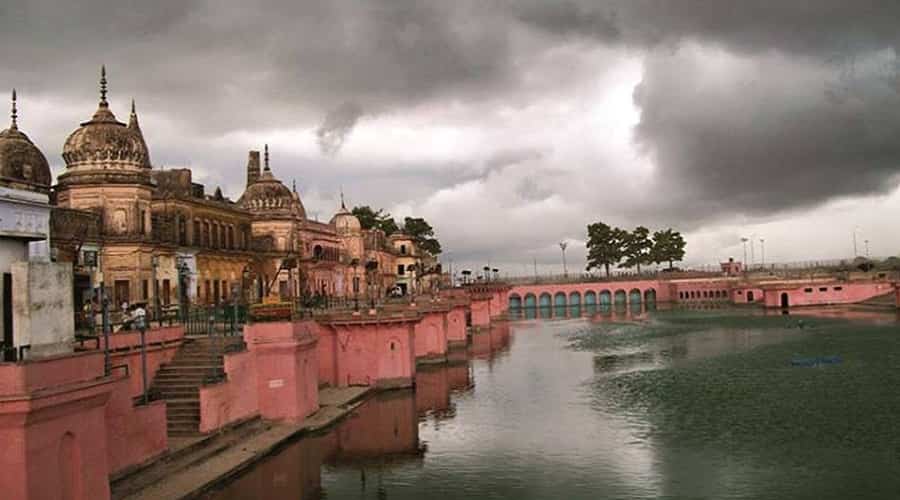
1. Ayodhya — Believed Birthplace of Lord Rama

| Detail | Information |
|---|---|
| Location | Ayodhya district, Uttar Pradesh; on the Saryu (Ghaghra) River |
| Primary Deity | Lord Rama — regarded as the 7th avatar of Vishnu in Hindu tradition |
| Scriptural Basis | Valmiki Ramayana; Skanda Purana; believed birthplace and capital of the Kosala Kingdom |
| Ram Mandir Prana Pratishtha | 22 January 2024 (PM Modi as Mukhya Yajamana) |
| Temple Status (2026) | Main sanctum and principal temple structure completed 25 November 2025; broader precinct development continues |
| 2024 Visitor Count | 135.5 million domestic tourists (UP Tourism Dept) — most visited UP destination in 2024 |
| H1 2025 Visitor Count | 23.82 crore visitors (January–June 2025) per local tourism data |
| Daily Visitors (avg.) | 1 to 1.5 lakh per day (steady average post-opening rush) |
| New Airport | Maharshi Valmiki International Airport (AYJ) — operational since December 2023 |
Ayodhya is considered the most spiritually significant Sapta Puri city for the Vaishnava tradition as the believed birthplace of Lord Rama. The Ram Mandir’s Prana Pratishtha was performed on 22 January 2024. The main temple structure was completed on 25 November 2025, though the broader temple complex precinct continues to develop. Ayodhya attracted 135.5 million domestic visitors in 2024, making it India’s most visited destination in Uttar Pradesh — surpassing Tirumala Tirupati’s annual count.
Key Sites in Ayodhya
- Ram Mandir (Ram Janmabhoomi) — consecrated January 2024; main structure completed November 2025; believed birthplace of Lord Rama
- Hanuman Garhi — fort-like temple to Hanuman; one of Ayodhya’s most visited shrines
- Kanak Bhawan — palace-temple with gold-crowned idols of Ram and Sita
- Saryu River Ghats — Ram ki Paidi; ritual bathing; especially crowded on Ram Navami
- Dashrath Mahal — traditional palace of King Dashrath; important for Ramayana pilgrims
2. Mathura — Believed Birthplace of Lord Krishna

| Detail | Information |
|---|---|
| Location | Mathura district, Uttar Pradesh; ~150 km south of Delhi; on the Yamuna River |
| Primary Deity | Lord Krishna — regarded as the 8th avatar of Vishnu in Hindu tradition |
| Scriptural Basis | Bhagavata Purana; Mahabharata; believed birthplace; capital of Surasena Kingdom |
| Related City | Vrindavan — approximately 12–20 km from Mathura (varies by route); believed site of Krishna’s childhood |
| Upcoming | Vrindavan Chandrodaya Mandir — under construction; designed at 213m, would be among the world’s tallest religious structures when complete |
According to Hindu tradition, Mathura is the birthplace of Lord Krishna, one of the oldest cities in India with archaeological evidence tracing continuous settlement to around 1200 BCE. Together with Vrindavan (approximately 12–20 km away), it forms the sacred Braj Bhoomi. The two cities are inseparable in the Vaishnava pilgrimage tradition.
Key Sites in Mathura and Vrindavan
- Krishna Janmabhoomi — temple complex on the believed exact birthplace of Krishna; spiritual heart of Mathura
- Dwarkadhish Temple — grand 19th-century temple in Mathura; fine marble architecture
- Vishram Ghat — main Yamuna ghat; believed rest site of Krishna after defeating Kansa
- Banke Bihari Mandir (Vrindavan) — most beloved Krishna temple in Vrindavan; unique curtain darshan
- ISKCON Temple (Vrindavan) — international temple with grand architecture
- Govardhan Hill (~26 km) — lifted by Krishna per Hindu tradition; 21-km parikrama is a major pilgrimage act
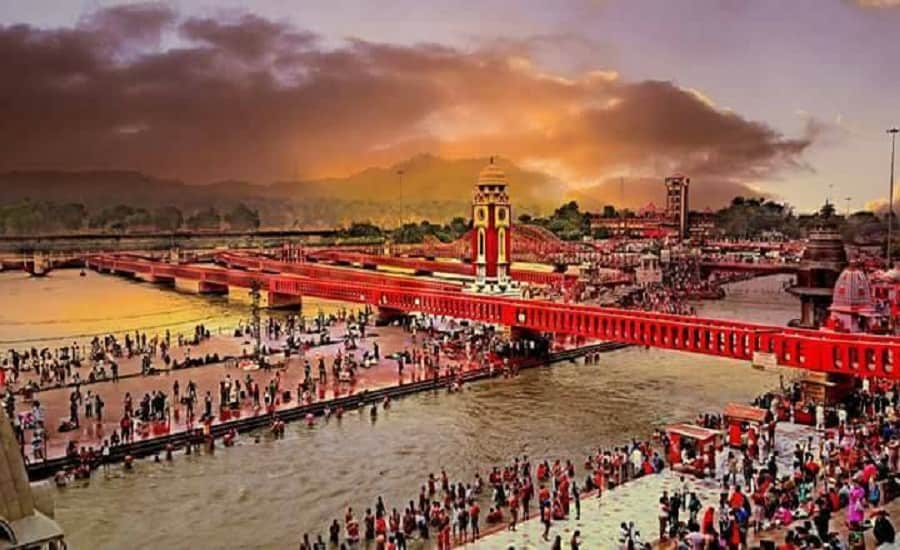
3. Haridwar — Gateway of the Ganga

| Detail | Information |
|---|---|
| Location | Haridwar district, Uttarakhand; where the Ganga generally enters the plains from the Shivalik foothills |
| City Name Meaning | Gateway to Hari (Vishnu) OR Gateway to Har (Shiva) — both interpretations are traditional |
| Scriptural Basis | Per Hindu tradition: one of 4 sites where drops of Amrita fell during Samudra Manthan; Bhagirath’s penance site |
| Kumbh Mela | Hosts Kumbh Mela every 12 years; last: 2021; next: 2033 |
| 2025 Context | Prayagraj Maha Kumbh (Jan–Feb 2025): world’s largest human gathering; separate from Haridwar’s cycle |
Haridwar is generally regarded as the point where the Ganga exits the Shivalik foothills and enters India’s plains. It is one of four Kumbh Mela cities (with Prayagraj, Nashik, and Ujjain). The Prayagraj Maha Kumbh (January–February 2025) was the world’s largest recorded human gathering; Haridwar’s own Kumbh returns in 2033.
Key Sites in Haridwar
- Har-Ki-Pauri — most sacred ghat; Vishnu’s footprint enshrined per tradition; famous evening Ganga aarti
- Mansa Devi Temple — Sidh Peetha of Uttarakhand; reachable by cable car or stairs
- Chandi Devi Temple — Sidh Peetha; reached by cable car; on Neel Parvat hill
- Maya Devi Temple — Shakti Peetha; among the three ancient temples marking Haridwar’s founding
4. Varanasi — The Eternal City of Kashi

| Detail | Information |
|---|---|
| Location | Varanasi district, Uttar Pradesh; western bank of the Ganga |
| Ancient Names | Kashi (the luminous city); Benaras; Avimukta (never forsaken by Shiva per tradition) |
| Primary Deity | Lord Shiva as Vishwanath (Lord of the Universe) |
| Scriptural Basis | Per Shiva Purana and Skanda Purana: Shiva is said to whisper the Taraka Mantra to the dying, granting Moksha |
| Historical Status | Among the world’s oldest continuously inhabited cities (one of; exact ranking varies by academic source) |
| Jyotirlinga | Kashi Vishwanath Jyotirlinga — one of the 12 most sacred Shiva temples in India |
| Kashi Vishwanath Corridor | Inaugurated 13 December 2021; 5-lakh sq ft complex; temple connected directly to Ganga ghats |
| 2024 Visitors | 6.2 crore domestic + 1.84 lakh international (Jan–Sep 2024, UP Tourism) |
Varanasi (Kashi) is considered the holiest of the seven holy cities of Hinduism. Per Hindu tradition, Lord Shiva whispers the Taraka Mantra to those who die within its bounds, granting liberation regardless of their karma. This belief makes it the preeminent Moksha city of the Sapta Puri. The Ganga flows northward through Varanasi — considered uniquely auspicious in Hindu cosmology.
The Kashi Vishwanath Corridor (13 December 2021) is one of India’s largest temple heritage projects, creating a 5-lakh sq ft complex connecting the Kashi Vishwanath Temple directly to the Manikarnika and Lalita Ghats. In Jan–Sep 2024, Varanasi attracted 6.2 crore domestic tourists and 1.84 lakh international visitors.
Key Sites in Varanasi
- Kashi Vishwanath Temple — one of 12 Jyotirlingas; accessible via the 2021 Kashi Vishwanath Corridor
- Dashashwamedha Ghat — famous daily Ganga aarti; one of India’s most spectacular evening ceremonies
- Manikarnika Ghat — primary cremation ghat; central to Varanasi’s moksha significance
- Assi Ghat — southernmost major ghat; popular for morning yoga and smaller aarti
- Sarnath (10 km) — where the Buddha gave his first sermon; major Buddhist pilgrimage site
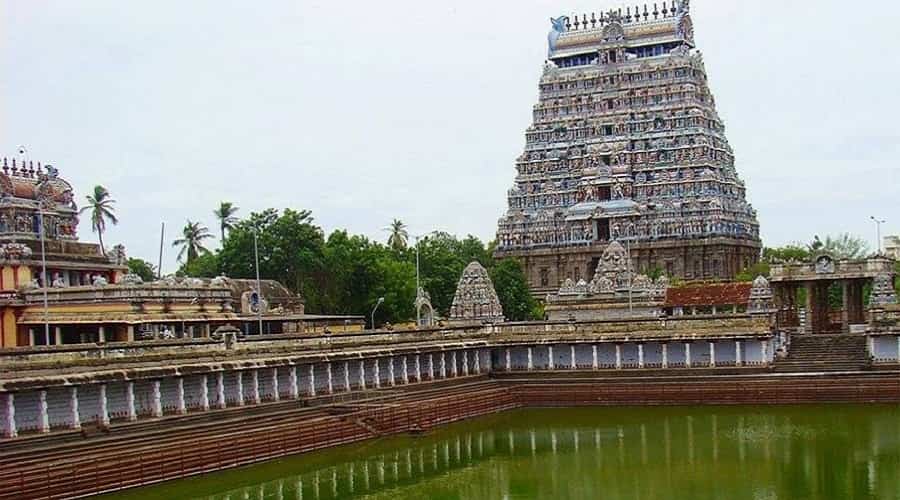
5. Kanchipuram — City of a Thousand Temples
| Detail | Information |
|---|---|
| Location | Kanchipuram district, Tamil Nadu; 75 km southwest of Chennai |
| Primary Deity | Kamakshi Amman (Parvati/Shakti); Ekambareswarar (Shiva); Varadaraja Perumal (Vishnu) |
| Temples | Historically known as ‘City of a Thousand Temples’; over 100 major and well-maintained temples recorded |
| Shaiva + Vaishnava | 108 Shaiva + 18 Vaishnava temples (traditionally counted; per Kanchipuram district official sources) |
| Silk Sarees | Kanchipuram silk sarees hold a Geographical Indication (GI) tag from the Government of India (recognized since 2005–2006) — NOT UNESCO Intangible Heritage |
| Shakti Connection | According to some Shakta traditions, Kamakshi Temple is regarded as a Shakti Peetha; the exact count and list of Shakti Peethas varies across traditions (51, 52, 64, or 108) |
| Philosophical Link | The Kanchi Kamakoti Peetham tradition attributes its origin to Adi Shankaracharya; this association is specific to that tradition and not universally accepted by all historians |
Kanchipuram is the only South Indian city in the Sapta Puri, representing Tamil and Dravidian religious tradition. It is also the only city in the Sapta Puri list with major temples dedicated to Shiva, Vishnu, and Shakti — making it uniquely important across all three major Hindu traditions. The city is historically known as the ‘City of a Thousand Temples.’
The Kanchipuram silk saree has been recognized as a Geographical Indication (GI) product by the Government of India since 2005–2006. The GI tag ensures only sarees produced in Kanchipuram and surrounding areas using traditional methods can bear the Kanchipuram name. This is distinct from UNESCO Intangible Heritage designation, which Kanchipuram silk has not received.
Key Temples in Kanchipuram
- Kamakshi Amman Temple — presiding goddess Kamakshi; regarded as a Shakti Peetha in some traditions; famous festival processions
- Ekambareswarar Temple — one of Pancha Bhuta Stalas (Earth element); 58-m gopuram is visible across the city
- Varadaraja Perumal Temple — one of 108 Divya Desams; gold-and-silver lizard sculpture considered auspicious
- Kailasanathar Temple — 8th-century Pallava temple; oldest in Kanchipuram; early Dravidian stone carvings
6. Ujjain — The City of Mahakal

| Detail | Information |
|---|---|
| Location | Ujjain district, Madhya Pradesh; on the Kshipra River |
| Ancient Names | Avantika / Avanti / Ujjayini |
| Primary Deity | Lord Shiva as Mahakala (Great Lord of Time) |
| Jyotirlinga | Mahakaleshwar — the only south-facing Shivalinga among the 12 Jyotirlingas |
| Kumbh Mela | Simhastha Kumbh every 12 years; last: 2016; next: 2028 |
| Mahakal Lok Corridor | Inaugurated 11 October 2022 by PM Modi; approximately 900–920m corridor; 108 columns; 200+ sandstone statues |
| Historical Role | Served as the prime meridian (0°) for Indian astronomical calculations for over 1,500 years |
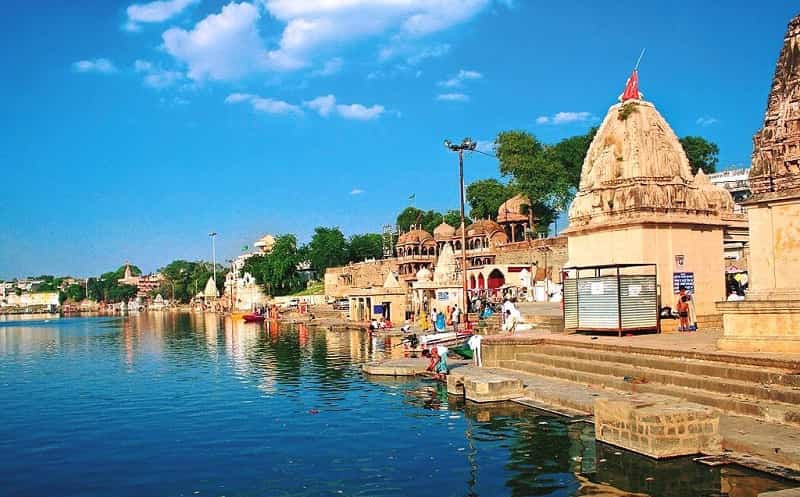
Ujjain is one of India’s most ancient cities, with a 3,000-year history as Avantika in Mahabharata-era texts. The Mahakaleshwar Jyotirlinga is the only south-facing Shivalinga among the 12 Jyotirlingas. The Mahakal Lok Corridor — inaugurated 11 October 2022 — is a 900–920m walkway approaching the temple featuring 108 columns and 200+ sandstone statues depicting Shiva’s stories from the Shiva Purana.
Key Sites in Ujjain
- Mahakaleshwar Jyotirlinga Temple — only south-facing Jyotirlinga; Bhasma Aarti at 4 AM requires advance booking
- Kal Bhairav Temple — accepts alcohol as prasad; unique in Indian temple tradition
- Harsiddhi Temple — Shakti Peetha; marble pillars with hundreds of oil lamps
- Mahakal Lok Corridor — 900–920m public walkway; open since 2022
- Sandipani Ashram — per tradition, where Krishna and Sudama studied under Guru Sandipani
7. Dwarka — Believed Kingdom of Lord Krishna
| Detail | Information |
|---|---|
| Location | Devbhoomi Dwarka district, Gujarat; western tip of Saurashtra peninsula; Arabian Sea |
| Ancient Names | Dwaravati / Dwarkapuri (Gate City) |
| Primary Deity | Lord Krishna as Dwarkadhish (Lord of Dwarka) |
| Char Dham | Dwarka is one of 4 Char Dhams (with Badrinath, Jagannath Puri, Rameswaram) — the only city in both Sapta Puri and Char Dham |
| Scriptural Basis | Per Bhagavata Purana and Mahabharata: believed capital of Krishna’s kingdom; said to have submerged after his death |
| Marine Archaeology | NIO (National Institute of Oceanography) has documented submerged stone structures, walls, and anchors offshore; archaeological significance is under study; these findings do not constitute confirmation of scriptural accounts |
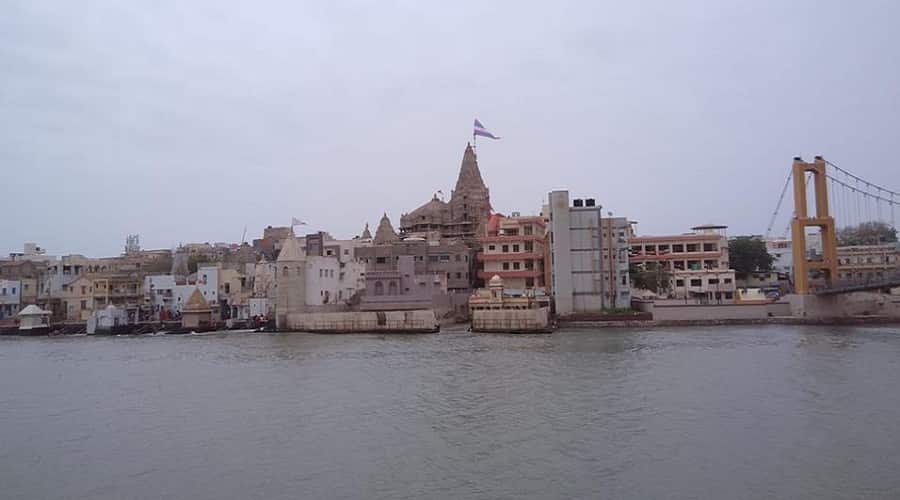
Dwarka is the only city to feature in both the Sapta Puri and the Char Dham pilgrimage circuits. Located at the westernmost tip of Gujarat’s Saurashtra peninsula, it is where the Gomti River meets the Arabian Sea. According to Hindu tradition, Lord Krishna established his kingdom here after leaving Mathura, and the city is believed to have submerged after his death.
Marine excavations by the National Institute of Oceanography (NIO) at the Dwarka coastline have documented submerged stone structures, walls, and stone anchors. The archaeological significance of these findings is the subject of ongoing study. Their relationship to the Dwarka described in ancient Hindu texts remains a matter of academic research rather than established conclusion.
Key Sites in Dwarka
- Dwarkadhish Temple (Jagat Mandir) — 5-storey; 78.3m tall; flag changed 5 times daily; most important Vaishnava temple in Gujarat
- Rukmini Devi Temple (~2 km) — dedicated to Krishna’s principal queen Rukmini
- Gomti Ghat — confluence of Gomti River and Arabian Sea; primary ritual bathing site
- Bet Dwarka Island (~30 km) — believed residential island of Krishna; accessible by boat
- Nageshwar Jyotirlinga (~around 28–30 km) — one of 12 Jyotirlingas; usually combined with Dwarka visit
Major Developments at Sapta Puri Cities: 2021–2026
| City | Development | Date | Significance |
|---|---|---|---|
| Ayodhya | Ram Mandir Prana Pratishtha | 22 January 2024 | Consecrated by PM Modi; opened to public 23 Jan 2024; over 500,000 visitors on Day 1 |
| Ayodhya | Main temple structure completed | 25 November 2025 | Dharma Dhwaja hoisting; broader precinct development continues |
| Ayodhya | Maharshi Valmiki Intl Airport opened | December 2023 | First direct air connectivity to Ayodhya |
| Varanasi | Kashi Vishwanath Corridor inaugurated | 13 December 2021 | 5-lakh sq ft; temple to Ganga direct connection |
| Ujjain | Mahakal Lok Corridor inaugurated | 11 October 2022 | 900–920m; 108 columns; 200+ Shiva statues |
| Haridwar | Kumbh Mela hosted | Jan–Apr 2021 | Last Haridwar Kumbh; next 2033 |
| Prayagraj (context) | Maha Kumbh 2025 | Jan–Feb 2025 | World’s largest human gathering; relevant for pilgrims planning Sapta Puri yatra |
| Mathura | Vrindavan Chandrodaya Mandir | Ongoing; expected 2026–2027 | Planned at 213m; would be among world’s tallest temples when complete |
FAQs
Q1. What are the 7 holy cities of Hinduism (Sapta Puri)?
Per the Garuda Purana (16.114), the seven holy cities of Hinduism are: Ayodhya, Mathura, Haridwar (Maya), Varanasi (Kashi), Kanchipuram (Kanchi), Ujjain (Avantika), and Dwarka (Dwaravati). These are the Sapta Puri believed to grant Moksha.
Q2. What does Sapta Puri mean?
Sapta Puri comes from Sanskrit: Sapta (seven) + Puri (city). It means the seven sacred cities of Hinduism that are believed to bestow Moksha (liberation from rebirth). They are listed in the Garuda Purana.
Q3. Is Jagannath Puri one of the Sapta Puri?
No. ‘Puri’ in the Garuda Purana shloka refers to Dwarka (Dwarkapuri). Jagannath Puri (Odisha) is part of the Char Dham circuit but is not in the classical Sapta Puri list.
Q4. What is the difference between Sapta Puri and Char Dham?
Sapta Puri (7 cities) are listed in the Garuda Purana as the cities that grant Moksha. Char Dham (4 sites: Badrinath, Dwarka, Jagannath Puri, Rameswaram) is the pilgrimage circuit attributed to Adi Shankaracharya. Dwarka is in both lists. Jyotirlinga is a separate circuit of 12 Shiva temples.
Q5. Which is the holiest of the seven holy cities of Hinduism?
Varanasi (Kashi) is widely regarded as the holiest. According to Hindu tradition (Shiva Purana, Skanda Purana), Lord Shiva whispers the Taraka Mantra to those who die there, granting liberation. It is also one of the world’s oldest continuously inhabited cities.
Q6. Is the Ram Mandir in Ayodhya complete?
The main temple sanctum and principal structure were completed on 25 November 2025 (Dharma Dhwaja hoisting). The broader temple complex precinct continues to develop. Ayodhya attracted 135.5 million visitors in 2024 (UP Tourism Department).
Q7. What is the Kashi Vishwanath Corridor?
The Kashi Vishwanath Dham Corridor is a 5-lakh sq ft complex inaugurated on 13 December 2021, connecting the Kashi Vishwanath Temple directly to the Manikarnika and Lalita Ghats on the Ganga. It is one of India’s largest temple heritage redevelopment projects.
Q8. What is the Mahakal Lok Corridor in Ujjain?
The Shri Mahakal Mahalok Corridor is an approximately 900–920m walkway approaching the Mahakaleshwar Jyotirlinga Temple, inaugurated on 11 October 2022. It features 108 columns and 200+ sandstone statues depicting stories from the Shiva Purana.
Q9. Why is Kanchipuram in the Sapta Puri?
Kanchipuram (Kanchi) is the southernmost and only South Indian city in the Sapta Puri, representing the Dravidian religious tradition within this list. It is historically known as the ‘City of a Thousand Temples’ and is sacred to Shaiva, Vaishnava, and Shakta traditions simultaneously.
Q10. How do I plan a complete Sapta Puri Yatra?
A practical 15–21 day route: Delhi → Mathura + Vrindavan (2 days) → Ayodhya (2 days) → Varanasi (3 days) → Haridwar (2 days) → fly Chennai → Kanchipuram (2 days) → fly Jamnagar/Ahmedabad → Dwarka (2 days) → fly Indore → Ujjain (2 days). October to March is the best season for all 7 cities.
Q11. Which Sapta Puri cities host the Kumbh Mela?
Two: Haridwar (every 12 years; last 2021, next 2033) and Ujjain (Simhastha; last 2016, next 2028). Prayagraj and Nashik host the other Kumbh Melas but are not part of the Sapta Puri.
Q12. Is Dwarka’s submerged city confirmed by archaeology?
Not definitively. The National Institute of Oceanography (NIO) has documented submerged stone structures and anchors offshore near Dwarka. The relationship of these findings to the Krishna’s Dwarka described in Hindu texts is still under academic study and has not been conclusively established.
Q13. Does Kanchipuram silk saree have a UNESCO heritage status?
No. Kanchipuram silk sarees are protected under India’s Geographical Indications (GI) Act, recognized since 2005–2006 by the Government of India. They do not hold UNESCO Intangible Cultural Heritage status. The GI tag means only sarees made in Kanchipuram using traditional methods can use the name.
Q14. Are there senior citizen facilities for Sapta Puri pilgrimage?
Yes. Indian Railways offers 40% concession on train fares for senior citizens (women 58+, men 60+). IRCTC also operates special pilgrimage packages for the elderly. Major temples like Kashi Vishwanath, Ram Mandir, and Dwarkadhish have wheelchair access and designated queues for elderly pilgrims.
Q15. What is the best Sapta Puri pilgrimage route?
Best route: Start North India circuit (Mathura–Ayodhya–Varanasi–Haridwar by train, 8–10 days). Then fly to Chennai for Kanchipuram (2 days). Then fly to Jamnagar/Ahmedabad for Dwarka (2 days). Then fly to Indore for Ujjain (2 days). October to March offers the most comfortable conditions across all seven cities.
Conclusion
The Sapta Puri — Ayodhya, Mathura, Haridwar, Varanasi, Kanchipuram, Ujjain, and Dwarka — represent the geographical and spiritual spine of Sanatana Dharma across India. From Haridwar where the Ganga enters the plains to Dwarka where the Arabian Sea meets India’s western edge, from Kanchipuram’s thousand-temple Dravidian city to the eternal burning ghats of Varanasi, these seven moksha cities together encapsulate India’s religious diversity within a single unified pilgrimage tradition.
Between 2021 and 2025, the Saptapuri witnessed extraordinary developments: Ram Mandir’s consecration drew 135 million visitors to Ayodhya in its first year; the Kashi Vishwanath Corridor transformed one of India’s holiest temple complexes; the Mahakal Lok reinvented the pilgrim experience at Ujjain. For travellers and devotees in 2026, these seven holy cities are more accessible, better connected, and more celebrated than at any point in recent history. The Garuda Purana promised liberation; 2026 infrastructure makes reaching these cities easier than ever before.