There is no epilogue to the discussion that revolves around the famous historical sites spread across India. One after another, some of the most beautiful places strike our minds, and the discussion goes on and on. A positive frenzy continues to rule our heads and stirs the nomadic spirit that lies within everyone as we talk about the landmarks of India. The City Palace of Udaipur, in the state of Rajasthan, is a classic example that adds fuel to the passion of travelers who are ever hungry to take a slice of Indian history and juxtapose the memories in the very center of their minds to cherish the experience of watching and exploring this fabulous monument.
Location
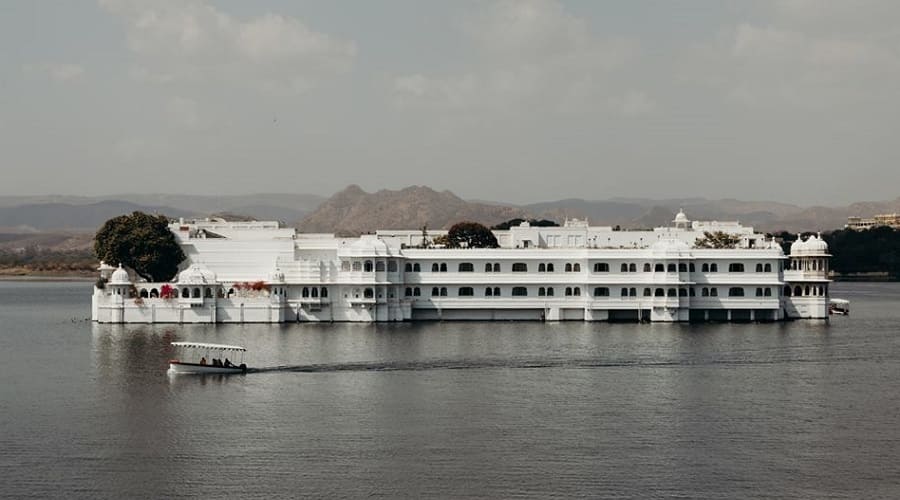
On the banks of Lake Pichola in the city of Udaipur stands this expression of royalty, built with extreme precautions and attention to detail to fulfill the demands of the residents.
History
With the establishment of Udaipur city, the construction of the City Palace began under the supervision of Maharana Udai Pratap Singh II in 1559. The construction continued to take place in bits and pieces due to the additions suggested by the descendants of Udai Pratap for the next three hundred years. Maharana Udai Pratap chose this site for constructing the palace as he felt that it was protected from all sides due to the wide expanse of forests, hills, and lakes that surrounded the area. It is also said that this site was suggested to Maharana by a hermit whom he met while hunting in the hills.
Udai Pratap died in 1572, after which his son Maharana Pratap inherited the kingdom of Udaipur. He soon had to face a battle against Akbar, whom he successfully defeated in what is now known as the Battle of Haldighati in 1576. In the later years, the city flourished with new palaces and artists who specialized in miniature paintings. In 1736, the decline of Udaipur began after it was attacked by the Maratha rulers. However, the city was rescued from falling into ruin by the British, who re-established the State of Mewar.
When India became independent in 1947, the State of Mewar, like all other princely states of the Indian subcontinent, merged into independent India as the state of Rajasthan. The emperors gradually gave up their royal privileges and titles; however, the descendants of the Maharana Dynasty continue to own the palaces and have established the Mewar Trust, which manages these historic sites and generates income through tourism. The income generated is invested to operate healthcare institutes, educational institutes, and also for the promotion of environmental preservation to avoid any depletion of the heritage sites.
Structure
The City Palace of Udaipur is a complex of palaces. The facade of the palace is 244 meters in length and 30.4 meters in height. This conglomerate is the result of contributions from several emperors of the Sisodia Dynasty who succeeded the throne. It is a rare mix of Rajasthani, Mughal, Medieval, European, and Chinese architecture. Built purely out of marble and granite, the interiors of the complex are divided strategically into eleven palaces, each exhibiting artwork, mirror-work, marble-work, wall paintings, murals, etc.
There are three gateways to the City Palace. Bara Pol or Great Gate is the main entry point to the palace. Tripolia Pol, a triple-arched gate, was added in 1725. The Hathi Pol is the third entry point to the palace. The roads that connect the Tripolia Pol and the palace are occupied by vendors who sell handmade crafts, books, textiles, paintings, and antiques.
The Palace area is Further Divided Into:
- Amar Vilas: This is the peak point of the City Palace where there are hanging gardens, fountains, towers, etc. It was a recreational and leisure spot for the emperors.
- Badi Mahal: At a height of 27 feet from the ground, on a natural rock formation, Badi Mahal is a garden equipped with a large swimming pool and a hall where miniature paintings dating back to the 18th and 19th centuries are displayed.
- Bhim Vilas: Here, a large collection of miniature paintings has been displayed. These paintings depict the life of Radha and Krishna, two deities who form a divine couple.
- Chini Chitrashala: In this part of the palace, ornamental tiles imported from China and the Netherlands amuse visitors.
- Choti Chitrashali: Pictures of peacocks have found room in this part of the palace.
- Dilkhusha Mahal: This palace was constructed in 1620.
- Fateh Prakash Palace: This heritage hotel has a gallery where unique crystal chairs, sofas, tables, table fountains, beds, and crockery are displayed. Another unique antique object here is a jewel-studded carpet.
- Durbar Hall: This hall exhibits some of the weapons used by the rulers of the Mewar Kingdom. It was built in 1909 when Maharana Fateh Singh was the ruler and served as a viewing gallery for the Royal ladies who wanted to watch the court proceedings. This hall is a part of the Fateh Prakash Palace.
- Jagdish Palace: This temple was built in 1652. A beautiful idol of Lord Jagannath carved out of black stone, and a brass image of the Garuda, Lord Vishnu’s vehicle, adorn the temple, along with statues of elephants on the stairs.
- Krishna Vilas: There are many miniature paintings in this chamber depicting the various festivals, games, and processions of the royal times.
- Laxmi Vilas Chowk: Some of the most beautiful paintings from Mewar are displayed here for visitors.
- Manak Mahal: This part of the palace was an enclosure for the audience of the rulers.
- Mor Chowk: Mor Chowk, translated to Peacock Square, is named so due to the peacock designs that represent the three seasons: monsoon, winter, and summer.
- Rang Bhavan: This is where the royal treasures were kept.
- Sheesh Mahal: The Palace of Mirrors was made in 1716. It is said that a sage spent his life meditating inside this place.
Also Read: Famous Hindu Temples to Visit in Udaipur
What to See
All the sections of the palace are open for visitors. A part of the Palace called “Zenana Mahal” or Ladies Chamber was converted into a museum in 1974. This museum is open for all visitors and displays some of the finest portraits and paintings.
Eat, Drink, Collect
Udaipur has become a coveted tourist attraction, and the eateries here have expanded to serve authentic Rajasthani and other Indian and world cuisines, owing to the visitors coming from all parts of the world.
You can collect some handicrafts as a souvenir as you bid adieu to this city.
Best Time to Visit
The best time to visit Udaipur is between the months of September and March. The climate is cool, making it convenient to explore the palace and the city, which otherwise turns very hot during the summer.
How to Reach
Udaipur is well connected with all the cities in the state and with other parts of India through road and rail networks. A national airport provides access to the city with various cities through a regular schedule of flights.
Once you reach Udaipur, you can opt for any of the public transport vehicles or private cabs. You can go for a ride on a Tonga, a transport vehicle pulled by a horse, a very traditional means of public transport.
- You may also like read about: Places to Visit in Rajasthan