Among many historical places in India that are now in ruins, Golkonda Fort is one that captures the attention of travelers. This is because, like every historical place that exists under the sky, there is a certain mystery associated with this place as well. Be it the vast expanse on which the ruins are visible or the legends that are heard about the place, Golkonda Fort continues to be the center of attraction.
Location
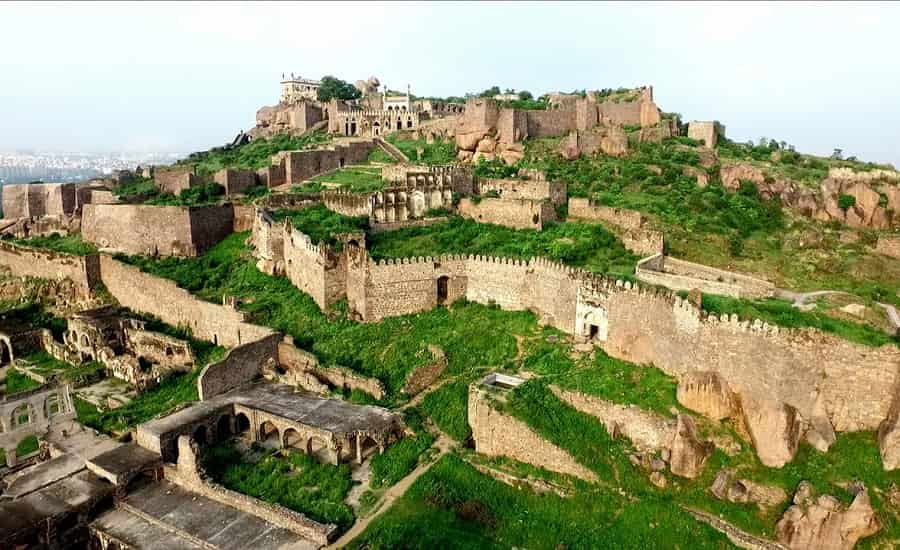
Located at a distance of 11 kilometers from the city of Hyderabad, in the state of Telangana (formerly Andhra Pradesh), Golkonda Fort is a part of the ruined Golkonda city, which was the capital of the Kingdom of Golkonda.
History
This fort was built by the Qutb Shahi dynasty in the 13th century in the capital city of Golkonda. Golkonda is a Tamil word which translates to “Shepherd’s Hill.” The legend goes that when a shepherd found an idol, a mud fort was built at the place where the ruins of Golkonda Fort lie now. Being the capital city, Golkonda was a commercial hub, and the diamond trade was in full bloom.
Originally, the city dates back to the period when the area was ruled by the emperors of the Hindu Kakatiya Dynasty, which is believed to have been named either after the ancient town of Kamathipura or the Goddess Kakati, who was worshiped by the people of this dynasty. Later, the Islamic Bahmani Sultanate ruled over this city before the Qutb Shahi Dynasty took over. Subsequently, Aurangzeb conquered the city and the fortress, after which the fort fell into ruins. Being a diamond trade center, the fort served as a vault to store diamonds.
Some of the historical diamonds such as the Kohinoor and Hope diamonds were once stored in the royal vault. Diamonds were mined from the Kollur Mine and cut in the city before they were put for sale in the market. However, there were many other mines in the vicinity. Other historical diamonds excavated from Golkonda mines include Darya-E-Noor, Noor-Ul-Ain, Regent, Wittelsbach, etc.
- Must Read: Top 10 Things to Do in Hyderabad
Structure
Built as a measure to defend the royal family against the Mughals from the north, Golkonda consists of four forts. The basic layout of the fort is made up of a ten-kilometer-long outer wall. There are eighty-seven semicircular citadels, eight gateways, four drawbridges, and a vast expanse that was a perfect place to do everything that was needed. There were apartments, stables, halls, mosques, and every other structure that a kingdom and its rulers would require. The lowest entry point is called Fateh Darwaza, which translates to Victory Gate. This name was given because Aurangzeb’s army marched in when it won over the fort. The gate itself was given a protective cover in the form of iron spikes to save it from the attack of elephants.
This gate is at the south-east corner of the fort. Despite the fact that the fort is far from what it once used to be, you can still experience the beauty of the internal structures. Every design that you see inside and outside is a masterpiece in itself, reminding us of the great efforts that the workers put in to bring the idea of this fort into existence. The gardens, gates, apartments, temples, mosques, and everything else will definitely compel you to appreciate the hard work, imagination, creativity, and practical insights of the people of that time.
The entry on the eastern side of the fort is through a gate named Bala Hissar Gate. Though there is a legend attached to how this gate was named, the design of this gate is worth a look. Spandrels with decorated roundels and yalis, granite block lintels, and designs of lions and peacocks—this gate itself speaks volumes about what you are about to witness inside the fort. However, the actual theory behind the construction of this gate is that the well outside this gate would act as a perfect spoilsport for the enemies who would try to break the gate by letting the soldiers or the elephants loose.
There is much more to Golkonda Fort in terms of detailing of a residential space. From the sources that provided generous amounts of drinking water to the ventilation system that provided cool comfort to the residents, the designers made sure that any sort of discomfort was kept miles away from the reach of the fort. Another characteristic of this fort is a unique acoustical system that enabled a person to hear the sound of a hand clap at the gate while being at a citadel 300 feet above.
- Also Reads on: Falaknuma Palace, Hyderabad
What to Do at the Fort
Spread across a massive expanse of land, Golkonda Fort is a place where you can spend a whole day exploring the interiors of the fort and collecting memories of what you feel and experience here. However, there is more for visitors who would like to explore the heritage of royal times. Naya Qila or the New Fort, built as an extension to the main fort, stands opposite to it. There is another place of interest for visitors called the Qutub Shahi Tombs, located about one kilometer from the main fort. The tombs are designed and preserved to maintain an original look. Beautiful carvings on the stone and gardens add to the charm of these tombs.
An audiovisual presentation is shown for the visitors to make them aware of the glory of this fort and the city. From November to February, the show begins at 6:30 pm, whereas from March to October, the show begins at 7:00 pm. Thursday is the day when the show is presented in Telugu, in English on Wednesday and Sunday, and in Hindi on Tuesday, Friday, and Saturday. The fort is open from 8:00 am to 6:30 pm every day. At a distance of just eleven kilometers from the city, this place is easily accessible by road. Autos, private taxis, and buses run to and fro all day long. If you find charm in the historical remains of time, Golkonda Fort is a destination that can satiate the appetite of the nomadic soul in you. Have a happy trip to the fort and back!