Quick Facts
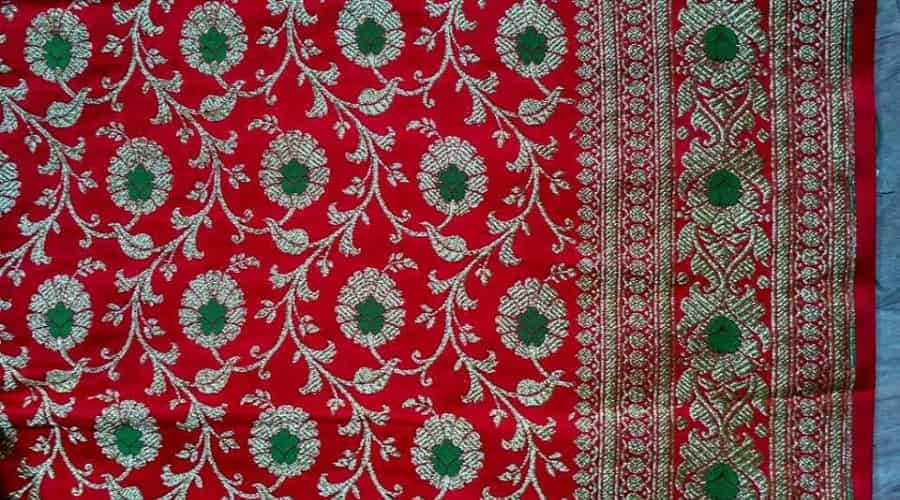
As unique as its name, the creation of the Banarasi Saree is also exclusive, involving a complex process. These sarees are renowned for their silver and gold brocade, fine silk borders, and luxurious embroidery. Banarasi sarees are made from finely woven silk and adorned with intricate designs. Due to the high-quality handwork, they are relatively heavier than regular sarees. The Mughal influence is evident in the saree’s design, with floral and foliate motifs, elaborate intertwining patterns, and elements like Bel (a floral motif) and Kalga (a string of upright leaves, also known as Hallar) featured along the outer edges of the borders. These intricate designs reflect superb handwork. Banarasi sarees are also known for heavy gold and silver work, metallic visual elements, net-like patterns, mina work, and compact weaving. A single Banarasi saree can take anywhere from 20 to 30 days to complete, and exceptionally intricate pieces can take up to six months to finish.
Banarasi sarees come in four different varieties: organza (Kora) with zari and silk, pure silk (Katan), georgette, and satin sarees. The sarees are also categorized by designs such as Jangla, Vaskat, Tanchoi, Butidar, and Tissue. In Varanasi, many people are employed in this profession and earn their livelihood by manufacturing Banarasi sarees. The southern regions, particularly Bangalore, are major suppliers of the silk used in Banarasi sarees, as they produce the finest silk. Local weavers in Varanasi then weave the silk into the basic texture of the saree using looms.
The basic width of a Banarasi saree is 24-25 inches, and an ideal saree contains about 5,500 threads with a width of approximately 45 inches. According to GI (Geographical Indication) certification, Banarasi products are categorized into four classes: textile goods, dress materials, silk brocades, and silk sarees with embroidery. This certification ensures that no saree made with Banarasi texture can be legally produced outside of the six identified districts in Uttar Pradesh: Chandauli, Jaunpur, Mirzapur, Azamgarh, Bhadohi, and Varanasi. In these districts, Banarasi sarees are legally sold under the name “Banarasi Saree.”
Creating these traditional sarees is not the work of a single individual; it is the result of a team effort. One person designs the motifs, while other traditional artists decorate them with handcrafted textures. Before the design is woven onto the saree, it is first sketched on paper, using colors and design tools. The design process involves hundreds of portrayals and knitting perforated cards with various colorful threads on the loom. Finally, the weaving is executed in a systematic manner to achieve the perfect match.
Also Read:
- Famous Ghats of Varanasi that You Must Visit
- Tourist Places & Excursions in Varanasi
- Varanasi Yoga and Meditation