Festivals in Meghalaya are closely tied to local community life, and that festive spirit is central to the state’s culture. Many of the state’s traditional festivals are rooted in indigenous Khasi, Jaintia (Pnar) and Garo custom, and most mark points in the farming year, after sowing and after harvest, when families give thanks and honour their ancestors.
Fast Facts:
- Located in: Meghalaya, northeastern India
- Main festival of the Garo Hills: Wangala (100 Drums Festival); Dore Rata Dance is a traditional Garo dance, not a separate festival
- Main festivals of the Khasi Hills: Shad Suk Mynsiem, Nongkrem Dance, Umsan Nongkharai
- Main festivals of the Jaintia Hills: Behdienkhlam, Chad Sukra; Lahoo is a folk dance performed during Behdienkhlam
Festivals of the Garo Hills
Wangala Festival
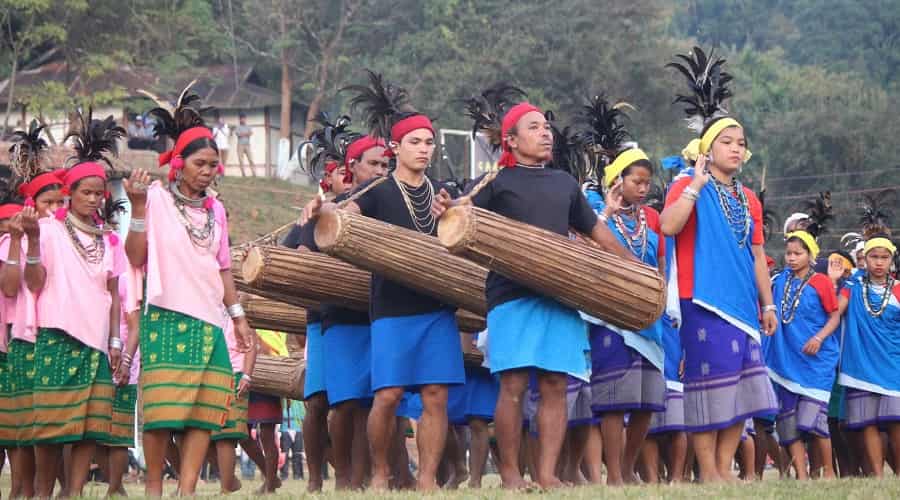
Also known as the Dance of the 100 Drums, Wangala is the main festival of the Garos. It marks the end of a season of hard work in the fields and celebrates a good harvest. The festival honours Saljong, the sun god of fertility. Dressed in traditional outfits, the community dances to the beat of long cylindrical drums.
The main public celebration, the 100 Drums Wangala Festival, has historically been held at Asanang, about 18 km from Tura in West Garo Hills, and runs for three days. It usually falls in the first or second week of November; the 2025 (49th) edition ran from 6 to 8 November. The 2026 Golden Jubilee, the 50th edition, moves to Wangala A’dam, Chibragre, and is set for 12 to 14 November. Individual villages hold their own Wangala rites at different times between September and December, and these can run from a couple of days up to a week.
- Where: Asanang, near Tura, West Garo Hills, the traditional venue (village-level celebrations happen across the Garo Hills)
- Wangala Festival dates: Usually first or second week of November. 2026 is the Golden Jubilee, the 50th edition, and the Hundred Drums Wangala Festival Committee has set it for 12 to 14 November 2026 at Wangala A’dam, Chibragre, near Tura; confirm the exact venue with Meghalaya Tourism closer to the date, since some listings still show Asanang
Other Garo Hills festivals
Besides Wangala, the Garo Hills have several smaller rituals tied to the Jhum (shifting cultivation) cycle. Rongchu Gala and Den Bilsia are two of the more prominent ones, both involving the sacrifice of a fowl at different stages of the farming year. These are largely observed in rural areas rather than at a fixed public venue.
Festivals of the Khasi Hills
Ka Shad Suk Mynsiem

Ka Shad Suk Mynsiem, the Dance of the Peaceful Hearts, is one of the main festivals of the Khasi tribe. It is an annual thanksgiving dance held in and around Shillong every April, at Lympung Weiking. Men and women in traditional attire dance to the tune of flute and drums. The festival lasts three days.
- Where: Lympung Weiking, Jaiaw, Shillong
- Ka Shad Suk Mynsiem dates: April (2026 edition concluded 13 April at Lympung Weiking; the Seng Khasi confirms exact dates each year)
Nongkrem Dance

Nongkrem Dance is a religious festival giving thanks to the goddess Ka Blei Synshar for a good harvest, prosperity and peace. It is held every year, generally in November, at Smit, the seat of the Hima Khyrim, close to Shillong. The festival lasts five days.
Young men, married and unmarried, perform the Nongkrem dance in the open. Women dressed in silk with gold, silver and coral ornaments dance in an inner circle. Men form an outer circle, dancing to drums and flutes.
A central part of the festival is the Pomblang, or the sacrifice of goats, offered to the Syiem of Khyrim, the head of the Hima. Ka Syiem Sad, the eldest sister of the ruler, is the high priestess and leads the rites. Ministers, priests and elders take part, and offerings are made to the ancestors of the ruling clan and to the deity of Shillong Peak.
- Venue: Smit
- Distance: Sources vary; the current Meghalaya Tourism site gives 15 km southwest of Shillong, while the Meghalaya Government portal gives 11 km. Either way, allow extra time on the hill road.
- Nongkrem dates: Generally November; exact dates are set by the Hima Khyrim each year
Umsan Nongkharai
Umsan Nongkharai is a Khasi festival held to honour Lei Shyllong, the deity after whom Shillong and its highest peak are named. Rituals begin at midnight with prayers and an animal sacrifice, followed by men dancing till dawn to drums and flutes. The festival runs for five days, each with its own theme and prayers, and includes fertility rituals and prayers for a good harvest and protection from storms and hail. The last day draws the largest crowds.
- Where: Umsan Nongkharai village, Ri Bhoi district
- Umsan Nongkharai dates: April or May
- Duration: 5 days
Also Reads on: Amazing Places to Visit in Shillong
Festivals of the Jaintia Hills
Behdienkhlam

Behdienkhlam is celebrated every year in July, after the sowing season, and is the main dance festival of the Jaintia (Pnar) tribe. The name is generally understood to mean chasing away sickness, evil spirits and plague, and young men strike the roof of every house with bamboo poles as part of this ritual. Long poles are also carried across the stream (Wah-eit-nar); people jump onto them and break them while dancing in the muddy water. A large beam is placed across the stream, and two groups compete for possession of it.
The festival is also a prayer to God for a good harvest. Women do not take part in the dance itself; their role is to offer sacrificial food to the spirits of the ancestors.
- Where: Jowai, West Jaintia Hills
- Duration: About 3 to 4 days
- Behdienkhlam dates: July (2026: 6 to 9 July, confirmed by the Sein Raij Jowai and the West Jaintia Hills district holiday notice; verify the 2027 date closer to the time)
Lahoo Dance

The Lahoo Dance (also spelled Laho) is performed by both men and women for entertainment, usually during Behdienkhlam rather than as a separate festival. Dressed in their finest clothes, two young men on either side of a woman link arms and dance in step. In place of the usual pipe and drum, a lead performer, typically a man skilled at improvised recitation, sings couplets to entertain the crowd.
- Where: Jowai and other parts of the Jaintia Hills, during Behdienkhlam
Chad Sukra
Chad Sukra is the sowing festival of the Jaintias (Pnars), observed before the sowing season begins. It is one of the significant dates on the Niamtre calendar, the indigenous religion of the Pnars, and includes prayers and rituals for a prosperous year and a good harvest. Visitors can see Pnar communities in traditional dress performing their folk dances.
- Where: Jaintia Hills
- Chad Sukra dates: April or early May, before sowing
Modern Festivals and Events
Alongside these tribal festivals, Meghalaya Tourism also lists newer cultural events, separate from the harvest calendar above.
- Shillong Cherry Blossom Festival: Shillong, when the cherry trees bloom, usually in November
- Shillong Literary Festival: Ward’s Lake, Shillong, in November
- Me•Gong Festival: Songsak and Tura, Garo Hills, in December
- Autumn Festival: organised by the Meghalaya Tourism Development Forum, October to November
Check Meghalaya Tourism’s events page for confirmed 2026 dates before planning travel around these.
Meghalaya Festival Calendar
| Festival | Region | Month | Duration |
| Ka Shad Suk Mynsiem | Khasi Hills, Shillong | April | 3 days |
| Chad Sukra | Jaintia Hills | April to early May | Varies by village |
| Umsan Nongkharai | Khasi Hills, Ri Bhoi | April or May | 5 days |
| Behdienkhlam | Jaintia Hills, Jowai | July | 3 to 4 days |
| Nongkrem Dance | Khasi Hills, Smit | Generally November | 5 days |
| Wangala (100 Drums Festival) | Garo Hills, Asanang / Wangala A’dam (2026) | First/second week of November (2026 Golden Jubilee: 12 to 14 Nov) | 3 days at the main venue; village rites longer |
Best Time to Visit for Festivals
- April: Ka Shad Suk Mynsiem in Shillong.
- July: Behdienkhlam in Jowai, during the monsoon; check rain and road conditions before travelling.
- November: Nongkrem at Smit and Wangala near Tura fall in the same month but in different hill regions, so most travellers plan around one.
How to Reach
- Shillong (for Shad Suk Mynsiem and Nongkrem/Smit): roughly 100 to 125 km from Guwahati Airport depending on route and starting point, commonly 2.5 to 4 hours by road. Smit is a further 11 to 15 km, depending on the source. Shillong sits at roughly 1,500 m elevation.
- Jowai (for Behdienkhlam): about 60 to 64 km from Shillong, roughly 1.5 hours by road on NH-40. Jowai sits at around 1,370 m elevation.
- Tura and Asanang (for Wangala): Tura is about 220 km from Guwahati; road travel time depends on route and conditions, typically 5 to 7 hours. Asanang is a further 18 km, about 30 minutes.
FAQs
What is the most famous festival of Meghalaya?
Wangala (the 100 Drums Festival) and Nongkrem are the two most widely known: Wangala is the Garo harvest festival, and Nongkrem is a main Khasi festival.
Which festival is called the 100 Drums Festival?
Wangala, the Garo tribe’s harvest festival held at Asanang near Tura.
When is Wangala celebrated?
Usually in the first or second week of November; village-level celebrations run from September to December.
What are the Wangala Festival 2026 dates?
12 to 14 November 2026, for the Golden Jubilee (50th) edition at Wangala A’dam, Chibragre, near Tura, per the Hundred Drums Wangala Festival Committee.
Where is the Nongkrem festival held?
At Smit, near Shillong, the seat of the Hima Khyrim.
How long does Nongkrem last?
Five days.
What does Shad Suk Mynsiem mean?
Dance of the Peaceful Hearts, a Khasi thanksgiving dance held in April at Shillong.
Which festival is celebrated in Jowai?
Behdienkhlam, the main festival of the Jaintia (Pnar) tribe, held every July.
Is Lahoo Dance a separate festival?
No, it is a folk dance performed mainly during Behdienkhlam, not a standalone festival.
What is Umsan Nongkharai?
A five-day Khasi festival in April or May at Umsan Nongkharai village, Ri Bhoi district, honouring the deity Lei Shyllong.
What is Chad Sukra?
A Jaintia (Pnar) sowing festival held in April or early May, before the sowing season, with prayers for a good harvest.
When is Behdienkhlam in 2026?
6 to 9 July 2026 at Jowai, confirmed by the Sein Raij Jowai and the West Jaintia Hills district holiday notice.
How far is Smit from Shillong?
Sources vary: 11 km (Meghalaya Government portal) to 15 km (current Meghalaya Tourism site). The hill road takes longer to drive than the distance alone suggests.
How far is Jowai from Shillong?
About 60 to 64 km, roughly 1.5 hours by road on NH 40.
Must Reads on
- 10 Offbeat Things to Do in Meghalaya
- Top Things to Do in Meghalaya in Monsoon
- Best Places to Visit in Meghalaya
- Scenic Waterfalls in Meghalaya


