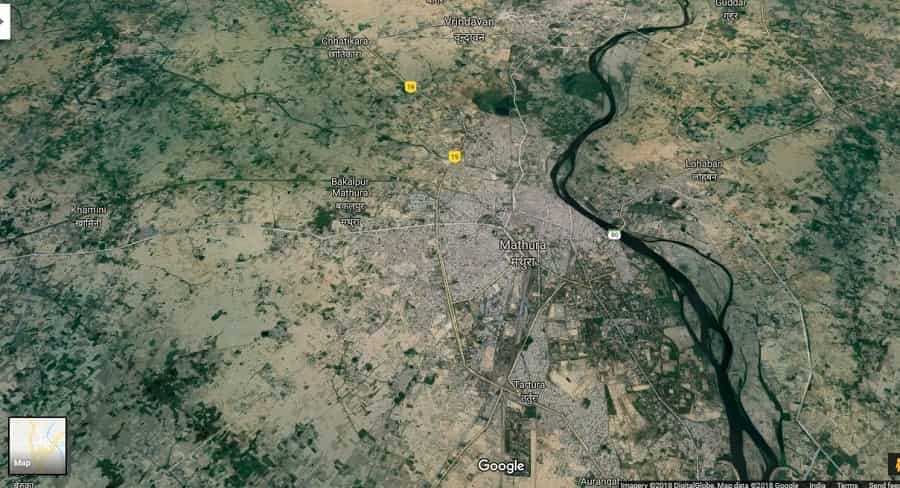
Mathura is known as a holy city in the North Indian state of Uttar Pradesh. It is located almost 50 kilometers to the north of Agra, 145 kilometers to the southeast of Delhi; about 11 kilometers from the town of Vrindavan and almost 22 kilometers from Govardhan. The city lies at 27°17′N 77°25′E and has an average elevation of 174 meters (570 feet) above sea level. Mathura has been chosen as one of the heritage cities under the Heritage City Development and Augmentation Scheme of the Government of India.
History
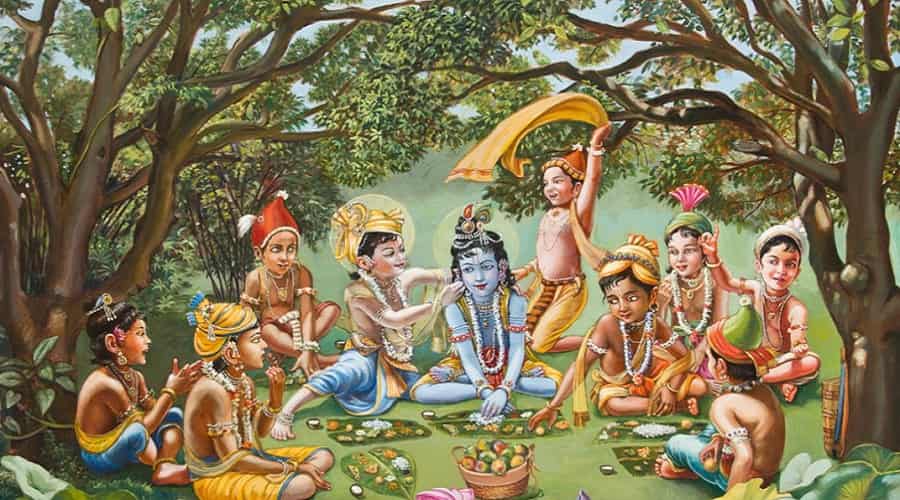
Mathura has a long and world-famous history. It is believed to be the birthplace of Lord Krishna, located at the center of Braj or Brij-Bhoomi, called Shri Krishna Janmabhoomi or ‘Lord Krishna’s birthplace,’ who was born in the Yadu dynasty. It was also ruled in turns by the kings of Solar and Lunar dynasties and became a center of three cultures, namely the Indian, Indo-Scythian, and Hellenistic. Mathura is also known as “The Athens of India.” During the ancient period, Mathura was a renowned economic hub located at the junction of important caravan routes.
The city was sacked, and many of its temples were destroyed by many rulers, including Mahmud of Ghazni and later by Sikandar Lodi, who ruled the Sultanate of Delhi from 1489 to 1517 CE. Sikandar Lodi was tagged as the ‘Destroyer of Hindu deities.’ The Mughal Emperor Aurangzeb built the Shahi-Eidgah Mosque during his rule, adjacent to Shri Krishna Janmabhoomi, which is believed to have been constructed over a Hindu temple.
Significance
Mathura has contributed immensely to Indian culture through its rich heritage. It is a haven for pilgrims and spiritual seekers. One of the significant nearby places is Vrindavan, where there are hundreds of shrines, numerous ghats, and several sacred tanks, including Brahma Kund and Govinda Kund. Barsana, the birthplace of Radha, is another famous pilgrimage site with regular bus services from Mathura. To the northeast of Mathura lies the beautiful village of Nandgaon, known as the home of Lord Krishna’s foster father, Nand, where a spacious temple is being built in his memory. Other important holy places in the region include Baldev, Kokilavan, and Mahavan.
Mathura is also known for the great school of sculpture, the Mathura School of Arts, which flourished for over 1,200 years. The extraordinary creativity and devotion to new art forms, including sculpture and clay figurines, are hallmarks of this school. A survey of this rich artistic tradition can be explored at the Government Museum of Mathura.
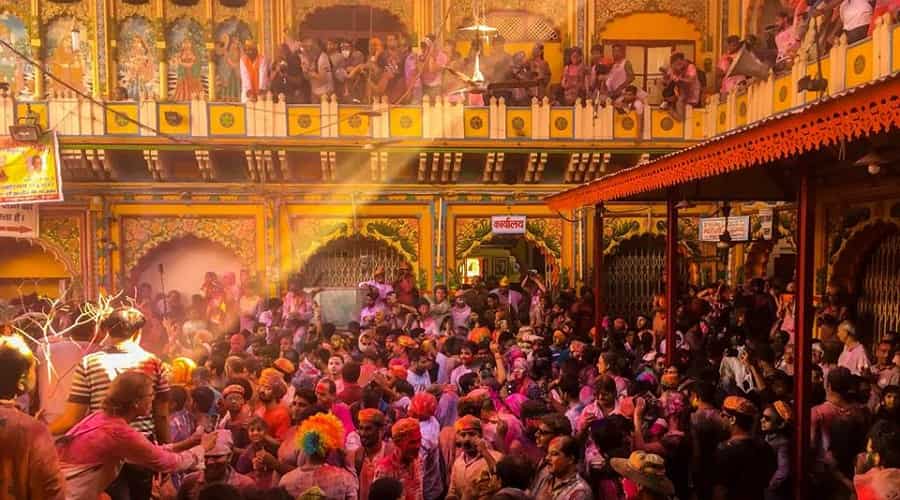
The present-day Mathura holds significant religious and historic importance worldwide. The city hosts a large number of festivals and fairs throughout the year, especially in the adjoining areas of Vrindavan, Gokul, Barsana, Nandgaon, and Govardhan.
The Raasleelas of Mathura have become an integral part of Indian folklore. This folk dance form originated when Lord Krishna danced “The Rasa” with the Gopis on the banks of the Yamuna River. Charkula is another traditional folk dance form of Braj, in which a woman balances a column of deepaks (lamps) on her head while dancing to the accompaniment of Rasiya songs sung by men.