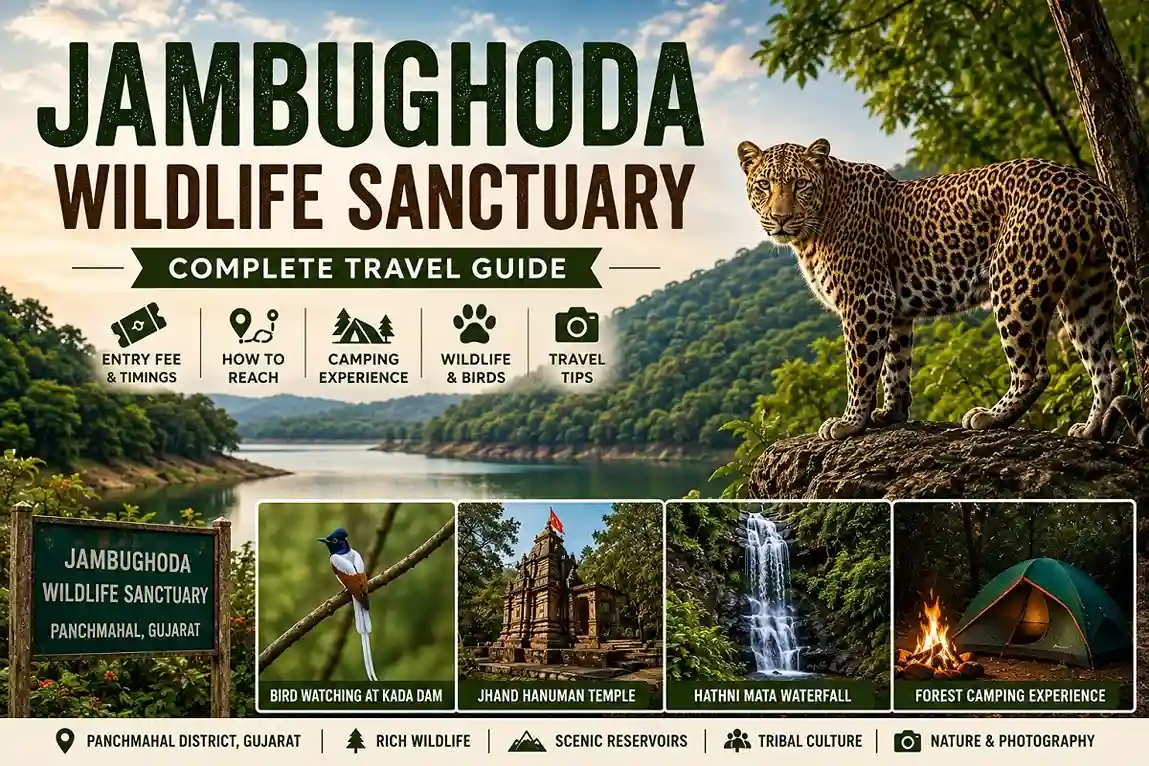
Hidden in the forested hills of Panchmahal district, the Jambughoda Wildlife Sanctuary is one of Gujarat’s best-kept nature secrets. Located just 70 km from Vadodara and 20 km from the UNESCO World Heritage Site of Champaner-Pavagadh, this 130.38 sq km protected forest offers a genuine wildlife experience away from the usual tourist crowds.
The sanctuary is known for leopard sightings, a rich variety of birds, tribal villages and some of the most atmospheric camping in central Gujarat. Unlike many larger parks, Jambughoda has no jeep safari — exploration is on foot through dense teak, bamboo and mahuda forest, which is what makes it feel so remote and rewarding.
Whether you are planning a weekend family trip from Vadodara, a solo nature walk or a two-night forest camping stay, this guide covers everything you need to know before visiting the Jambughoda forest.
Key Takeaways
- Jambughoda Wildlife Sanctuary covers 130.38 sq km in the Panchmahal district of Gujarat, declared a protected sanctuary in May 1990.
- Distance: 70 km from Vadodara, 20 km from Champaner, approximately 173 km from Ahmedabad.
- Entry: Rs 50 per person (Indians); timings 6 AM to 7 PM daily.
- No jeep safari is available — the main activity is a guided nature walk.
- Best time to visit: October to March for wildlife; July to September for monsoon greenery.
- Three eco-tourism campsites: Dhanpari, Bhat and Targol, run by local tribal communities.
Quick Facts: Jambughoda Wildlife Sanctuary
| Location | Panchmahal district, central Gujarat |
| Distance from Vadodara | 70 km (approx. 1.5 hrs by road) |
| Distance from Ahmedabad | Approx. 173 km (approx. 3.5 hrs by road) |
| Distance from Champaner | 20 km |
| Area | 130.38 sq km |
| Established | May 1990 (under Wildlife Protection Act, 1972) |
| Timings | 6:00 AM – 7:00 PM (all days; may vary seasonally — confirm before visiting) |
| Entry Fee (Indian adults) | Rs 50 per person (subject to revision by Gujarat Forest Department) |
| Entry Fee (Foreign visitors) | Rs 100 per person (subject to revision) |
| Vehicle Permit | Two-wheelers Rs 20 | Private cars Rs 100 (subject to revision) |
| Safari | No jeep safari — guided nature walk only |
| Best Time to Visit | October to March (peak wildlife season) |
| Nearest Railway Station | Vadodara (main), Shivrajpur (1 km from Dhanpari gate) |
| Nearest Airport | Vadodara Airport (approx. 70 km) |
History of Jambughoda Wildlife Sanctuary
Long before it became a protected forest, Jambughoda was the private hunting estate of the Ranas of Jambughoda, the princely rulers of the region. This royal ownership had an unintended conservation benefit — the forest was kept free from large-scale agricultural clearing and commercial logging for generations.
After Indian independence in 1947, the princely state was dissolved and the land came under the Gujarat government. Formal protection was established in May 1990, when the area was officially declared a Wildlife Sanctuary under the Wildlife Protection Act of 1972, with the Gujarat Forest Department taking over management.
The Jambughoda Palace, the former home of the Ranas, still stands near the sanctuary entrance and has been converted into a heritage resort, giving visitors a sense of the region’s royal past alongside its natural heritage.
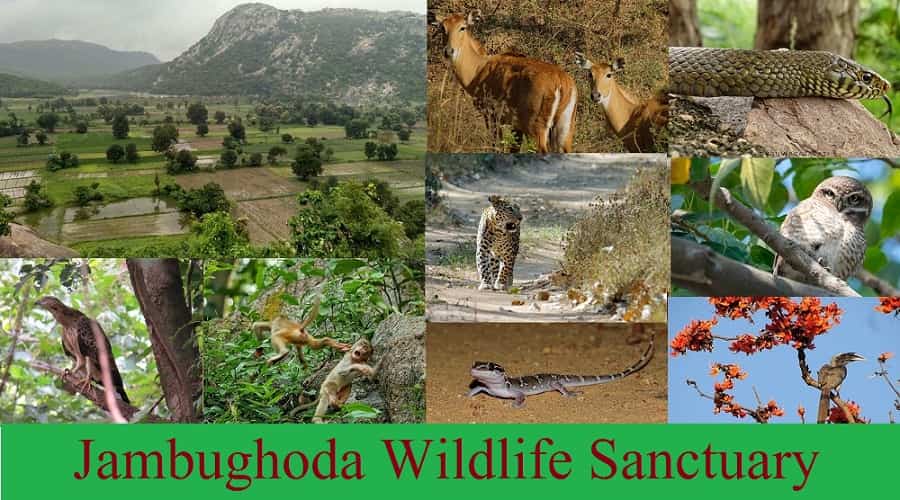
Wildlife of the Jambughoda Forest
More than a dozen mammalian species have been documented at Jambughoda Wildlife Sanctuary, making it one of the more biodiverse forests in central Gujarat despite its modest size.
The leopard is the sanctuary’s top predator and the species most visitors hope to encounter. Leopard presence is well documented, though sightings remain relatively uncommon — wildlife can never be guaranteed on any given visit. Sloth bear sightings are documented near the water bodies but are also infrequent. Other carnivores include the hyena and jackal. Wolf has been recorded in the area occasionally, though it is not a commonly reported sighting. Indian flying foxes are commonly found around water bodies and large trees.
Herbivores include the blue bull (nilgai), four-horned antelope (chausingha), barking deer and wild boar. Smaller mammals such as Indian civet, mongoose, porcupine and Indian giant squirrel also inhabit the forest. A rusty-spotted cat was sighted here in 2013, one of the world’s smallest wild cat species.
Reptiles
The sanctuary has a rich diversity of reptiles. The Indian rock python and marsh crocodile are among the most notable. Venomous snakes including the Indian cobra and Russell’s viper are also present, alongside several non-venomous species. The two reservoirs — Kada and Targol — provide habitat for the crocodile population.
Birds
Birdlife is one of Jambughoda’s greatest strengths. The sanctuary supports a wide range of resident and migratory species, with seasonal variation in what can be spotted.
Some of the most commonly recorded birds include the Indian Paradise Flycatcher, Golden Oriole, Tailor Bird, Tickell’s Blue Flycatcher, Pied Kingfisher and White-Breasted Kingfisher. Migratory ducks and teals use the Kada and Targol reservoirs during the winter months, making winter visits particularly rewarding for birdwatchers. Dozens of species have been documented across the full year.
Flora and Forest Cover
Jambughoda is a dry deciduous forest, characterised by teak, bamboo and mahuda (mahua) as the dominant tree species. Other trees found across the sanctuary include Sag, Sadad, Shisham, Khair, Dhav, Bili, Dudhalo, Timru and Bor.
The forest floor supports grasslands, water-borne plants and medicinal herbs used by local tribal communities. Between February and April, the Palash (Flame of the Forest) trees erupt in vivid orange-red across the hillsides and reservoir edges, making it one of the most photographed natural events in central Gujarat during that season.
How to Reach Jambughoda Wildlife Sanctuary
The sanctuary is located in Jambughoda Tehsil, Panchmahal district. The nearest major city is Vadodara (Baroda), which serves as the most practical base for a day trip or overnight visit.
By Road
Jambughoda is 70 km from Vadodara — approximately a 1.5-hour drive. The route passes through the Halol state highway toward Bodeli before turning toward the Jambughoda forests. Regular buses run from Vadodara to Halol and onward to Jambughoda. Taxis and private vehicles are a more convenient option, especially for early morning entry.
From Ahmedabad, the sanctuary is approximately 173 km, around 3.5 hours by road. Champaner and Pavagadh are just 20 km away and are ideal to combine with a Jambughoda visit on the same trip.
By Train
Vadodara Railway Junction is the nearest major railway station, well connected to Mumbai, Ahmedabad and other Indian cities. Shivrajpur railway station is even closer — just 1 km from the Dhanpari gate of the sanctuary — and useful for visitors travelling light who want to go directly into the forest.
By Air
Vadodara Airport is the nearest airport, approximately 70 km from the sanctuary and connected to major Indian cities. Sardar Vallabhbhai Patel International Airport in Ahmedabad is the nearest international airport, about 173 km away.
Things to Do at Jambughoda Wildlife Sanctuary
Guided Nature Walk
The primary and most rewarding activity at Jambughoda is a guided nature walk through the teak, bamboo and mahuda forest. Unlike larger wildlife sanctuaries in India, there is no jeep safari inside the Jambughoda sanctuary — all exploration is done on foot. Hiring a guide at the entrance is strongly recommended, as local guides know the forest trails, animal tracks and bird call patterns well.
Early morning is the best time for the nature walk, when wildlife is most active. The walk typically leads to the Kada reservoir, where animal pugmarks are often visible near the waterline.
Birdwatching at Kada Dam
The Kada reservoir is the single best birdwatching spot in the sanctuary. Visitors can observe kingfishers, cormorants, migratory ducks and raptors from the reservoir banks. A watchtower near the reservoir is available for forest staff, though visitors can view from the embankment. Bring binoculars for the best experience.
Camping and Eco-Tourism
Three eco-tourism campsites run by local tribal communities are among the highlights of a Jambughoda visit. Dhanpari, located in the heart of the sanctuary, is the most popular and offers forest trails, early morning walks and wildlife spotting. Bhat campsite has a similar setup with simple hut accommodation. Targol campsite is closest to the Targol reservoir and is good for evening photography and lakeside relaxation.
All three campsites offer traditional all-vegetarian Gujarati home-cooked meals. Advance booking is essential, especially during weekends and the October to February season. Booking contact: Chief Conservator of Forests, Vadodara Division, Kothi Building, Raopura, Vadodara — Phone: 0265-2425136.
Tribal Village Tours
The Rathwa and Nayaka tribal communities have lived in and around the Jambughoda forest for generations. Visitors can arrange guided tours to nearby tribal hamlets to observe traditional painted homes, crafts, organic farming and daily forest life. Eco-tourism initiatives at Jambughoda often involve tribal guides who provide culturally enriching nature walks alongside the wildlife experience.

Nearby Attractions Around Jambughoda Sanctuary
Jhand Hanuman Temple
About 12 km from the main sanctuary area, the Jhand Hanuman temple is dedicated to Lord Hanuman and is situated in the middle of the forest, surrounded by trees and natural quiet. The temple’s large Hanuman idol, standing approximately 18 feet tall, is the main draw for devotees and visitors alike.
Hathni Mata Waterfall
The Hathni Mata waterfall is one of the most scenic spots near the sanctuary, set within a natural cave formation. It is a spectacular sight, particularly during and just after the monsoon season when water levels are at their highest. The waterfall is also a popular spot for photography.
Champaner-Pavagadh Archaeological Park
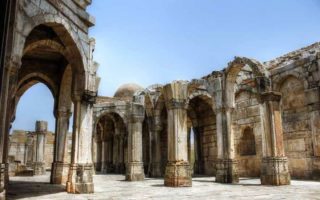
Just 20 km from Jambughoda, Champaner-Pavagadh is a UNESCO World Heritage Site and one of the most significant historical and religious destinations in Gujarat. The site encompasses the Jami Masjid (a 15th-century mosque considered one of India’s finest), the Kalika Mata Temple — a Shakti Peetha at the top of Pavagadh Hill — ancient stepwells, fortifications and the ruins of Sultan Mahmud Begada’s royal capital. It is highly recommended to combine Jambughoda with a half-day at Champaner-Pavagadh.
- Must Reads on: Popular Tourist Attractions of Gujarat
Kada and Targol Reservoirs
The two water reservoirs inside the sanctuary — Kada and Targol — are not just scenic spots but key wildlife habitats. Animals come to the reservoirs to drink at dawn and dusk, making them ideal for wildlife watching. The Kada site also has a forest rest house on the reservoir banks which is one of the most atmospheric accommodation options in the sanctuary.
Best Time to Visit Jambughoda Wildlife Sanctuary
| Season | Months | Experience |
| Peak / Best | October to March | Pleasant weather, best wildlife activity, birdwatching, camping |
| Monsoon | July to September | Lush greenery, waterfalls flowing, trails can be slippery; some paths may close |
| Avoid | May to June | Very hot (40°C+), low wildlife activity, uncomfortable for walking |
| Palash season | February to April | Forest turns orange-red with Flame of the Forest trees — best for photography |
Note: Confirm eco-camp availability before visiting during monsoon, as some sites operate with limited capacity. Always book campsites at least 2 weeks in advance during the October to February peak season.
Where to Stay Near Jambughoda Wildlife Sanctuary
Forest Rest House (Kada)
The Forest Department rest house at Kada reservoir is the most atmospheric stay option, positioned on the banks of the reservoir with direct forest views. Booking is through the Chief Conservator of Forests, Vadodara Division (Phone: 0265-2425136). It is in high demand during the peak season and must be booked well in advance.
Eco-Tourism Campsites
Dhanpari, Bhat and Targol eco-campsites within the sanctuary offer tents or simple huts with traditional meals. These are run by local communities and provide the most immersive forest experience. Night bonfires are possible at some campsites.
Jambughoda Palace Heritage Hotel
The former palace of the Ranas of Jambughoda, located about 3 km from the sanctuary, has been converted into a heritage resort and is a comfortable option for those who prefer more amenities. It offers a taste of the region’s royal history alongside proximity to the forest.
Hotels in Vadodara
For those doing a day trip, Vadodara (70 km away) offers a full range of hotels from budget to five-star. It is convenient to base yourself in Vadodara and leave before dawn to reach the sanctuary by 6 AM opening time.
Travel Tips for Visiting Jambughoda Forest
- Arrive by 6 AM for the best chance of wildlife activity during the golden morning hours. Wildlife sightings can never be guaranteed on any single visit.
- Carry binoculars, a camera with a zoom lens and a fully charged phone — mobile connectivity may be limited in some forest areas.
- Plastic carry-bags are generally banned inside the sanctuary; confirm current rules at the gate before entering.
- Download offline maps and your eco-camp booking confirmation before entering the forest zone where signal may be weak.
- Wear neutral-coloured, full-sleeve clothing — it helps with wildlife spotting and reduces insect bites.
- Do not stray from marked trails; always stay with your guide inside the protected forest.
- There is no food facility at the Kada campsite; eat at Dhanpari or carry your own supplies.
- The sanctuary pairs well with Champaner-Pavagadh UNESCO site (20 km) for a two-day Panchmahal itinerary.
Forest Rules at Jambughoda Wildlife Sanctuary
The Gujarat Forest Department enforces the following rules inside the sanctuary. Visitors should read these before entering.
- Do not feed or approach any wild animal; maintain a safe distance at all times.
- No loud music, shouting or noise that could disturb wildlife or other visitors.
- Smoking and open fire are strictly prohibited inside the forest.
- Do not litter; carry all waste out of the forest.
- Stay on designated trails and never enter restricted zones without forest staff.
- Photography of wildlife is generally permitted for personal use; commercial shoots and drone usage require prior permission from the Forest Department.
- Children must be accompanied by adults at all times inside the sanctuary.
Responsible Tourism and Eco-Travel at Jambughoda
Jambughoda is a relatively small, sensitive conservation area. How visitors behave directly affects the wildlife and the livelihoods of the tribal communities who manage the eco-camps.
- Carry a reusable water bottle and avoid single-use plastic inside the forest.
- Buy handicrafts and food directly from the Rathwa and Nayaka tribal vendors to support the local community.
- Follow a leave-no-trace approach: take only photographs and leave only footprints.
- Respect tribal villages — ask before photographing people and their homes.
- Prefer local guides over external operators; it keeps income within the community.
Wildlife Photography at Jambughoda
Jambughoda Wildlife Sanctuary is an increasingly popular destination for wildlife and nature photographers, thanks to its relatively undisturbed habitat and striking Palash season.
Best Spots
- Kada reservoir at dawn — best for birds, pugmarks and reflections.
- Targol reservoir edge — good for migratory water birds in winter.
- Forest trails in February–April — Palash (Flame of the Forest) trees in bloom.
Photography Tips
- A 300–500mm telephoto lens is ideal for bird and wildlife photography.
- Arrive at the Kada reservoir by 6:15 AM before human activity disturbs bird patterns.
- Drone photography requires prior written permission from the Gujarat Forest Department; do not fly drones without clearance.
- February to April gives the best light and colour for landscape and forest photography.
Tribal Culture: Rathwa, Nayaka and Pithora Art
The Rathwa tribal community living around the Jambughoda forest is known for Pithora, a sacred mural art form painted on the interior walls of homes to mark auspicious occasions. Pithora paintings are vivid, colourful and filled with figures of horses, deities and forest scenes — they are recognised as one of Gujarat’s most distinctive traditional art forms.
Visitors on tribal village tours can observe Pithora paintings firsthand, and some community-run eco-camps have displays or demonstrations. Purchasing tribal handicrafts directly from local artisans is one of the most meaningful ways to support the community during your visit to this protected forest.
Seasonal Wildlife and Activity Guide
| Season | Months | Wildlife Activity | Best For |
| Winter (Peak) | Oct–Feb | High: leopard, bear, deer, migratory birds | Wildlife walks, birdwatching, camping |
| Palash Bloom | Feb–Apr | Moderate: reptiles active, fewer migrants | Photography, Pithora art tours |
| Summer | May–Jun | Low: very hot, animals near water | Not recommended |
| Monsoon | Jul–Sep | Forest lush; some trails closed | Landscape photography, waterfall |
Sample Itineraries for Jambughoda Wildlife Sanctuary
Half-Day Trip (from Vadodara)
- 5:30 AM: Depart Vadodara by taxi/private vehicle.
- 7:00 AM: Reach Dhanpari gate; collect entry tickets and hire a local guide.
- 7:15–10:00 AM: Guided nature walk to Kada reservoir; birdwatching, pugmark spotting.
- 10:30 AM: Visit Jhand Hanuman Temple (12 km from gate).
- 12:00 PM: Return to Vadodara.
Full-Day Trip (Jambughoda + Champaner)
- 5:30 AM: Depart Vadodara.
- 7:00–11:00 AM: Nature walk and birdwatching at Jambughoda; breakfast at Dhanpari camp.
- 11:30 AM: Drive 20 km to Champaner-Pavagadh UNESCO site.
- 12:00–4:00 PM: Explore Jami Masjid, Kalika Mata Temple and stepwells.
- 4:30 PM: Return to Vadodara.
Weekend Overnight Stay
- Day 1: Drive from Vadodara; check into Dhanpari eco-camp or Jambughoda Palace; afternoon nature walk; bonfire at camp.
- Day 2: Early morning walk to Kada reservoir; birdwatching; Hathni Mata waterfall; visit Champaner-Pavagadh; drive back by evening.
Approximate Trip Cost: Jambughoda Wildlife Sanctuary
The following is an indicative budget for a day trip from Vadodara. Actual costs depend on group size, accommodation type and transport mode.
| Item | Budget Option | Comfortable Option |
| Transport (Vadodara return) | Rs 300–500 (bus) | Rs 1,500–2,500 (taxi) |
| Entry fee (per person) | Rs 50 | Rs 50 |
| Guide (per group) | Rs 150–300 | Rs 300–500 |
| Food (per person) | Rs 150–250 (camp meal) | Rs 400–700 (resort) |
| Eco-camp stay (per person) | Rs 500–800 | Rs 1,500–3,000 (Palace) |
Note: All prices are indicative and subject to change. Verify current rates directly with the Forest Department or accommodation provider.
Is Jambughoda Wildlife Sanctuary Worth Visiting? Who Should Go
| Traveller Type | Why Jambughoda Suits You |
| Families with children | Calm, safe environment; short nature walk suitable for older kids |
| Birdwatchers | Rich variety of resident and migratory species at Kada reservoir |
| Wildlife photographers | Undisturbed habitat, Palash bloom, Kada reservoir — excellent photography |
| Solo travellers | Safe with a guide; eco-camps offer community-based stays |
| Weekend getaway seekers | Easy 70 km drive from Vadodara; combine with Champaner for a full weekend |
| Tribal culture enthusiasts | Rathwa Pithora paintings, Nayaka village tours, tribal eco-camps |
Jambughoda vs Other Wildlife Sanctuaries Near Vadodara
| Sanctuary | Distance from Vadodara | Safari | Camping | Best For |
| Jambughoda | 70 km | Nature walk only | Yes (eco-camps) | Birds, tribal culture |
| Ratanmahal | ~120 km | Boat / walk | Limited | Sloth bear, bears |
| Vansda NP | ~190 km | Walk | No | Forest trails, birds |
| Gir NP | ~320 km | Jeep safari | Yes | Asiatic lion |
Note: Distances and safari availability are approximate and subject to change. Always check with Gujarat Tourism or the respective forest authority before planning a visit.
Frequently Asked Questions
Where is Jambughoda Wildlife Sanctuary located?
It is in the Panchmahal district of central Gujarat, 70 km from Vadodara and 20 km from the Champaner-Pavagadh UNESCO World Heritage Site.
What is the entry fee for Jambughoda Wildlife Sanctuary?
Entry is approximately Rs 50 per person for Indian visitors and Rs 100 for foreign nationals, though fees are subject to revision by the Gujarat Forest Department.
What are the timings of Jambughoda Wildlife Sanctuary?
The sanctuary is generally open daily from 6:00 AM to 7:00 PM, though timings may change seasonally — confirm before visiting.
Is there a jeep safari at Jambughoda Wildlife Sanctuary?
Currently, visitors explore the sanctuary primarily through guided nature walks rather than jeep safaris. Check with the Gujarat Forest Department for the latest activities available.
What animals can be seen in Jambughoda?
Leopard, sloth bear, hyena, jackal, blue bull (nilgai), four-horned antelope, barking deer, wild boar, marsh crocodile and python have all been documented here, though sightings are never guaranteed.
Is photography allowed in Jambughoda Wildlife Sanctuary?
Photography for personal use is generally permitted. Commercial photography and drone usage require prior written permission from the Gujarat Forest Department.
What birds can I spot at Jambughoda Wildlife Sanctuary?
Indian Paradise Flycatcher, Golden Oriole, Tickell’s Blue Flycatcher, Pied Kingfisher and migratory ducks at the Kada and Targol reservoirs are among the commonly recorded species.
What is the best time to visit Jambughoda Wildlife Sanctuary?
October to March is the best period for wildlife activity and comfortable walking. February to April is ideal for Palash bloom photography. Avoid May and June due to extreme heat.
How many hours are needed to explore Jambughoda?
A guided nature walk typically takes 2 to 3 hours. Combined with nearby attractions like Champaner and Jhand Hanuman Temple, a full day is recommended.
How do I reach Jambughoda from Vadodara?
Take the Halol state highway toward Bodeli and follow signs to Jambughoda — approximately 70 km, about 1.5 hours by car or taxi.
Are eco-camps available inside Jambughoda sanctuary?
Yes — Dhanpari, Bhat and Targol eco-campsites operate in association with local tribal communities and the Forest Department. Advance booking is essential via CCF Vadodara: 0265-2425136.
Can I stay inside the Jambughoda Wildlife Sanctuary?
Yes, through the Forest Department rest house at Kada reservoir and the three eco-campsites. The Jambughoda Palace heritage hotel is also available just 3 km from the entrance.
Is Jambughoda safe for solo travellers?
Yes, it is generally safe with a hired guide. Always inform someone of your itinerary and avoid trekking alone inside the forest.
Can I visit Jambughoda and Champaner on the same day?
Yes. Champaner-Pavagadh UNESCO site is just 20 km away and is ideal for a combined full-day trip from Vadodara.
What is the area of Jambughoda Wildlife Sanctuary?
The sanctuary covers 130.38 sq km, with a small portion (Targol Round) falling in the adjoining Vadodara district.
When was Jambughoda Wildlife Sanctuary established?
It was officially declared a wildlife sanctuary in May 1990 under the Wildlife Protection Act of 1972.
Is Jambughoda good for birdwatching?
Yes, particularly in winter (October to February) when migratory species join resident birds at the Kada and Targol reservoirs. A wide variety of species has been recorded across seasons.
What food is available at Jambughoda?
Eco-campsites serve traditional all-vegetarian Gujarati home-cooked meals. The Kada campsite has no food facility — carry supplies if staying there.
Is Jambughoda Wildlife Sanctuary suitable for families with children?
Yes. The nature walk is calm and manageable for older children with a guide. The eco-camps and forest atmosphere make it a memorable family experience.
What is Pithora art and where can I see it near Jambughoda?
Pithora is a sacred mural art form of the Rathwa tribal community, painted on home walls for auspicious occasions. It can be seen during guided tribal village tours arranged through the eco-camps.
Conclusion
The Jambughoda Wildlife Sanctuary is one of central Gujarat’s most rewarding wildlife destinations — compact enough for a weekend trip, rich enough in leopards, birds, forest camping and tribal culture to make the journey well worth it. Its proximity to the UNESCO-listed Champaner-Pavagadh site makes it an easy two-in-one itinerary from Vadodara.
Plan your visit between October and March, book your eco-camp well in advance, arrive at the forest reserve by sunrise and let a local guide lead the way — that is the formula for an unforgettable Jambughoda nature experience.