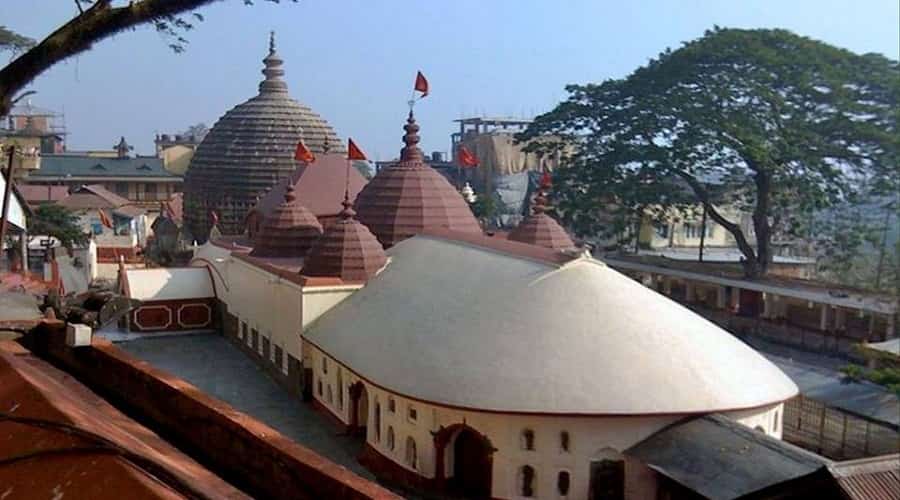
The place of worship is located just a few kilometers from the Guwahati Railway Station and is thronged by devotees throughout the year. King Nar Narayan of Cooch Behar is credited with constructing the temple in 1665. The temple has seven oval spires, each crowned with three golden pitchers. The entrance to the temple is a winding path that leads to the temple. Many carved panels on the temple bear depictions of Hindu deities, arranged in an enchanting pattern. You will spot many pigeons, tortoises, and monkeys loitering in the premises of the temple, as the temple is considered their dwelling place. The peaceful atmosphere of the temple helps devotees find inner peace and embark on a journey of spiritual salvation.
With its picturesque surroundings and enigmatic beauty, Kamakhya Temple is one of the most outstanding structures, not only famous in Assam but across the country.
The other temples in the complex are dedicated to various forms of the Mother Goddess, including Bhuvaneshvari, Bagalamukhi, Chinnamasta, Tripura Sundari, and Tara. Additionally, the complex houses smaller shrines dedicated to Kala Bhairava, Lord Shiva, and other Hindu deities.
Legend
According to legend, this is the spot where the female genitalia (yoni) of Sati fell when Lord Vishnu dissected her body to alleviate the grief of Lord Shiva and compel him to perform his celestial duties.
It happened that King Daksha, Sati’s father, had organized a sacrificial ritual and invited all the deities, but intentionally left Lord Shiva out. Enraged by this, Sati attended the ceremony even though she was not invited. During the ceremony, Daksha started insulting Lord Shiva, which became unbearable for Sati, and she threw herself into the sacred fire to mark the presence of Shiva at the ceremony. In response, Lord Shiva’s meditation was disturbed, and in a state of devastation, he reached this place where he destroyed everything.
Inconsolable, Lord Shiva performed the Tandav dance while carrying the body of his beloved wife on his shoulders at this place. Seeing this, Lord Vishnu sent his Sudarshan Chakra (Divine Wheel) to dismember the body in order to pacify Shiva and prevent the destruction of the world. It is believed that parts of Sati’s body fell at different places on Earth, and these locations are collectively known as Shakti Peethas. Kamakhya Temple is believed to be the place where her yoni fell.
When Sati’s yoni fell at the site of the temple, the hill turned blue, which is how it came to be called Nilachal. Originally, Kamdev, the God of Love, along with the celestial architect Vishwakarma, established the temple. The temple was later named by the demon king Narakasura, who made the goddess his patron deity. The temple has a series of steps that lead downwards to a mysterious chamber where the yoni is covered with a silk sari and flowers.
History
This sacred site is first mentioned in the Allahabad inscriptions of Emperor Samudragupta. According to legend, the goddess herself forbade the Koch Bihar royal family from performing puja at the temple. Even today, none of the descendants of the royal family dare to look at the hill of the temple due to this ancient prohibition.
The temple went through difficult times without proper patrons. In 1658, the Ahoms under King Jayadhwaj Singh took interest in renovating the temple. The temple continued to receive support from the Ahom kings and later devout Shaivites and Shaktas.
From 1696 to 1714, Rudra Singh ruled the area and decided to embrace Hinduism fully. He sought a spiritual teacher and invited Krishnaram Bhattacharyya, a renowned Mahant of the Shakta tradition from Malipota near Santipur in Nadia district, Bengal. Initially, the Mahant was reluctant to come, but upon promising to give the Kamakhya temple under his care, the Mahant agreed.
After Rudra Singh’s death, his son Siba Singha, who ruled from 1714 to 1744, assigned the responsibility of the Kamakhya temple and a large portion of the Debottar land to the Mahant. Since then, the Mahant and his successors, known as the Parbatiya Gosains, have taken care of the temple. Today, many Kamakhya priests and Shakta devotees in Assam trace their lineage to this group.
- Also Read: Best Tourist Places to Visit In Assam
Temple – At a Glance
The original temple was destroyed by Kala Pahar, and the current structure dates back to 1565. It was reconstructed by Chilarai of the Koch dynasty in a medieval style. The temple is adorned with a beehive-shaped structure, featuring seven oval spires crowned with three golden pitchers. The exterior is decorated with beautiful panels and images of various gods and goddesses, including Lord Ganesha, the son of Shiva and Parvati (rebirth of Sati), who is regarded as the god of wisdom and prosperity.
Festivals
Kamakhya Temple is famous for Tantra worship, and many devotees attend the annual Ambuvaci festival. Manasha Puja is another important festival. Furthermore, during Navratri in September/October, Durga Puja is celebrated for five days, attracting thousands of devotees from around the world.
Tourists’ Attractions around Kamakhya
- Kachapukhuri: This site features a natural pond filled with countless turtles at a great height, which is an intriguing phenomenon for zoologists and visitors alike.
- Other Temples: Nearby temples include the Bhutanese Tara Temple, the shrine of the snake goddess Manasa, and the Bhubaneswari Temple located at the peak near Kamakhya. The Bhubaneswari Temple offers a spectacular view of Guwahati and the Brahmaputra River.
Reaching the Temple
- By Air: The nearest airport is Gopinath Bordoloi International Airport, located 14 km from the temple.
- By Rail: Guwahati Railway Station is the nearest major railway station, located 8 km from the temple.
- By Road: The Kamakhya Temple is well connected to the city via good roads. Guwahati is also well linked by road, air, and rail to major cities like Kolkata and Delhi.
Kamakhya temple is the most beautiful and spiritual place to visit. Thanks and subscribed your blog for updates.