Forts are found in almost every part of the world. Within these forts, a large number of people resided and conducted their business, community events, and other activities. The forts also served as military bastions and were the venue for many epic battles fought in the history of mankind. The Rajgad Fort, or the Royal Fort in Maharashtra, is one such place that served many purposes before becoming a popular tourist destination.
Rajgad Location
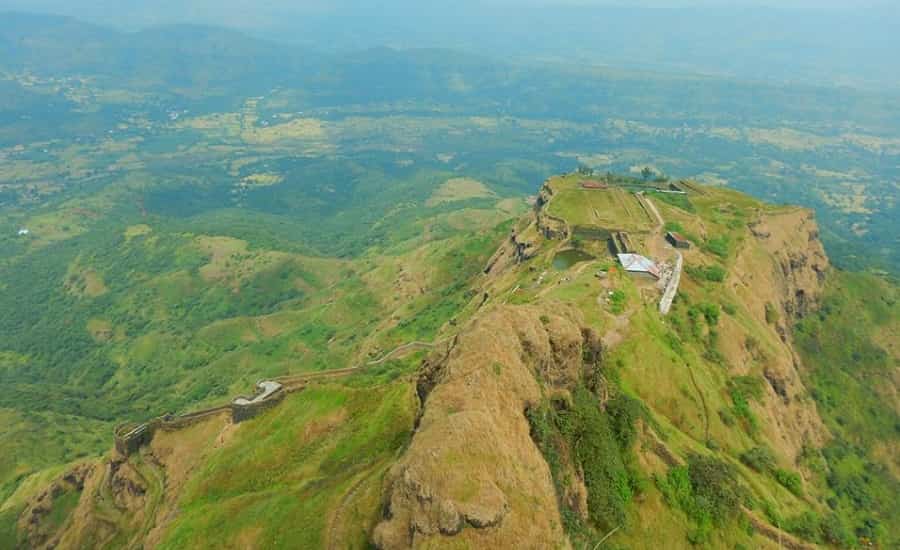
The Rajgad Fort is located in the Pune district of Maharashtra, approximately 65 km southwest of Pune city. It is around 15 km beyond the Nasrapur Village, nestled amidst the Sahyadri Ranges. The fort spans a large area of 40 km at its base and is situated at an elevation of nearly 1,376 meters above sea level.
History
Apart from serving as the residence of Shivaji Maharaj for twenty-five years, Rajgad Fort has witnessed numerous significant events during its history of occupation by various rulers. Rajaram Chhatrapati, the son of Shivaji Maharaj, was born here. Saibai, the queen of the Maratha Empire and wife of Shivaji, passed away here. The fort was captured by Ahmed Bahiri Nizamshah in the late 14th century. In the early 16th century, it was attacked and captured by Adilshah. The ownership of the fort returned to the Nizamshahi Dynasty and became part of Shahaji Raje’s legacy in 1842.
In 1647, Shivaji Maharaj attacked and captured the fort. He initiated repair works in 1649 and renamed the fort “Rajgad” in 1654. Shivaji left the fort to conquer the northern Konkan region, returning victorious in 1658. A year later, he left for Pratapgad to battle Afzal Khan. In the same year, his wife, Saibai, passed away inside the fort.
In 1660, Siddi Jauhar attacked the fort and attempted to capture Shivaji Maharaj, but Shivaji managed to escape to Vishalgad. Construction of new buildings around the fort was completed in 1662, and Shivaji returned after capturing Kalyan and Penn. In 1663, following a raid by Shaista Khan, Shivaji Maharaj left for Kondana and later returned to Rajgad. In the following year, the fort played a crucial role in the loot taken during the Surat raid.
The Mughals attempted to seize the fort in 1665, but after the attack by Jai Singh, Shivaji Maharaj accepted the defeat. In 1670, Rajaram, Shivaji’s son, was born, while one of Shivaji’s trusted companions, Tanaji Malusare, sacrificed his life defending the fort. Another phase of repairs began in 1671. The fort was later captured by the Mughals after the assassination of Sambhaji Maharaj in 1689. Three years later, Shankarji Narayan captured the fort, which became Rajaram Maharaj’s capital in 1697. In 1818, the fort came under the control of the British Empire.
What to See
The fort itself is a treat for the eyes of visitors, with several structures worth exploring. At the north end of the fort is Padmavati Machee, which features a temple and a lake of the same name. There are also the Chor Darwaza, Gunjavane Darwaza, and Pali Darwaza. A storage facility for arms and ammunition, known as Daru Kothar, was also built here. Visitors can also explore an office, Diwankhana, and Rajwada. The Ghod Tale lake was constructed to provide water for the horses. Additionally, the tomb of Saibai is located here.
To the southeast of the fort is Suvela Machee. This Machee has multiple doorways and secret routes that helped rulers and soldiers escape in case they were unable to defend the fort. One such escape route is the Kaleswari Buruz, attached to the bastion. The Sanjeevani Machee, situated southwest of the fort, is another fortified section. The center of the fort, known as Bale Killa, houses palaces and water reservoirs, now in ruins. The main entrance to this area is called the Maha Darwaza, and numerous caves are also located here.
Rajgad is now one of the most popular trekking destinations in Pune district. Visitors can plan a trip at any time of the year to explore the fort and the surrounding hills. From the top of the fort, one can view Sinhagad to the north, Torna Fort to the west, Lingana Fort, and Raigad in the Konkan district. To the east of Rajgad, you can spot the Purandar and Vajragad forts.
Eat, Drink, Collect
Local people cook and serve regional delicacies at the fort. Though the food may be slightly pricey, its quality and taste are unmatched. The water from the reservoirs is safe for consumption. Before heading to the fort, visitors can arrange for locals to carry their luggage up and provide food and beverages at specific times. Tourists can rest at the Padmavati temple, which can accommodate around fifty people. You can also set up a tent and enjoy the night sky.
Best Time to Visit
While the fort is open year-round, it is recommended to visit after the monsoons. The post-rain weather enhances the beauty of the hilly areas, and the lush greenery keeps you energized as you trek to the fort.
The trek is tiring but rewarding. The view from the top and the greenery along the way are an experience not to be missed.
How to Reach
The closest city to Rajgad Fort is Pune, which is well-connected by rail, road, and air to most parts of the state and country. Pune’s international airport links the city to various countries, making it easier for trekkers and travelers to reach. From Pune, head towards Nasrapur and then to Gunjavane village, located at the foothills of Rajgad.
- You may also like to read about: Popular Historical Monuments in Maharashtra