Gujarat is a state known for its colour, warmth and strong sense of community, and this comes through clearly in its weddings. Gujarati people are famously hospitable, and their wedding ceremonies reflect that same warmth — every ritual, from the first engagement meeting to the final farewell, is built around family participation and joyful celebration.
The wedding rituals in Gujarat are spread across three stages: pre-wedding ceremonies, the wedding day itself, and post-wedding traditions. Understanding each stage helps guests, families and couples appreciate the meaning behind every custom, while also making it easier to plan a wedding that honours tradition.
Key Takeaways
- Gujarati weddings unfold in three clear stages: pre-wedding rituals, wedding-day ceremonies, and post-wedding traditions.
- Many traditional Gujarati Hindu weddings follow four Mangal Pheras instead of seven, followed by the seven vows of Saptapadi, though practices can vary by community.
- Mehendi, Sangeet (also called Sanji in some families) and Pithi are essential pre-wedding rituals central to most Gujarati weddings.
- Playful customs like Juta Churai, Chero Pakaryo and Aeki Beki add humour and bonding between the two families.
- The bride traditionally wears a Panetar saree for the main ceremony, often changing into a Gharchola saree for the reception.
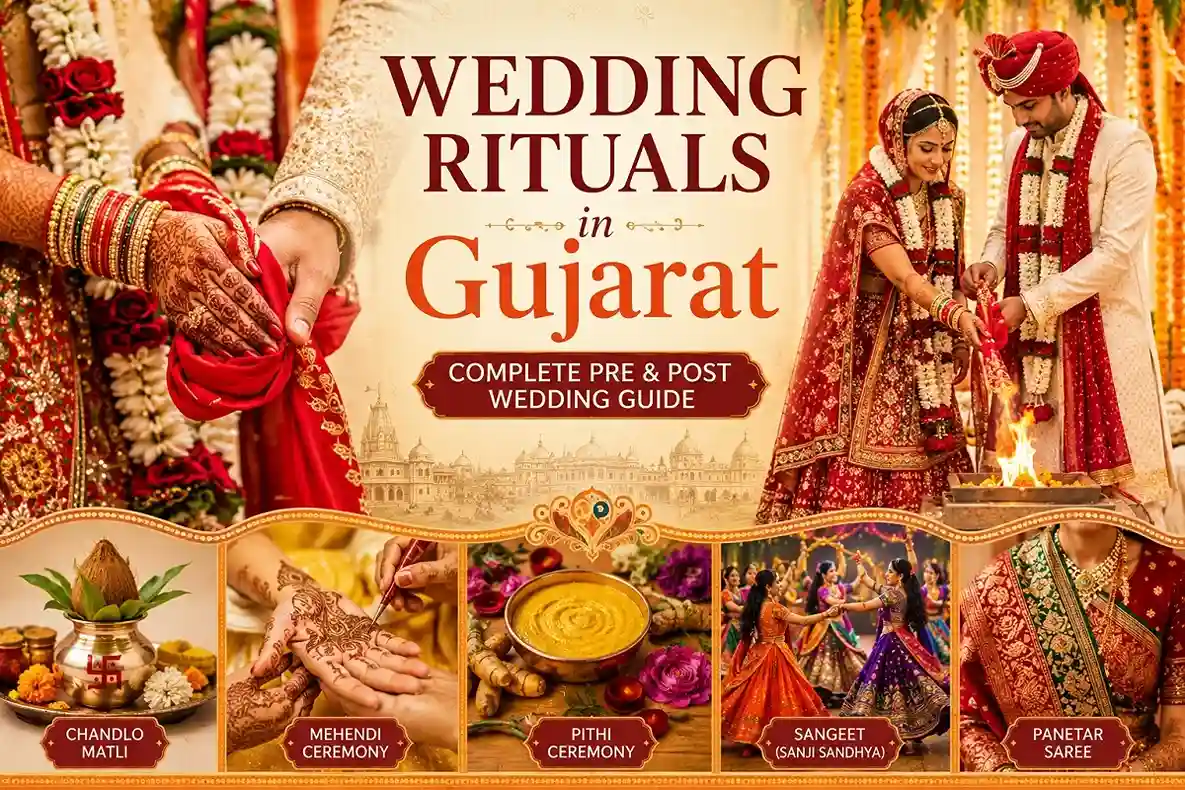
Pre-Wedding Rituals in Gujarat
The pre-wedding rituals in Gujarat begin weeks before the main ceremony and are mostly about formally bringing the two families together.
Chandlo Matli
This is often the very first formal ritual, marking the acceptance of the match. The bride’s father, accompanied by a few male relatives, visits the groom’s home with a matli (a small steel vessel) filled with sweets and gifts. He applies a red chandlo (tilak) on the groom’s forehead as a symbol of approval before handing over the gifts.
Sagai (Engagement)
The engagement, or Sagai, is a family occasion rather than just a moment between the couple. The bride and groom exchange rings in front of both families, and blessings are sought from five married women on each side, symbolising the joining of the two families.
Mandap Muhurat and Ganesh Sthapana
Held separately at the bride’s and groom’s homes, this ceremony begins with Ganesh Sthapana — invoking Lord Ganesha, the remover of obstacles, before any auspicious event.
The Mandap Muhurat marks the start of mandap construction at home and seeks blessings from Mother Earth. A Graha Shanti Puja often follows, performed to bring peace and harmony to both households before the wedding.
Mamera / Mosalu
In this affectionate pre-wedding custom, the bride’s maternal uncle (mama) and his family visit with gifts of clothes, jewellery and sweets for the bride and her immediate family. Mamera strengthens the bond between the bride and her maternal relatives just before she starts a new chapter of life.
Mehendi Ceremony
No Gujarati wedding is complete without the Mehendi ceremony, usually held at the bride’s home a day or two before the wedding. Intricate henna designs are applied to the bride’s hands and feet, often including the groom’s initials hidden within the pattern. Female friends and relatives join in with music and dancing, making it one of the most lively pre-wedding events.
Pithi (Haldi) Ceremony
Performed separately at both homes, the Pithi ceremony involves applying a paste of turmeric, sandalwood and rosewater to the bride and groom. It is believed to bless the couple, purify them before the wedding, and give the skin a natural glow. The bride or groom sits on a low wooden seat called a bajat during this ritual.
Sangeet (Sanji Sandhya)
The Sangeet, also known in some Gujarati families as Sanji or Sanji Sandhya, is a musical evening usually held the night before or on the morning of the wedding.
Both families come together for folk songs, Garba and Dandiya performances, and modern dance routines. It is one of the best opportunities for the two families to bond before the formal wedding rituals begin.
Wedding Day Rituals in Gujarat

The actual wedding day in Gujarat is packed with rituals, each carrying its own symbolism and emotion.
The Jaan Ritual and Ponkhvu
When the groom’s procession (baraat) arrives at the venue, the bride’s mother welcomes him with sweets and aarti. In many Gujarati families, he then touches her feet to seek blessings.
In a playful custom known as Ponkhvu, the bride’s mother gently pinches the groom’s nose while he tries to dodge her grip — a light-hearted reminder that he is being entrusted with her precious daughter and should remain humble and grateful.
Jaimala
This is the first ritual of the formal wedding ceremony. The bride and groom exchange garlands made of fresh flowers, usually twice, symbolising their mutual acceptance of one another.
Madhuparka
In this ritual, the bride’s family washes the groom’s feet, after which he is offered a drink made of honey and milk, welcoming him formally into the family.
Juta Churai
One of the most entertaining customs at any Gujarati wedding, the bride’s sisters and cousins steal the groom’s shoes once he removes them. They then negotiate with him to return the shoes only in exchange for gifts or money, leading to plenty of laughter and friendly bargaining.
Antarpat
Once the bride enters the mandap, escorted by her maternal uncle or brothers, a cloth called the Antarpat is held up between her and the groom so they cannot see each other’s face. As the priest chants mantras, the cloth is slowly lowered, and the couple sees each other for the first time on their wedding day.
Kanyadaan, Hasta Milap and Varmala
Kanyadaan is an emotional moment where the bride’s father places her hand in the groom’s hand, symbolically giving away his daughter.
This is followed by Hasta Milap, where the priest ties the bride’s saree pallu to the groom’s shawl, representing their union. The elders then tie a sacred thread, known as Varmala, around the groom’s neck to ward off evil.
Mangal Pheras and Saptapadi
Many traditional Hindu Gujarati weddings follow four Mangal Pheras around the sacred fire, rather than the seven seen in most other Hindu weddings, though the exact practice can vary among communities such as Patel, Lohana, Rabari, Jain Gujarati and Rajput families.
Each phera represents one of the four goals of life: Dharma (duty), Artha (prosperity), Kama (desire) and Moksha (liberation). As the priest chants mantras, the couple circles the fire together.
After the pheras, the couple takes seven steps known as the Saptapadi, exchanging seven vows for their married life, and then seeks the blessings of their elders.
Sindoor and Mangalsutra
To mark the bride’s new status as a married woman, the groom applies sindoor (vermilion) along the parting of her hair and ties a Mangalsutra around her neck. The couple traditionally completes the ceremony by feeding each other a sweet known as Kansar.
Chero Pakaryo
Another fun-filled custom, this sees the groom playfully grab his mother-in-law’s saree pallu and refuse to let go until he is promised gifts. The pallu is then filled with money and presents by family members and later handed over to the groom’s family.
Post-Wedding Traditions and Wedding Rituals in Gujarat
Vidaai
In this emotional farewell ceremony, the bride says goodbye to her family. In a custom common across many Gujarati families, she throws a handful of rice backward over her shoulder without looking, which her mother often catches in her saree pallu — symbolising the prosperity she leaves behind for her family.
Ghar Nu Laxmi
On arriving at her new home, the bride gently kicks over a small vessel (lota) filled with rice using her right foot. This symbolises her stepping in as the new Laxmi, or goddess of prosperity, of the household.
Aeki Beki
A favourite post-wedding game, a large plate is filled with milk and a ring is dropped into it. The bride and groom both reach in to find the ring, and whoever finds it first is said to have the upper hand in the marriage — all in good fun.
Reception
The groom’s family may host a wedding reception after all the rituals are complete. This is usually a more relaxed gathering attended by close friends and relatives of both families, often featuring a formal dinner and photographs.
Traditional Gujarati Wedding Attire
Clothing plays an important role in Gujarati wedding traditions. The bride traditionally wears a Panetar, a silk saree with a white body and red border, for the main ceremony.
She often changes into a Gharchola saree — red with checks woven in gold — for the reception, traditionally gifted by her maternal uncle as part of the Mamera custom.
Grooms typically wear a dhoti-kurta or sherwani with a colourful pagdi (turban), though many now opt for indo-western outfits. Bandhani prints and vibrant chaniya cholis are also common at Sangeet and Mehendi functions.
Panetar vs Gharchola: Quick Comparison
| Aspect | Panetar | Gharchola |
| Colour | White with red border | Red with gold checks |
| Worn during | Main wedding ceremony | Reception / later functions |
| Symbolism | Purity, new beginnings | Prosperity, married life |
| Typically gifted by | Groom’s family | Bride’s maternal uncle (Mamera) |
Gujarati Wedding Ritual Timeline
Engagement → Chandlo Matli → Mandap Muhurat → Mehendi → Pithi → Sangeet → Jaan → Antarpat → Kanyadaan → Mangal Pheras → Vidaai → Reception
Ritual Summary Table
| Ritual | Stage | Purpose | Who Participates |
| Mehendi | Pre-wedding | Beauty, blessing, bonding | Bride, female relatives |
| Mangal Pheras | Wedding day | Sacred vows around fire | Bride, groom, priest |
| Vidaai | Post-wedding | Farewell, family blessing | Bride, immediate family |
Planning Tips for a Gujarati Wedding
A few practical tips can help families and guests plan around the wedding rituals in Gujarat more smoothly.
- Book key vendors (mehendi artist, caterers, decorators) at least two to three months in advance during the wedding season (October to February).
- Keep separate budgets for pre-wedding functions like Mehendi and Sangeet, since these are often as elaborate as the main ceremony.
- Coordinate with both families early on rituals like Chandlo Matli and Pithi, which happen simultaneously at two homes.
- Guests attending the Sangeet or Mehendi should dress in bright, festive colours, while white is generally avoided.
- Gujarati wedding menus are typically vegetarian, featuring dishes like undhiyu, dal dhokli and a wide range of farsan and sweets; chaas (buttermilk) is a signature drink at most weddings.
- Wedding costs vary widely depending on guest count, venue and number of functions; couples increasingly set a clear budget for each ceremony separately to manage costs better.
Modern Trends in Gujarati Weddings
Like weddings across India, Gujarati weddings are evolving alongside modern lifestyles while keeping core rituals intact.
- Destination weddings at venues in Gujarat (Rann of Kutch, Saputara) or other states are increasingly popular among Gujarati families.
- Digital and QR-code wedding invitations are now common alongside or instead of traditional printed cards.
- Many couples are choosing eco-friendly decor and reducing plastic use at functions, in line with broader sustainable wedding trends.
- Live streaming of the wedding ceremony has become common for relatives who cannot travel.
Gujarati Wedding Culture Beyond the Rituals
Gujarati weddings are closely tied to the state’s wider cultural identity. Garba and Dandiya, the folk dances seen at Sangeet nights, are rooted in the same tradition as Navratri celebrations across Gujarat.
Bandhani tie-dye textiles, seen in dupattas and outfits worn through the functions, are a Gujarati craft with centuries of history. These elements, together with vegetarian cuisine and warm hospitality, make a Gujarati wedding feel distinct from weddings in other parts of India.
Frequently Asked Questions
Q-1: How many pheras are there in a Gujarati wedding?
Many traditional Gujarati weddings follow four Mangal Pheras, instead of the seven seen in most Hindu weddings, though this can vary by community.
Q-2: What is the Jaan ritual in Gujarati weddings?
The Jaan ritual happens when the groom arrives at the venue and is welcomed by the bride’s mother with sweets and aarti, often followed by blessings.
Q-3: What is Ponkhvu?
Ponkhvu is the playful custom where the bride’s mother gently pinches the groom’s nose during the Jaan ritual to remind him to stay humble.
Q-4: What is Antarpat?
Antarpat is a cloth held between the bride and groom in the mandap, slowly lowered so they see each other for the first time on their wedding day.
Q-5: What is Chero Pakaryo?
Chero Pakaryo is a playful post-ceremony custom where the groom holds his mother-in-law’s saree pallu and asks for more gifts.
Q-6: What is the difference between Panetar and Gharchola?
Panetar is the white-and-red saree worn for the main ceremony, while Gharchola is a red-and-gold saree often worn at the reception.
Q-7: What does the bride wear for a Gujarati wedding?
The bride traditionally wears a Panetar for the main ceremony, often changing into a Gharchola saree later in the celebrations.
Q-8: What is the significance of Saptapadi?
Saptapadi means seven steps taken together by the couple, each representing a vow for their married life.
Q-9: Is Mehendi an important part of Gujarati wedding rituals?
Yes, Mehendi is a key pre-wedding ritual where henna is applied to the bride’s hands and feet, usually with music and dancing.
Q-10: What happens during the Pithi ceremony?
In the Pithi ceremony, a turmeric, sandalwood and rosewater paste is applied to the bride and groom separately to bless and purify them.
Q-11: What is Juta Churai?
Juta Churai is when the bride’s sisters steal the groom’s shoes and return them only after he pays a fun ransom in gifts or money.
Q-12: What is the meaning of Kanyadaan?
Kanyadaan is the ritual where the bride’s father places her hand in the groom’s hand, symbolically giving away his daughter in marriage.
Q-13: What is Vidaai in a Gujarati wedding?
Vidaai is the emotional farewell ritual where the bride often throws rice backward over her shoulder as she leaves her family home.
Q-14: What is Aeki Beki?
Aeki Beki is a playful post-wedding game where the bride and groom search for a ring dropped in a plate of milk.
Q-15: What is Mamera or Mosalu?
Mamera is a pre-wedding custom where the bride’s maternal uncle brings gifts of clothes and jewellery for the bride and her family.
Q-16: What is the Sangeet ceremony called in Gujarati weddings?
It is often called Sanji or Sanji Sandhya in some families, a musical evening with folk songs, Garba and Dandiya before the wedding.
Q-17: Why do many Gujarati weddings have four pheras instead of seven?
The four pheras represent the four goals of life — Dharma, Artha, Kama and Moksha — though some communities still follow seven.
Q-18: What is Ghar Nu Laxmi ritual?
Ghar Nu Laxmi is performed when the bride enters her new home and gently kicks over a small vessel of rice with her right foot.
Q-20: How long does a typical Gujarati wedding last?
Including pre-wedding functions, a Gujarati wedding typically spans two to four days, from Mehendi and Sangeet to the wedding and reception.
Q-21: What food is served at Gujarati weddings?
Gujarati wedding menus are mostly vegetarian, featuring dishes like undhiyu, dal dhokli, farsan and a wide variety of sweets.
Conclusion
The wedding rituals in Gujarat are a vibrant blend of devotion, humour and family bonding, from the early Chandlo Matli and Mehendi to the joyful Mangal Pheras and the emotional Vidaai. Each custom carries its own meaning, and together they reflect the warmth and richness of Gujarati culture, even as exact practices vary a little from one community to another. Whether you are planning a Gujarati wedding or simply curious about its traditions, these ceremonies offer a beautiful window into one of India’s most colourful wedding customs.
- Also Reads on: Popular Fair and Festivals of Gujarat