Gujarat, known for its tradition, culture and heritage, is one of India’s most vibrant travel destinations. The state has drawn travellers for generations because of its colourful festivals, devotional fairs and deep-rooted folk culture. Beyond the festivals celebrated across India, Gujarat hosts hundreds of its own unique regional fairs and melas throughout the year.
Gujarat is believed to host hundreds of local fairs and cultural festivals throughout the year, ranging from small village melas to state-organised mega-events, making it one of India’s richest cultural calendars. Religious identity and diverse culture come through strongly during these celebrations, as people from different communities gather around shared gods, goddesses, saints and seasonal traditions.
Among the most popular fairs and festivals of Gujarat are Navratri, the Kite Festival (Uttarayan), Rann Utsav and the tribal fairs of Saurashtra and Kutch. Many of these festivals are still observed exactly as they were generations ago, which is part of what makes Gujarat such a rewarding state to visit for cultural travellers.
Key Takeaways
- Gujarat hosts an extraordinary number of fairs and festivals each year, most tied to the Hindu lunar calendar, so dates shift annually.
- Navratri (Sept/Oct) and the International Kite Festival (Jan) are Gujarat’s two most internationally recognised celebrations.
- Tribal fairs such as Tarnetar, Chitra-Vichitra and Vautha offer an authentic look at Gujarat’s rural and indigenous communities.
- Rann Utsav, the White Desert Festival of Kutch, is now one of Gujarat’s biggest tourism draws and runs for several months each winter.
- Always confirm exact dates with Gujarat Tourism before travelling, since many festivals follow the lunar calendar and shift every year.
Must Read: Popular Tourist Attractions of Gujarat
Bhadra Purnima
| Location | Ambaji Shrine, Banaskantha district, Gujarat |
| Held in | August/September (Bhadrapada month) |
| Transport | Rail / Road / Local Transportation |

Bhadra Purnima, also known as Ambaji Bhadra Purnima, is among the biggest religious fairs in Gujarat. It is celebrated at Ambaji, located at the foothills of the Aravalli range. The shrine is dedicated to Goddess Amba (Ambika), and while its exact founding date is unknown, references to the site date back over a thousand years.
The most important day is Bhadrapada Purnima, when farmers and devotees gather to worship the goddess. Unlike most temples, the Ambaji shrine has no idol — the goddess is represented by the ‘Shree Yantra’, a sacred geometric symbol. Ambaji is also recognised as one of the 51 Shakti Peeths of India, sites believed to mark where parts of the goddess Sati’s body fell.
During the fair, devotees perform Garba and Bhavai folk dances, and recite the seven-hundred-verse Devi Saptashati. Padyatris (pilgrims who travel long distances on foot) walk to the temple as an act of devotion, and the fair draws visitors from across India and abroad.
Accommodation: Ahmedabad and nearby Gujarat towns offer everything from budget lodges to five-star hotels.
Transportation: Ahmedabad is well connected by rail to the rest of Gujarat. Roads to Ambaji are well maintained, and local buses and auto-rickshaws cover the final stretch from Ahmedabad.
Dhrang Fair

The Dhrang Fair is held in honour of the folk saint Mekan Dada (also spelt Mekaran Dada). Dhrang is a small village in the northwest of Kutch district, close to the border with Pakistan and about 40 km from Bhuj. The samadhi (memorial shrine) of this revered social reformer is located here, drawing followers who come to pay respect and take part in the religious gathering.
According to local tradition, Mekan Dada lived in the 18th century and devoted his life to serving the poor and challenging social superstitions and untouchability. Folklore describes him travelling through the Rann with his donkey, Laliyo, and dog, Motiyo, providing food and water to lost travellers and guiding them to safety.
Mekan Dada is revered by the Ahir community as a folk deity, and the fair is organised in his honour, typically held around mid-February (Magh Vad) according to the Hindu calendar.
Navratri Festival
| Location | All around Gujarat |
| Held in | September/October (Ashwin month) |
| Duration | 9 nights |
| Transport | Rail / Road / Local Transportation |

Navratri is Gujarat’s signature festival and one of the world’s largest and longest-running dance festivals. It begins on the first day of the bright fortnight of the Hindu month of Ashwin, usually falling in September or October.
The festival continues for nine consecutive nights of dancing across the state. The tenth day, Dussehra (Vijayadashami), marks the victory of Lord Rama over Ravana.
In many places, a Ram Leela performance ends with the burning of a giant effigy of Ravana, symbolising the triumph of good over evil. The day is also considered auspicious for new beginnings, including buying vehicles or other big-ticket purchases.
Each evening, after the Aarti of Maa Durga, the Garba and Dandiya Raas dances begin. Dancers move in concentric circles around a central shrine, using small wooden sticks (dandiya) struck together in rhythm.
The shrine typically contains a Garbo — a decorated earthen pot — with a coin, betel nut and coconut placed inside, symbolising the divine feminine energy.
Accommodation: Hotels and budget lodges are widely available across Gujarat during Navratri, though it is wise to book early in major cities.
Transportation: Gujarat’s main cities are connected by rail and well-maintained roads, and metered as well as shared local transport is easy to find.
Rath Yatra
| Location | All over Gujarat (main event in Ahmedabad) |
| Held in | June/July (Ashadh Sud Bij) |
| Transport | Rail / Road / Local Transportation |

Rath Yatra is a major festival dedicated to Lord Jagannath (Krishna), celebrated with great devotion across Gujarat. ‘Rath’ means chariot and ‘Yatra’ means journey or pilgrimage. Massive wooden chariots carry the idols of Lord Jagannath, Lord Balabhadra and Goddess Subhadra through the streets, accompanied by music, dance and large crowds of devotees.
According to the Bhagavata Purana, the festival recalls the day Krishna and Balarama left Gokul for Mathura, and the grief of the Gopis who tried to stop their chariot. The annual Rath Yatra is observed in this spirit of devotion and remembrance.
Ahmedabad’s Rath Yatra is the city’s largest and best known, beginning at the historic Jagannath Temple in the Jamalpur area. The first recorded Rath Yatra in Ahmedabad took place in 1878, which means the festival now has a history of nearly 150 years.
It is one of India’s largest Rath Yatra celebrations, after Puri and Kolkata. The chariots, pulled by devotees, are decorated with flowers and accompanied by bhajan mandalis, decorated elephants, gymnasts and acrobats.
The route today covers roughly 14 to 16 km through the old city, including stops such as Kalupur, Saraspur and Shahpur.
Rath Yatra is also celebrated in other Gujarat cities including Surat, Porbandar, Bhavnagar, Vadodara and Gandhinagar.
Accommodation: Ahmedabad and other host cities have a wide range of hotels and lodges to suit most budgets.
Transportation: Ahmedabad’s railway station connects well with the rest of Gujarat; local auto-rickshaws and buses are available for the final approach to the temple area.
Tarnetar Fair

The Tarnetar Fair is one of Gujarat’s most colourful tribal fairs, held over three days at the Trinetreshwar Shiva temple in Tarnetar village, in the Chotila taluka of Surendranagar district, around 75 km from Rajkot.
The temple’s sacred reservoir, known for its purifying waters, is the fair’s central attraction, and is locally believed to wash away sins much like the river Ganga. Legend connects the temple site to the archery contest at which Arjuna won Draupadi’s hand in marriage during the Mahabharata.
The fair is mainly attended by tribal communities including the Kanbi, Bharwad, Koli, Kathi, Rabari, Charan and Khant. Women wear heavy silver jewellery with traditional attire, while men wear colourful dhotis, turbans and embroidered jackets.
The Bharwad community in particular uses the fair as a traditional meeting ground for marriage alliances among young people.
A distinctive feature of the fair is the heavily embroidered, mirror-worked umbrella known as the Tarnetar Chhatri, carried by unmarried young men and crafted over months by tribal artisans.
The fair also features folk dances such as Hudo and Raas Garba, along with the women’s Rasada dance performed in large circles to the music of the double flute (Jodia Pava) and traditional drums.
How to Reach: Gujarat Tourism operates organised tours to Tarnetar from Rajkot and Ahmedabad during the fair.
Other Attractions: Visitors can sample Gujarati delicacies and stay in tent villages or traditional Kuba huts set up for the fair.
Bhavnath Mahadev Fair
| Location | Junagadh, Gujarat |
| Held in | Maha Shivratri (Magh month, usually falls in February, occasionally early March) |
| Duration | 5 days |
| Transport | Rail / Road / Local Transportation |

The Bhavnath Mahadev fair is held at the Bhavnath Mahadev Temple in Junagadh, at the foothills of Mount Girnar, to mark Maha Shivratri. Because Maha Shivratri follows the lunar calendar, the exact date varies each year and occasionally falls in early March rather than February.
Gorakhnath Peak, at 3,666 feet, is the highest of Girnar’s peaks and is home to several Jain and Hindu shrines along the pilgrim route.
On the night of Maha Shivratri, a Mahapuja of Lord Shiva is performed at midnight. Naga sadhus — ash-smeared ascetics associated with the Juna Akhada — arrive in a ceremonial procession, some riding elephants, blowing conch shells and carrying flags.
Free community meals (Bhandara) are served throughout the fair, and vendors from across India set up stalls selling rosaries, idols and religious items.
Accommodation: Junagadh and surrounding areas in Gujarat have a range of hotel options to suit most budgets.
Transportation: Junagadh’s railway station is well connected to the rest of Gujarat; local auto-rickshaws and jeeps cover the route to the Bhavnath Mahadev Temple.
International Kite Festival (Uttarayan)
| Location | Ahmedabad and other cities across Gujarat |
| Held in | Early-to-mid January (main day: 14th January) |
| Duration | Around 7–9 days of events; main Uttarayan celebration runs 2 days |
| Transport | Rail / Road / Local Transportation |
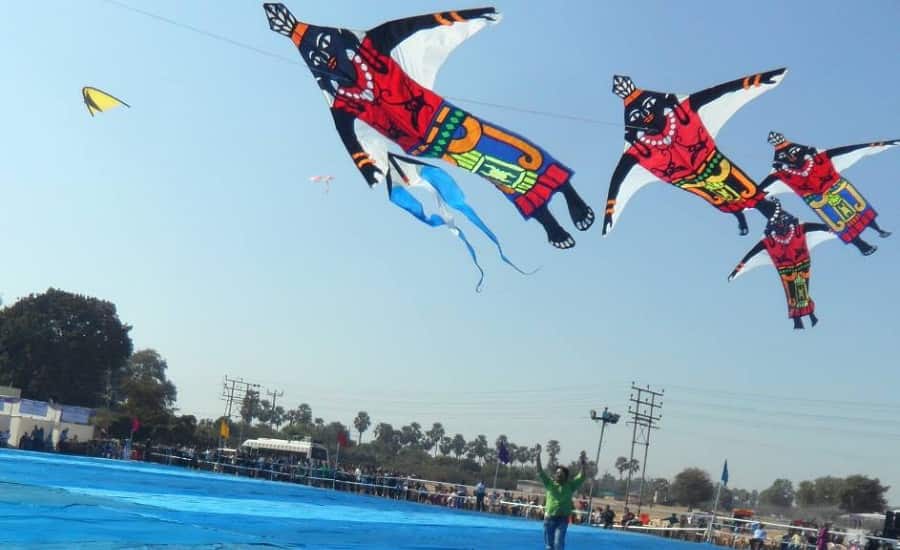
The International Kite Festival, organised by the Tourism Corporation of Gujarat since 1989, is one of Gujarat’s most famous events. Uttarayan itself is a one or two-day public holiday centred on 14th January.
The International Kite Festival around it now runs as a multi-day event, typically starting in the first half of January across cities such as Rajkot, Surat, Vadodara and Ahmedabad before culminating in Ahmedabad’s main celebrations along the Sabarmati Riverfront.
Uttarayan marks Makar Sankranti, the day the sun begins its northward journey, traditionally signalling longer days and the start of the harvest season. Families gather on rooftops from before dawn to fly kites using sharpened thread known as Manja.
Friendly contests continue into the night, when colourful kite-flying competitions try to cut down rival kites. In many parts of Gujarat, especially Ahmedabad, small lanterns are tied to kites after dark for a striking night-time display.
Master kite-makers and flyers from dozens of countries take part in the international event, and the festival has grown into a major draw for domestic and international tourists alike. Traditional foods such as undhiyu, chikki and til-gud laddoos are prepared in most Gujarati households during the celebration.
History of the Kite Festival
Kite flying in Gujarat is believed to date back centuries, with royal patronage from kings and Nawabs who saw it as both entertainment and a display of status.
Today, kite-making has grown into a significant cottage industry, with entire neighbourhoods in Ahmedabad, particularly around the Patang Bazaar, dedicated to producing kites in the weeks leading up to the festival.
Accommodation: Ahmedabad and Gujarat offer a wide choice of hotels, from budget lodges to five-star properties, though advance booking is recommended during the festival.
Transportation: Ahmedabad’s railway station connects to all major cities; local auto-rickshaws, buses and jeeps are widely available.
Poshina Chitra-Vichitra Fair

The Chitra-Vichitra fair takes place around two weeks after Holi, in March or April, at the confluence of three rivers — the Vyakul, Akul and Sabarmati — near Poshina village in Gunbhakhari, Sabarkantha district, close to the Rajasthan border.
It is one of the largest tribal fairs in the region, with attendance regularly exceeding 60,000 people. The fair is named after Chitravirya and Vichitravirya, sons of King Shantanu in the Mahabharata, who according to local legend were cured of illness at this site.
The main communities attending include the Garasia, known for their elaborate jewellery and colourful attire; the Rabari, traditionally pastoralists, recognisable by their heavy silver ornaments; and the Bhil, known for their archery traditions and distinct culture.
Traditional dress includes a dhoti, blue shirt and saffron or red turban for men, while women wear voluminous Ghagra skirts — some with a circumference of up to 20 yards — paired with heavy silver jewellery.
Each visitor typically carries their own drum, and the fair also functions as a meeting point for arranging marriages within tribal communities. Celebrations begin at night with ritual mourning at the river confluence and continue with dancing, singing and music.
Other Attractions
- A wide range of silver ornaments and tribal handicrafts are available at the fair’s stalls.
- Fairground rides such as merry-go-rounds and giant wheels are set up for visitors.
Vautha Fair

The Vautha Fair is held at Vautha, where the Vatrak and Sabarmati rivers meet — a confluence locally known as Saptasangam. The fair takes place over the full-moon night of the Kartik month (Kartik Purnima).
It honours Lord Kartikeya, son of Shiva and Parvati and commander of the army of the Devas, who is believed to have visited this spot. The Siddhanath Mahadev temple is the fair’s central shrine.
Vautha is best known as Gujarat’s only major animal trading fair, where camels, cattle and especially donkeys are bought and sold. It is regarded as one of India’s largest traditional donkey trading fairs, with Banjara (Gypsy) traders forming a large share of the buyers.
Donkeys and camels are often decorated for the occasion, and many traders camp on the riverbanks for the duration of the fair. Devotees also take a ritual dip in the river to wash away misfortune.
Other Attractions
- Stalls selling handicrafts and regional food line the fairground.
- Kartik Purnima is also marked elsewhere in Gujarat with a religious fair at Somnath, a camel fair at Sidhpur, and a tribal fair at the Shamlaji temple.
Kachchh Mahotsav
| Location | Kachchh (Kutch), Gujarat |
| Held in | February/March |
| Duration | Around 5–6 days |
| Transport | Rail / Road / Local Transportation |
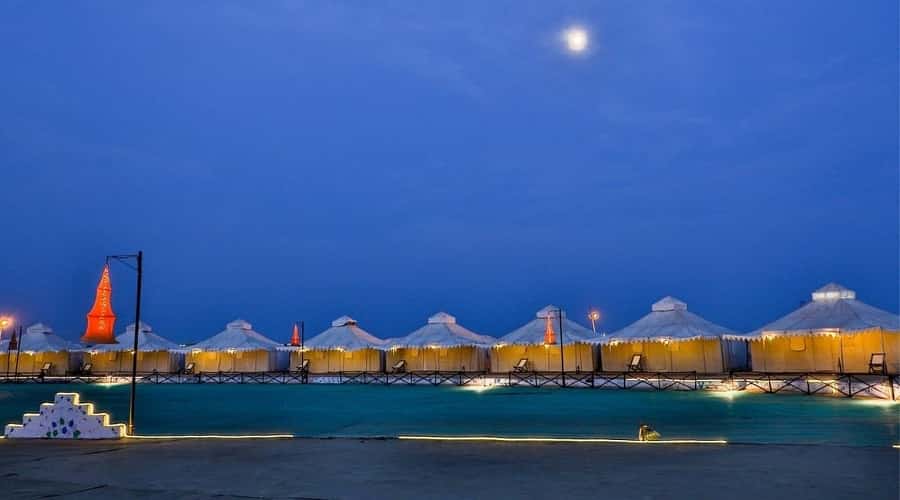
Kachchh, also spelled Kutch, is a distinctive region of Gujarat bordered by the Great Rann of Kachchh to the north and the Gulf of Kachchh to the east, home to around 18 different tribal communities.
The Kachchh Mahotsav is a guided multi-day tour of the Bhuj-Kutch region organised by Gujarat Tourism, combining culture, landscape and wildlife — including flamingo sightings — with visits to historic forts, museums and monuments.
Other Attractions in and around Bhuj
- The 18th-century Aina Mahal palace.
- The Kutch Museum, one of the oldest museums in Gujarat.
- Rural bazaars selling Kutchi handicrafts and embroidery.
- Mata no Madh, a roughly 1,200-year-old temple dedicated to the Mother Goddess.
- Lakhpat, Narayan Sarovar, Bhadreshwar Temple, Anjar, Mandvi and the UNESCO World Heritage Site of Dholavira.
Accommodation: Bhuj and the wider Kutch region offer hotels, huts and budget lodges across price ranges.
Rann Utsav — The White Desert Festival of Kutch
| Location | Dhordo and the White Rann, Kutch, Gujarat |
| Held in | Late October/November to February (winter season) |
| Duration | Around 100+ days (seasonal, not single-day) |
| Transport | Rail / Road / Local Transportation; nearest airport Bhuj |
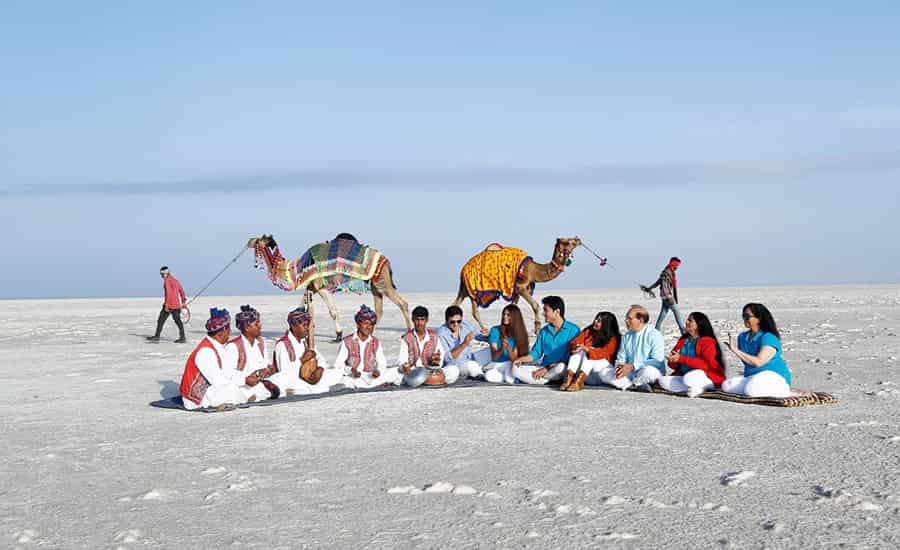
No modern guide to the fairs and festivals of Gujarat is complete without Rann Utsav, the state’s biggest tourism event and arguably its most internationally recognised. Organised by Gujarat Tourism, it transforms the vast salt desert of the Great Rann of Kachchh, near Dhordo village, into a season-long carnival of culture, music, handicrafts and adventure activities.
It typically runs from around late October or November through to February each year, timed to coincide with the cooler winter months and the full moon nights when the white salt flats are especially striking.
Visitors stay in specially built tent cities offering everything from basic accommodation to luxury ‘Swiss tents’. The festival programme includes folk music and dance performances by local Kutchi artists, camel and ATV safaris, stargazing sessions, hot-air balloon rides, and stalls selling the region’s famous mirror-work embroidery, bandhani textiles and silver jewellery.
Rann Utsav has played a major role in boosting tourism to Kutch since it was launched in the mid-2000s. The white desert itself, best seen at sunset or under a full moon, has become one of the most photographed landscapes in Gujarat.
Accommodation: Most visitors stay at the official Tent City near Dhordo, which must be booked in advance through Gujarat Tourism, alongside a growing number of private resorts nearby.
Transportation: Bhuj is the nearest railway station and airport, roughly 80–85 km from the festival site, with regular taxis and tour buses covering the route.
- Also Reads on: Best Places to Visit in Kutch
Dang Darbar — Royal Tribal Festival of the Dangs
| Location | Ahwa, Dang district (near Saputara), Gujarat |
| Held in | March (a few days before Holi) |
| Duration | 1–3 days |
| Transport | Rail to Surat, then Road / Local Transportation |
Dang Darbar is one of Gujarat’s most unusual tribal festivals of the year, held in Ahwa, the headquarters of the forested Dang district near the hill station of Saputara. The festival honours the forefathers of five tribal kingdoms — Gadhavi, Pimpri, Amala-Linga, Vasurana and Daher — whose hereditary rulers still receive a symbolic government pension each year during the event, a tradition dating back to British rule.
Thousands of tribal residents from over 300 villages, including the Bhil, Kunbi, Gamit and Warli communities, gather in their traditional dress for the darbar. Men wear lion-print waistcoats with colourful turbans, while women dress in sarees with heavy silver jewellery.
The fair features tribal dances performed in circles to the beat of percussion and wind instruments, along with stalls selling tribal handicrafts and textiles. It is considered one of the best opportunities for visitors to experience the traditional gathering and folk celebration of Gujarat’s tribal heartland up close.
Accommodation: Saputara, Gujarat’s only hill station, is about 42 km from Ahwa and offers a wide choice of hotels and guesthouses.
Transportation: Surat is the nearest major railway station and airport, roughly 116 km away, with regular buses and taxis connecting Surat to Saputara and onward to Ahwa.
- Also Reads on: Best Places to Visit in Surat
Dance Festival Modhera (Uttarardh Mahotsav)
| Location | Modhera, Gujarat |
| Held in | January |
| Duration | 3 days |
| Venue | Sun Temple, Modhera |
| Transport | Rail / Road / Local Transportation |
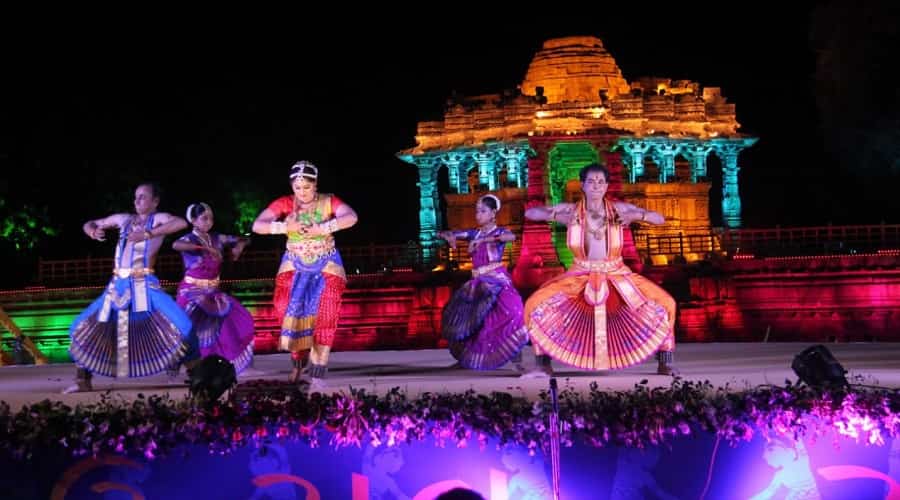
The Modhera Dance Festival, also known as the Uttarardh Mahotsav, is organised annually by Gujarat Tourism at the 11th-century Sun Temple in Modhera, dedicated to the Sun God, Surya. The festival is held over three days each January, against the backdrop of the temple’s intricately carved sandstone walls, which are illuminated for the occasion.
Classical dance forms including Bharatanatyam, Kathak, Kuchipudi, Kathakali and Manipuri are performed alongside Gujarat’s own folk dances such as Garba, drawing performers and audiences from across India and abroad.
Accommodation: Hotels in Ahmedabad and across Gujarat are easily accessible; Modhera itself has limited stay options, so many visitors base themselves in Mehsana.
Transportation: Mehsana railway station is the nearest rail link, with local transport available onward to the Sun Temple.
Gujarat Festival Calendar at a Glance
Most of these festivals follow the Hindu lunar calendar, so exact dates shift from year to year. The table below gives the typical season for planning purposes — always confirm exact dates closer to your travel time.
| Festival | Typical Month | Location |
| International Kite Festival | Early–mid January | Ahmedabad & statewide |
| Dance Festival Modhera | January | Modhera |
| Dhrang Fair | February | Dhrang, Kutch |
| Bhavnath Mahadev Fair | Feb–Mar (Maha Shivratri) | Junagadh |
| Kachchh Mahotsav | Feb–Mar | Bhuj, Kutch |
| Rann Utsav | Nov–Feb (seasonal) | Dhordo, Kutch |
| Chitra-Vichitra Fair | March–April | Poshina, Sabarkantha |
| Dang Darbar | March (before Holi) | Ahwa, Dang district |
| Rath Yatra | June–July | Ahmedabad & statewide |
| Bhadra Purnima | Aug–Sept | Ambaji |
| Navratri | Sept–Oct | Statewide |
| Tarnetar Fair | Aug–Sept | Tarnetar, Surendranagar |
| Vautha Fair | October–November (Kartik Purnima) | Vautha |
Note: Dates vary every year according to the Hindu lunar calendar. Always check the official Gujarat Tourism calendar before planning your visit.
Navratri vs Rann Utsav vs Tarnetar: Which Gujarat Festival Should You Pick?
If you can only attend one festival in Gujarat, the right choice depends on what kind of experience you want. The comparison below should help.
| Festival | Best For | Vibe | Family Friendly |
| Navratri | Dance, music, nightlife | Urban, energetic | Yes |
| Rann Utsav | Landscape, photography, luxury camping | Scenic, relaxed | Yes |
| Tarnetar Fair | Tribal culture, authenticity | Rustic, traditional | Yes, with planning |
FAQ’s
Q-1: Which is the most famous festival of Gujarat?
Navratri is Gujarat’s most famous festival, known for nine nights of Garba and Dandiya Raas dancing across the state.
Q-2: When is the best time to visit Gujarat for festivals?
Winter, from October to March, covers most major events, including Navratri, the Kite Festival, Rann Utsav and Dang Darbar.
Q-3: What is Rann Utsav and where is it held?
Rann Utsav is a season-long festival in the white salt desert of Kutch, near Dhordo, usually held from November to February.
Q-4: How many days does Navratri last in Gujarat?
Navratri lasts nine nights, followed by Dussehra on the tenth day, usually in September or October.
Q-5: When is the Rath Yatra celebrated in Ahmedabad?
Ahmedabad’s Rath Yatra is held in June or July and has been celebrated since 1878, nearly 150 years ago.
Q-6: Is the International Kite Festival a one-day event?
No. While Uttarayan centres on 14th January, the wider International Kite Festival runs across several days in early-to-mid January.
Q-7: What makes Tarnetar Fair unique?
Tarnetar is a tribal fair near Chotila that also serves as a traditional marriage meeting ground for the Bharwad community.
Q-8: Where can travellers see Gujarat’s tribal culture firsthand?
Tarnetar, Chitra-Vichitra, Vautha and Dang Darbar all bring together tribal communities in their traditional dress and customs.
Q-9: What is unique about the Vautha Fair?
Vautha is Gujarat’s only major animal trading fair, where camels, cattle and donkeys are bought and sold each year.
Q-10: When is Maha Shivratri celebrated at Bhavnath Mahadev?
Maha Shivratri follows the lunar calendar and usually falls in February, occasionally shifting into early March.
Q-11: What should I carry while visiting Gujarat’s fairs and festivals?
A first aid kit, weather-appropriate clothing, a water bottle, sun protection and a camera are recommended.
Q-12: How do I reach Rann Utsav from Ahmedabad?
Bhuj is the nearest railway station and airport, about 80–85 km from the Rann Utsav site, with taxis and buses connecting onward.
Q-13: Are Gujarat’s tribal fairs suitable for foreign tourists?
Yes, fairs like Tarnetar and Dang Darbar are open to all visitors, though advance accommodation booking is recommended.
Q-14: What is the significance of the Kite Festival in Gujarat?
It marks Uttarayan or Makar Sankranti, the day the sun begins its northward journey, celebrated by flying kites from rooftops.
Q-15: Does Gujarat Tourism organise official tours to these festivals?
Yes, Gujarat Tourism runs official tours and tent accommodation for events like Rann Utsav, Tarnetar Fair and Kachchh Mahotsav.
Q-16: Which Gujarat festival is linked to a UNESCO World Heritage Site?
Kachchh Mahotsav includes visits to Dholavira, a UNESCO World Heritage Site, as part of its Kutch tour itinerary.
Q-17: Which festival in Gujarat is best for foreign tourists wanting a comfortable experience?
Rann Utsav offers the most tourist-friendly setup, with organised tent cities, guided tours and easy access from Bhuj.
Q-18: Which is Gujarat’s biggest tribal fair?
Chitra-Vichitra Fair near Poshina is among the largest, with attendance regularly exceeding 60,000 people.
Q-19: What is Dang Darbar known for?
Dang Darbar is a tribal royal festival held near Saputara before Holi, honouring five traditional tribal kingdoms of the Dangs.
Q-20: Which festival in Gujarat is best in winter?
Rann Utsav and the International Kite Festival are the two biggest winter events, both running between November and January.
Beyond the Fairs: Gujarat’s Living Culture
The fairs and festivals of Gujarat are closely tied to the state’s wider craft and food traditions. Kutchi embroidery, bandhani tie-dye textiles and Rogan painting are sold at many of the fairs described above, particularly Tarnetar, Chitra-Vichitra and Kachchh Mahotsav.
Local cuisine is also part of the experience — expect undhiyu, fafda-jalebi, dhokla and seasonal sweets at most fairgrounds and festival stalls. Several events, including Rann Utsav, have also begun promoting more responsible and eco-friendly tourism practices, such as reduced plastic use at tent cities and managed visitor numbers during peak weekends.
Conclusion
From the devotional crowds of Bhadra Purnima and the nine nights of Navratri to the tribal gatherings at Tarnetar, Dang Darbar and the sweeping white desert of Rann Utsav, the fairs and festivals of Gujarat offer one of India’s richest cultural calendars.
Whichever season you travel in, there is almost always a fair, mela or seasonal fair somewhere in the state worth building a trip around — just remember to check the year’s exact dates before you go, since most of these annual celebrations follow the lunar calendar.