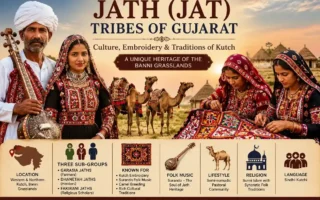
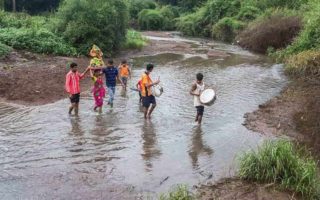
This pastoral community of Gujarat has traditionally herded sheep, goats, and cattle for generations. Many of their traditions are centred on devotion to Krishna, and oral history traces their origins to Gokul Vrindavan, near Mathura in present-day Uttar Pradesh.
According to this tradition, ancestors migrated from Vrindavan along with Krishna’s cowherd companions, travelled through Mewar in Rajasthan, and finally settled across Gujarat. This is the most widely told origin legend.
Some ethnographic researchers also trace possible roots to the Bharude cattle-herding communities of Madhya Pradesh, with a similar onward migration through Mewar into Gujarat. Both versions are oral or scholarly traditions rather than settled historical fact.
This guide covers the verified history, dress, jewellery, festivals, and beliefs of the Bharwad community, along with their current social classification and how they compare to the closely related Rabari community.
Key Facts About the Bharwad Community
- Location: Gujarat, mainly Junagadh, Rajkot, Surendranagar, and Bhavnagar districts
- Language: Gujarati, with regional pastoral dialects
- Main occupation: Livestock herding (sheep, goats, cattle), increasingly combined with farming
- Official classification: OBC across most of Gujarat; ST only within specific forest Nesses (Alech, Barda, Gir)
- Major festival: Tarnetar fair at the Trinetreshwar temple, Surendranagar district
History and Origin of the Community
Many of their traditions are centred on devotion to Krishna. According to oral tradition, ancestors came from Vrindavan and gradually settled in Gujarat — and Vrindavan is indeed very near Mathura, in present-day Uttar Pradesh.
The name ‘Bharwad’ is commonly believed to derive from the Gujarati words ‘bada’ (sheep) and ‘wada’ (enclosure or pen) — referring to the community’s traditional occupation as shepherds who kept enclosures for their flocks. This etymology is widely repeated but not formally settled by linguists.
It is worth noting that the Krishna-migration story is a cherished oral tradition rather than a documented historical record. Some scholars and ethnographic surveys propose an alternate theory: that the Bharwads may descend from the Bharude cattle-herding communities of Madhya Pradesh, who also moved through Mewar before settling in Gujarat.
Both accounts agree on the Mewar stage of the journey, even though they differ on the original starting point.
ST or OBC Status: Their Official Classification in 2026
One of the most important and frequently searched facts about this community is its official classification, which is more nuanced than a simple single answer.
- Across most of Gujarat, the Bharwad community is officially classified as Other Backward Class (OBC) in both the central OBC list and Gujarat’s state list of Socially and Educationally Backward Classes
- Within specific forest enclosures — known as Nesses — in the Alech, Barda, and Gir forest areas, Bharwads are instead recognised as a Scheduled Tribe (ST)
- This dual classification reflects their historically distinct pastoral lifestyle in these particular ecologically sensitive forest zones, compared to Bharwad communities living elsewhere in the state
Traditional Dress of the Community
Bharwad traditional dress is similar to that of the Rabari community, though there are differences in detail.
Men’s clothing is distinctive in design, often featuring patterns of parrots, peacocks, and flowers embroidered on their garments, known as Kehdiyun.
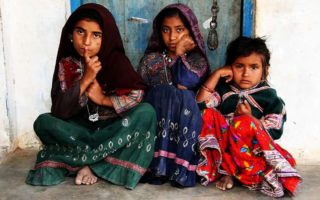
Bharwad women traditionally wear backless tops or shirts, only loosely covered with the help of veils. The most attractive piece of clothing is the ‘Ghaghro’ — a skirt whose embroidery work alone can take approximately two months to complete by hand.
Both men and women wear a thick cloth wrapped around the waist, known as ‘Bori.’
Bharwad Jewellery and Ornaments
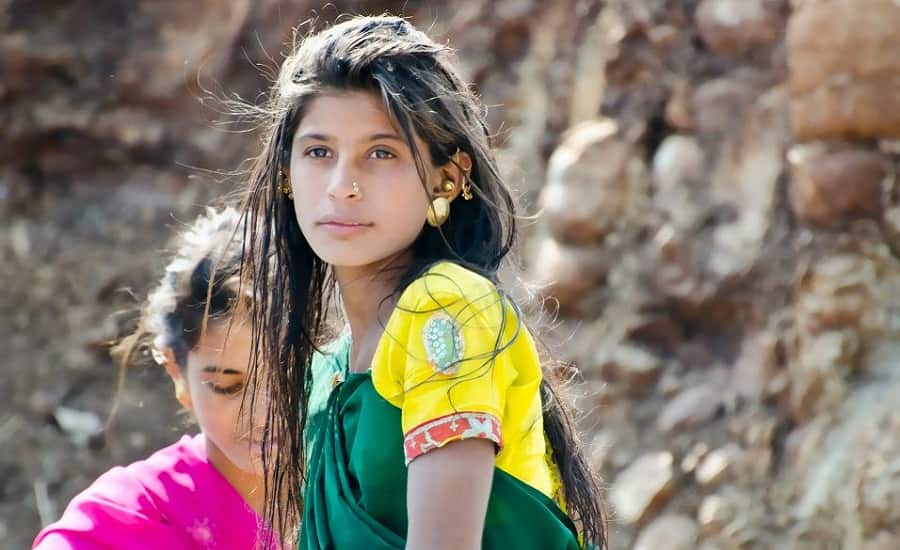
In earlier times, this community traditionally wore ivory ornaments. Today, Bharwad women commonly wear jewellery including kansu, khoteritu, kambikadla, anhuthi, vedhla, dalyu, kokarva, akota, and baloya — the latter two worn on the wrists — along with a nathli, worn on the nose.
Bharwad men also wear distinctive jewellery, including rings on their fingers, neck ornaments, an armlet, and a single earring known as ‘Variyo.’ The richness of their jewellery is most visible during the annual Tarnetar Fair.
Tarnetar Fair — Their Most Important Festival
|
Location |
Trinetreshwar Temple, Tarnetar village, Surendranagar district, Gujarat |
|
Distance from Rajkot |
Approximately 75 km (not 65 km, as sometimes incorrectly stated) |
|
Timing |
Bhadarva Sud Pancham — Hindu lunar calendar dates, typically late August or early September |
|
Duration |
Traditionally a 3-day fair; some sources describe an extended 4-day Lokmela including rural games and animal exhibitions |
|
Tradition Began |
Local accounts place its origins around 200–250 years ago |
|
Attendance |
Estimates vary by source and year; tourism reports commonly cite tens of thousands of visitors |
In past decades, mass marriages used to take place among Bharwad families during this gathering, helping families arrange weddings efficiently in one place at one time during the fair season.
The Bharwad community traditionally gathers at the Trinetreshwar temple in Tarnetar, following the Hindu lunar calendar dates of Bhadarva Sud. They celebrate this festival by singing traditional songs and dancing.
They also take shelter under decorated, embroidered canopies, a practice reserved for special occasions like this one.
During the fair, different groups of the community meet and celebrate together. These groups also visit their temples at Tharagam in Banaskantha district, and worship the deity Shivpuri Bapa at the Jajavada temple.
This community is also known for traditional folk songs such as Garbi and Hinch, with other folk songs like Duba, Garba, and Bhajan sung during occasions such as Sagai (engagement), Lagan (marriage), and Bharawano.
Bharwad vs Rabari: Key Differences
The similarity between Bharwad and Rabari dress often raises a natural follow-up question: what actually separates these two communities? Here is a quick comparison.
|
Aspect |
Bharwad Community |
Rabari Community |
|
Traditional Livestock |
Sheep, goats, and cattle |
Primarily camels, also cattle |
|
Origin Legend |
Krishna’s cowherd companions from Vrindavan |
Different origin traditions, often linked to camel-herding ancestry |
|
Women’s Dress |
Backless tops, Ghaghro skirts, dark veils |
Distinct embroidery style, also dark veils, but different ornament patterns |
|
Shared Events |
Both attend the Tarnetar fair together |
Both attend the Tarnetar fair together |
Religious Beliefs and Deities of the Community
Bharwad communities are widely known for following the Mata (mother goddess) tradition within Hinduism, and many groups have long-standing social ties with the Vala and Jhala Rajput clans of the region.
Within Hindu belief, the community worships regional folk deities and mother goddesses including Khodiar, Mahamai, Sindhui, Havechi, Machhu Mata, and Chamunda.
Machhu Mata is one of the important regional deities worshipped by many Bharwad groups, associated with the Machhu River, which flows through Gujarat’s Morbi district — though devotion to specific deities can vary by sub-group and region.
Many Bharwad groups also revere the moon, mountains, rivers, forests, animals, and the sun as part of broader nature-based devotional practices.
The Bharwad Community Today
While herding livestock remains central to Bharwad identity, many families today combine pastoral work with agriculture and other occupations, reflecting broader changes in rural Gujarat over recent decades.
Government and community initiatives in Gujarat have also encouraged pastoral communities like this one to continue practices such as using natural manure from their herds in farming — a traditional strength that aligns well with current organic farming interest.
Despite these changes, the community continues to maintain a strong, recognisable cultural identity through its dress, jewellery, songs, and festivals, particularly visible each year at events like the Tarnetar fair.
Frequently Asked Questions
Quick answers to the most common questions about the Bharwad community of Gujarat.
1. What is the origin of the Bharwad community?
Community oral tradition traces origins to Gokul Vrindavan near Mathura, with migration through Mewar in Rajasthan before settling in Gujarat.
2. Are Bharwads classified as Scheduled Tribe in Gujarat?
Only partially. Most Bharwads are OBC, but those living in the Alech, Barda, and Gir forest Nesses are officially recognised as Scheduled Tribe.
3. Where do Bharwad families mainly live?
Mainly in Junagadh, Rajkot, Surendranagar, and Bhavnagar districts of Gujarat, including the Barda forest area of Jamnagar and the Gir forest of Junagadh.
4. What is the traditional occupation of the Bharwad community?
Herding sheep, goats, and cattle has traditionally been the main occupation, though many families today also engage in agriculture.
5. What is the Tarnetar fair, and which communities attend it?
The Tarnetar fair is an annual three-day festival at the Trinetreshwar temple in Surendranagar district, attended by Bharwad, Rabari, Koli, and other pastoral communities of the region.
6. When is the Tarnetar fair held?
The fair follows the Hindu lunar calendar dates of Bhadarva Sud, which typically fall in late August or early September, rather than a fixed date every year.
7. How far is Tarnetar from Rajkot?
Tarnetar is approximately 75 km from Rajkot, accessible by road, rail via nearby Thangadh, or air through Rajkot Airport.
8. What is the traditional dress of the Bharwad community?
Men wear embroidered garments called Kehdiyun, while women wear backless tops and the heavily embroidered Ghaghro skirt, along with a thick waist cloth called Bori worn by both genders.
9. What jewellery do Bharwad women wear?
Bharwad women traditionally wear ornaments such as kansu, khoteritu, kambikadla, vedhla, akota, and baloya on the wrists, along with a nathli nose ring.
10. What is the difference between Bharwad and Rabari?
Bharwads traditionally herd sheep, goats, and cattle, while Rabaris are more closely associated with camel herding; both share similar dress styles but differ in ornament patterns and origin legends.
11. Which deities does the Bharwad community worship?
Regional Hindu folk goddesses including Khodiar, Mahamai, Machhu Mata, and Chamunda, alongside nature elements like the sun, moon, rivers, and mountains.
12. What are the major festivals celebrated by this community?
Krishna Janmashtami, the Tarnetar fair, and Navratri are the major festivals celebrated by the Bharwad community of Gujarat.
13. Did mass marriages really happen at Tarnetar to protect girls from kidnapping?
This specific historical claim could not be verified through reliable sources. Tarnetar is well documented as a long-running community matchmaking gathering, sometimes compared to a real-life swayamvar.
14. What does the name ‘Bharwad’ mean?
The name is commonly believed to come from the Gujarati words ‘bada’ (sheep) and ‘wada’ (enclosure), reflecting the community’s traditional occupation, though this etymology isn’t formally settled.
15. Are Bharwad traditions still practised today?
Yes. While many families have diversified into agriculture and other work, traditional dress, jewellery, songs, and festivals like Tarnetar remain actively practised each year.
16. Is ‘Bharwad tribe’ the correct term to use?
Not universally. Since most Bharwads are OBC rather than Scheduled Tribe, ‘Bharwad community’ is the more accurate general term, with ‘tribe’ reserved for the specific ST-recognised forest Nesses.
17. What language do Bharwad families speak?
Bharwad families primarily speak Gujarati, often with regional pastoral dialect variations depending on their district.
18. Can tourists attend the Tarnetar fair?
Yes, the Tarnetar fair is open to visitors and is a popular cultural tourism event, with Gujarat Tourism promoting it as a key annual attraction.
19. How is the Bharwad community connected to the Krishna tradition?
Many Bharwad families see themselves as descendants of Krishna’s cowherd companions, an oral tradition that shapes festivals like Krishna Janmashtami and their broader devotional identity.
20. Are Bharwad and Bharvad the same community?
Yes, ‘Bharvad’ is simply an alternate spelling of ‘Bharwad,’ referring to the same Gujarati pastoral community.
Conclusion
The Bharwad community of Gujarat carries forward a rich pastoral heritage rooted in devotion to Krishna, distinctive dress and jewellery, and vibrant festivals like the Tarnetar fair.
Their oral traditions of migration from Vrindavan through Mewar to Gujarat connect them to a much larger story of pastoral communities across western India.
From their official OBC and, in select forest areas, ST status, to their colourful embroidered Ghaghro skirts and the annual gathering at Trinetreshwar temple, the Bharwad people — and the wider Gujarat shepherd community they belong to — remain one of the most visually and culturally distinctive groups in the state today.
- Also Reads: List of Scheduled Tribes in Gujarat