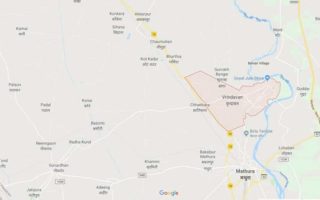
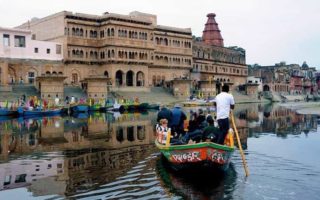
Vrindavan, the holy playground of Lord Krishna, sits just 11 km from Mathura, another major pilgrimage city. Also known as Brajbhoomi, Vrindavan lay largely forgotten until Sri Chaitanya Mahaprabhu visited around 1515 and set about uncovering its lost sacred sites.
Today, the temples in Vrindavan range from centuries-old shrines to grand modern marble complexes, and together they draw millions of pilgrims and travellers every year. This guide covers the 15 most visited temples in Vrindavan, ranked by a mix of historical significance and present-day footfall, along with the practical details — timings, routes, and travel tips — you need to plan your visit.
At a Glance
| Detail | Quick Fact |
|---|---|
| Major temples covered | 15 |
| Suggested visit duration | 1–2 days |
| Entry fee | Free at almost all temples in Vrindavan |
| Best season | October–March |
| Nearest railway station | Mathura Junction (~11 km) |
| Nearest major airport | Delhi IGI Airport (~160 km); Agra Airport offers limited connectivity |
| Ideal for | Pilgrims, history lovers, architecture and culture enthusiasts |
Quick Answer
|
Temples in Vrindavan
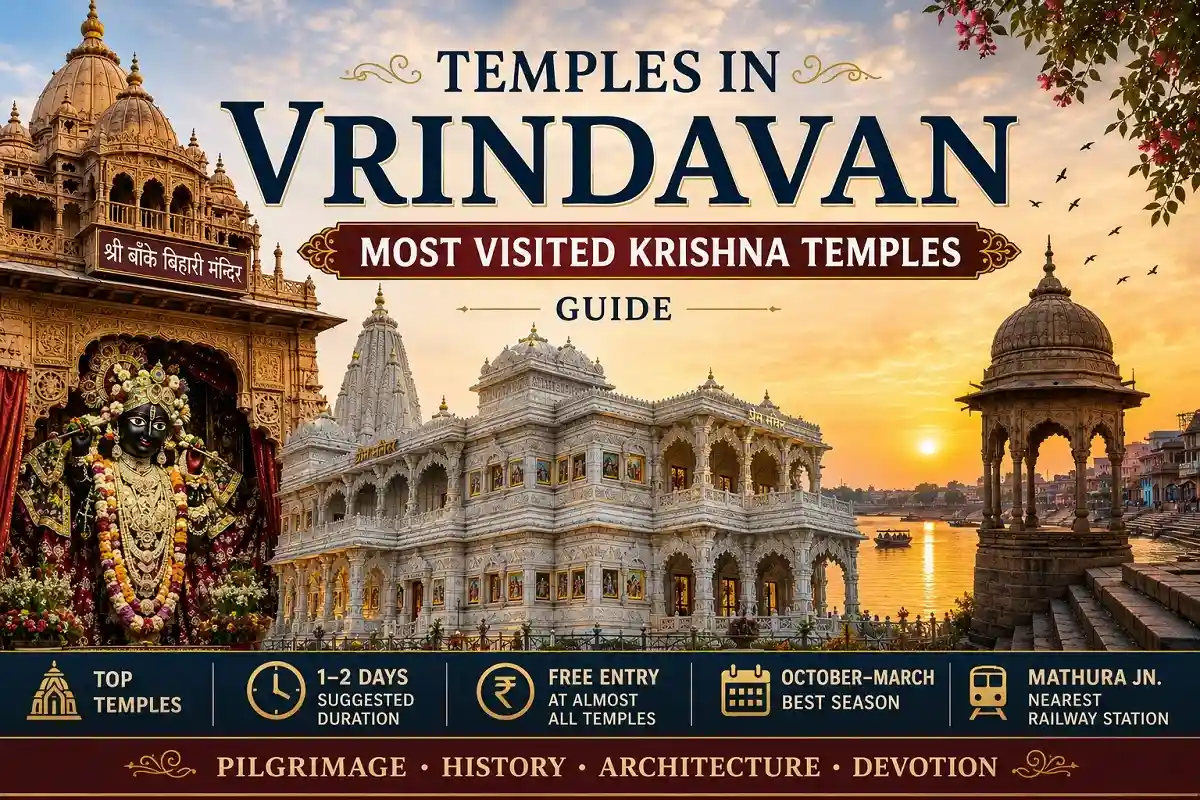
Vrindavan, the holy playground of Lord Krishna, sits just 11 km from Mathura, another major pilgrimage city. Also known as Brajbhoomi, Vrindavan lay largely forgotten until Sri Chaitanya Mahaprabhu visited around 1515 and set about uncovering its lost sacred sites.
Today, the temples in Vrindavan range from centuries-old shrines to grand modern marble complexes, and together they draw millions of pilgrims and travellers every year. This guide covers the 15 most visited temples in Vrindavan, ranked by a mix of historical significance and present-day footfall, along with the practical details — timings, routes, and travel tips — you need to plan your visit.
Best Time to Visit Vrindavan Temples
October to March is the most comfortable season for visiting Krishna temples in Vrindavan, with cool weather that makes walking between shrines easy. Summers (April–June) get very hot, and the monsoon months (July–September) bring heavy humidity.
| Months | Weather | Notes |
|---|---|---|
| October–December | Pleasant, cool evenings | Kartik month draws large pilgrim crowds |
| January–February | Cold mornings, mild days | Comfortable for temple-hopping, moderate crowds |
| March | Warming up | Holi season — vibrant but very crowded |
| April–June | Hot, dry | Avoid midday temple walks; early morning visits only |
| July–September | Humid, monsoon showers | Janmashtami in Aug/Sep draws huge crowds |
Major festivals like Janmashtami and Holi draw enormous crowds — a wonderful experience if you enjoy the energy, but worth avoiding if you prefer quieter darshan.
How to Reach Vrindavan
Vrindavan is well connected by road, rail, and air, making it an easy addition to a Mathura, Agra, or Delhi itinerary.
- By road: Roughly 150 km from Delhi (3–4 hours) and 65 km from Agra (1.5–2 hours) via the Yamuna Expressway and NH19
- By rail: Mathura Junction, about 11 km away, is the nearest major railway station with connections across India
- By air: Delhi’s Indira Gandhi International Airport (roughly 160 km away) is the practical primary gateway for most domestic and international travellers, thanks to far better flight connectivity. Agra Airport is closer but has limited scheduled flights. Read more…
Also Reads on: How to Reach Vrindavan from Haridwar
Suggested One-Day Temple Route
If you only have one day, this sequence covers the major temples in Vrindavan with minimal backtracking.
- Morning: Banke Bihari Temple (arrive at opening time for the calmest darshan)
- Mid-morning: Radha Raman Temple and Radha Damodar Temple, both a short walk away
- Late morning: Radha Govind Temple and Radha Gopinath Temple
- Afternoon: Seva Kunj, Nidhivan, and the Yamuna ghats
- Evening: ISKCON Temple for the evening kirtan, followed by Prem Mandir for the light and musical fountain show
With two days, add Rangaji Temple, Shahji Temple, and the Jaipur Temple, plus a side trip to Mathura’s Krishna Janmabhoomi.
The 15 Most Visited Temples in Vrindavan
Vrindavan is known as the grove of Tulsi plants, and it remains one of India’s most significant pilgrimage destinations. Devotees circumambulate the town and visit its many sacred shrines — some rooted in antiquity, others built more recently. Some accounts below reflect temple tradition and legend rather than documented history; we’ve noted this where relevant.
1. Sri Radha Shyamsundar Temple
Entry: Free | Duration: 15–20 min | Best for: Quiet, lesser-visited darshan
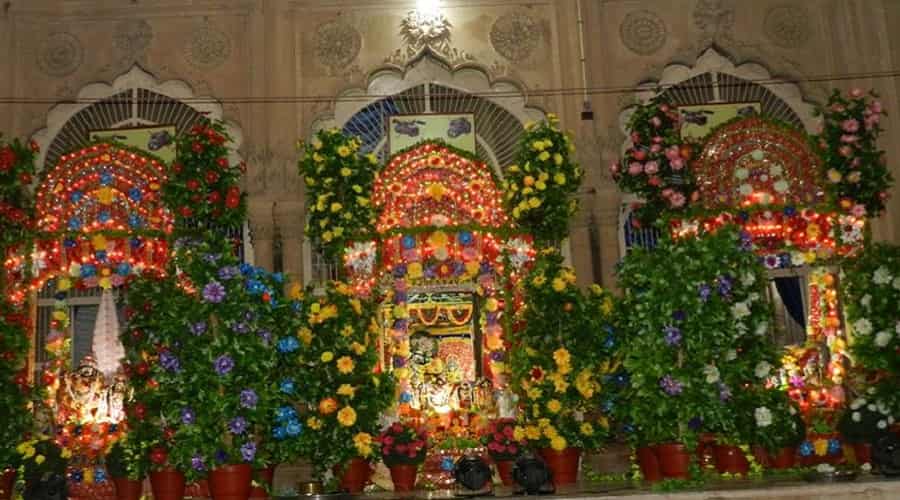
This is an old temple said to have been established by Sri Shyamananda Pandit. According to tradition, the temple houses a deity gifted to the Swami by Radha, the consort of Lord Krishna.
2. Sri Sri Radha Madan Mohan Temple
Entry: Free | Duration: 20–30 min | Best for: River views and early temple architecture
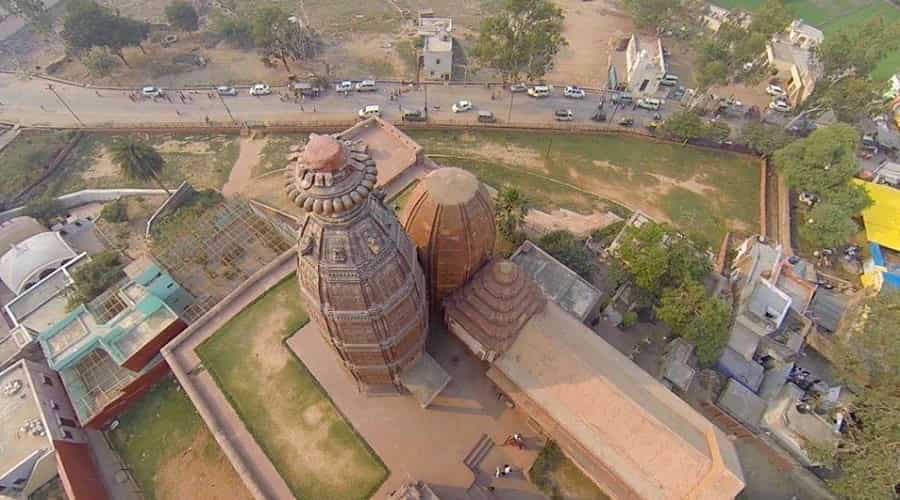
Built around 1580 on the 50-foot-high Dvadasaditya Tila hill adjoining the river Yamuna, it ranks as one of the first temples to Lord Krishna built in Vrindavan. Sanatana Goswami is said to have discovered the idol of Madan Mohan and installed it in the 60-foot-high temple. Radha and Lalita Shakti are worshipped alongside Lord Krishna.
3. Sri Radha Damodar Temple
Entry: Free | Duration: 20–30 min | Best for: ISKCON history and lineage
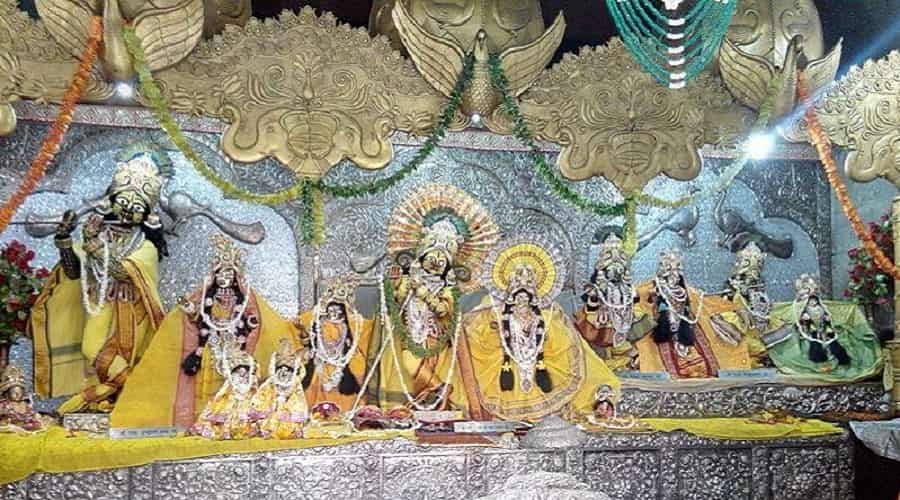
This is another ancient temple dating back to 1540. Built by Jiva Goswami at Seva Kunj, the temple’s claim to fame is that Srila Prabhupada, the founder of ISKCON, spent his early years here.
4. Sri Radha Raman Temple
Entry: Free | Duration: 30 min | Best for: One of the few temples with an original centuries-old deity
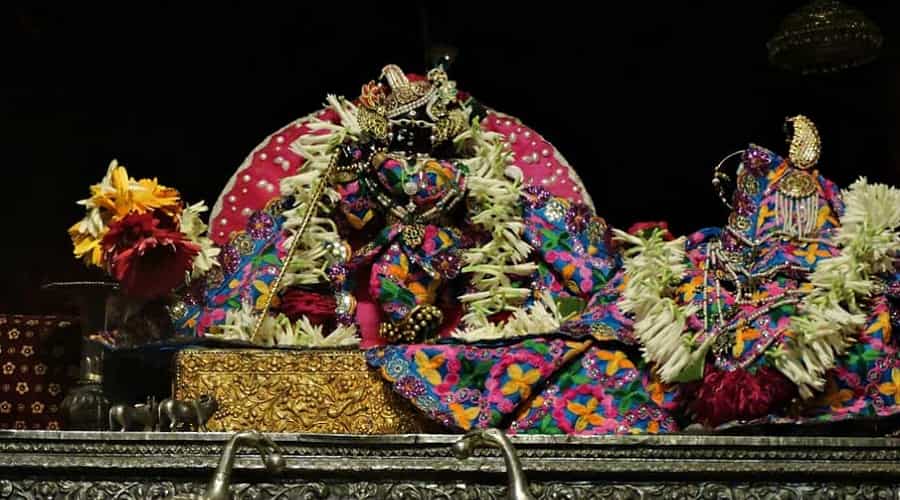
The Radha Raman temple was constructed in the sixteenth century, and it is one of the more finely carved temples of Vrindavan. It was built at the request of Gopala Bhatta Goswami, and the temple houses the original self-manifested idol of the deity, discovered in the forest according to temple tradition.
5. Sri Radha Govind Temple
Entry: Free | Duration: 20–30 min | Best for: Mughal-era architecture and history
Built by Maharaja Man Singh I of Amber, a general under Emperor Akbar and a disciple of Raghunath Bhatta Goswami, this is one of the grandest temples of Vrindavan, with an altar of gold, marble, and silver. The main hall has a giant sculpted lotus flower in its ceiling.
Constructed of red sandstone donated by Emperor Akbar, the temple’s construction began around 1590 and took about five years to complete, once standing seven storeys tall. In 1670, during the reign of Aurangzeb, the temple was attacked and plundered, leaving intact only three storeys of the original seven. This remains a must-visit temple in Vrindavan for Krishna Bhakts.
6. Sri Radha Gopinath Temple
Entry: Free | Duration: 15–20 min | Best for: Legend and lore around Krishna’s descendants
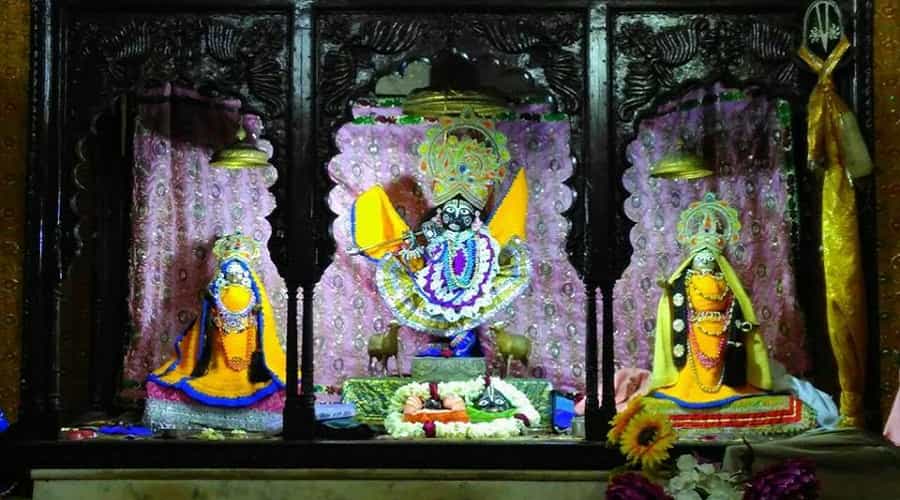
Not far from the Govind temple is the Sri Radha Gopinath temple, built by Madhu Pandit Goswami. Temple tradition holds that it houses an idol dating back thousands of years, the same one that Vajranabh, grandson of Lord Krishna, is said to have created. The idol was discovered by Parmanand Goswami at Vamsi Vata.
7. Sri Radha Gokulananda Temple
Entry: Free | Duration: 15–20 min | Best for: Govardhan Shila darshan
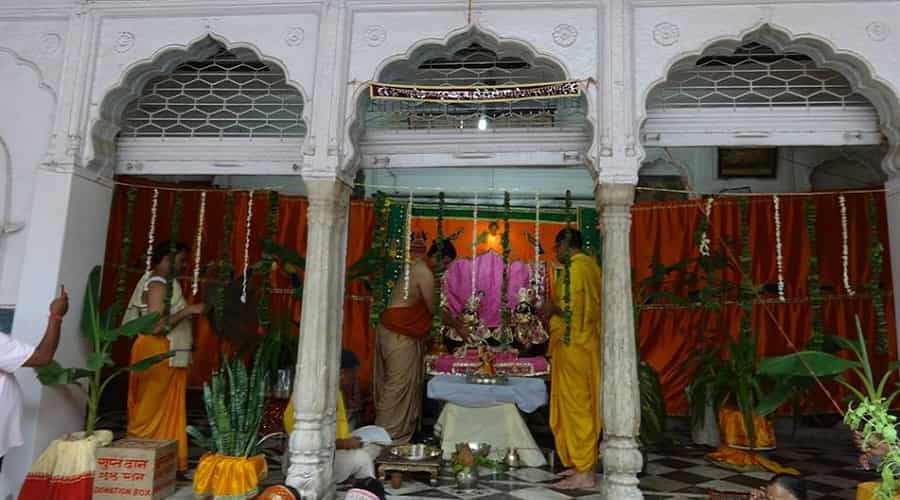
Another old temple, this one was built by Vishwanath Chakravarti, and it houses the deity of Radha Vinod as well as a Govardhan Shila gifted by Lord Chaitanya Mahaprabhu to Raghunath Das Goswami.
8. ISKCON Temple (Sri Krishna Balaram Mandir)
Timings: ~4:30 AM–8:00 PM daily | Entry: Free | Duration: 45–60 min | Best for: Evening kirtan and international/foreign visitors
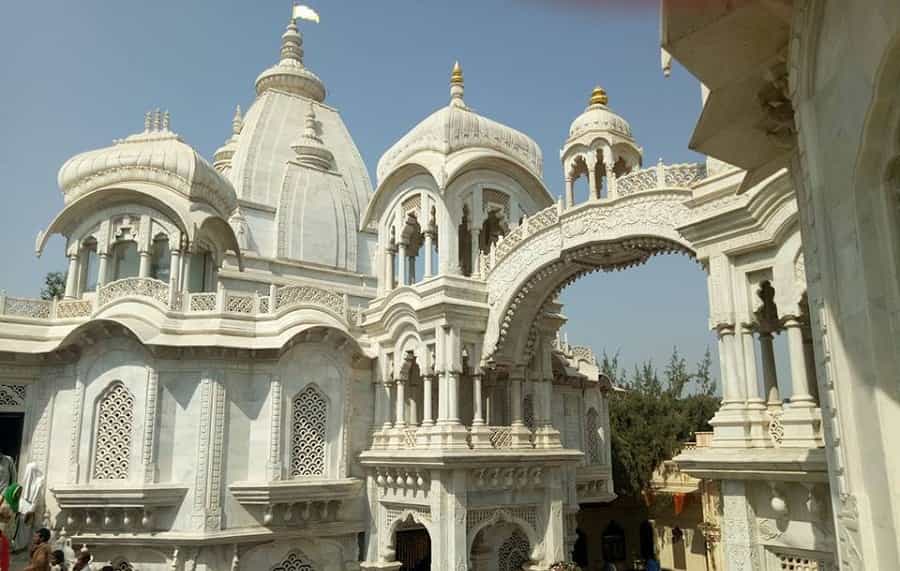
The first temple constructed by ISKCON anywhere in the world is the Krishna Balaram temple in Vrindavan, built in 1975 by Srila Prabhupada. The temple houses idols of Krishna and Balaram, as well as Gaura-Nitai and Radha Shyamsundar, and remains one of the most visited temples in Vrindavan for both Indian and international devotees.
9. Bankey Bihari Temple
Timings: Summer 7:45 AM–12 PM & 5:30–9:30 PM; Winter 8:45 AM–1 PM & 4:30–8:30 PM | Entry: Free (no official VIP pass) | Duration: 30–60 min | Best for: The most iconic darshan experience in Vrindavan
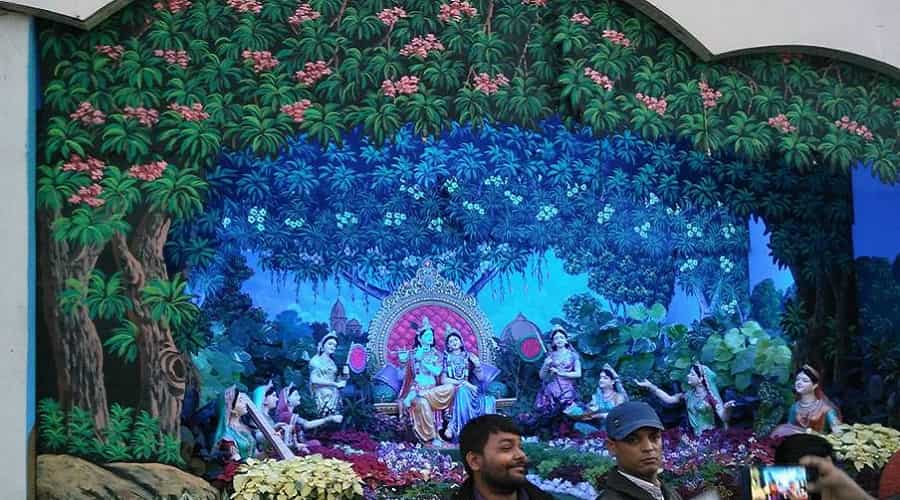
The Bankey Bihari temple is the most visited temple in Vrindavan. The deity was established in 1864 by followers of the 16th-century saint Swami Haridas, and the temple houses an idol of Lord Krishna in the Tribhanga pose. The unique fact about this temple is that the curtain in front of the idol is raised and lowered every few minutes, since it is believed that none can withstand the brilliance emanating from the eyes of Bankey Bihari for too long.
10. Prem Mandir
Timings: 8:30 AM–12 PM & 4:30–8:30 PM; light show ~7–7:30 PM (winter) / 7:30–8 PM (summer) | Entry: Free | Duration: 1–2 hr | Best for: Architecture, gardens, and the evening light show
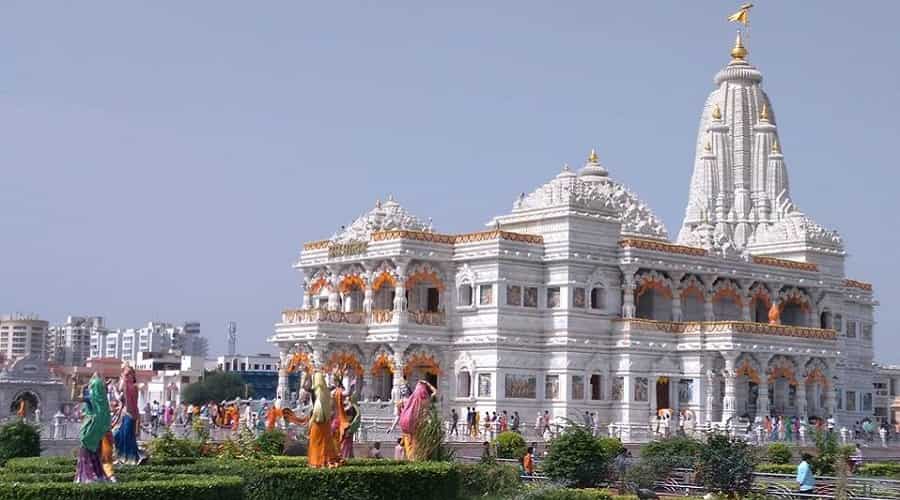
This is another major attraction in Vrindavan. Located on the outskirts of the city, it is the main temple complex of Jagadguru Kripalu Parishat. Of comparatively recent origin, construction began in 2001 and took about 11 years, with the temple opening to the public in February 2012.
The two-storey temple is built of fine Italian white marble and houses the idols of Krishna and Radha, as well as Sita and Ram. The temple walls carry carvings depicting episodes from the life of Radha and Krishna, and its evening light-and-sound fountain show is a major draw for visitors.
11. Rangaji Temple
Entry: Free | Duration: 30–40 min | Best for: South Indian-style architecture, rare in North India
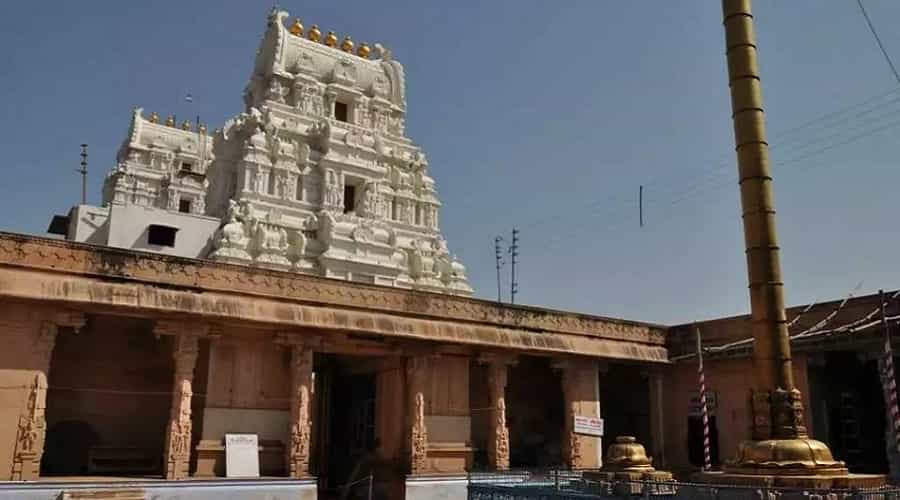
The Rangaji temple in Vrindavan is unique in that it follows the Dravidian style of architecture. Dedicated to Lord Rangaji, also known as Ranganathan, it has a 50-foot-high flat post with gold plating and a six-storey-high Gopuram. The temple was built in 1851 and is one of the more charming attractions in Vrindavan, with its water tank and beautiful garden.
12. Seva Kunj and Nidhivan
Entry: Free | Duration: 20–30 min | Best for: Legend, folklore, and a peaceful garden setting
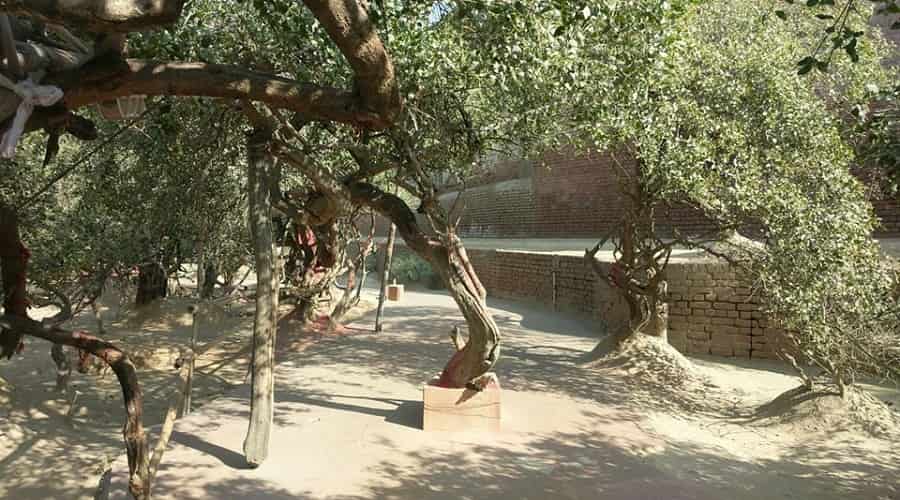
Temple tradition holds that the garden and shrine at Nidhivan mark the place where Lord Krishna and Radha performed their Raslila, dancing with the Gopis. It is believed the Lord and Radha still play their Leela here at night, which is why the premises are locked after dusk and no one is allowed to stay. Nidhivan has other temples nearby, such as Radha Vrindavan Chandra temple, Radha Shyamsundar temple, and Radha Damodar temple.
13. Jaipur Temple
Entry: Free | Duration: 20 min | Best for: Rajasthani stone carving
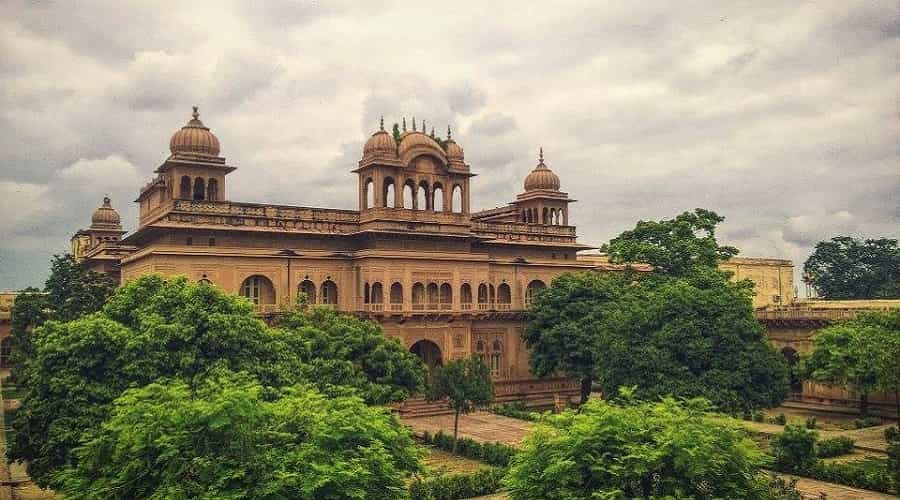
The Jaipur temple was built in 1917 by Sawai Madho Singh II, the Maharaja of Jaipur, and it is one of the more beautifully carved temples of Vrindavan. The temple is dedicated to Radha and Madhav.
14. Shahji Temple
Entry: Free | Duration: 20–30 min | Best for: Belgian glass chandeliers and marble spiral columns
The Shahji temple was built by Shah Kundan Lal, a jeweller from Lucknow, and it houses an idol of Lord Krishna. It has beautifully carved marble sculptures and spiral columns, with the highlight being the Darbar hall with its Belgian glass chandeliers.
15. Radha Ras Bihari Ashta Sakhi Temple
Entry: Free | Duration: 15–20 min | Best for: A unique focus on Radha’s companions
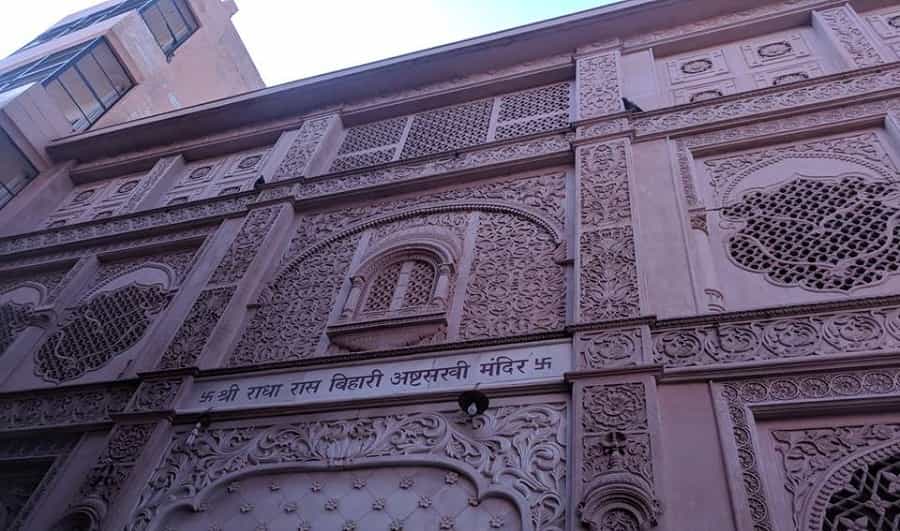
This temple is dedicated not only to Radha and Krishna but also to her eight companions, or Ashta Sakhi. The temple represents the Leela of Lord Krishna with Radha and her companions, and it deserves a spot on your list of temples to visit in Vrindavan.
Round off your temple tour of Vrindavan with a visit to the Yamuna River. Lord Krishna played on its banks and in its waters with the Gopis, so it is well worth a visit to this holy river, especially around Keshi Ghat in the evening.
Quick Comparison — Which Temple Suits You?
| Temple | Best For |
|---|---|
| Bankey Bihari | Traditional darshan and the iconic curtain ritual |
| Prem Mandir | Architecture, gardens, and the evening light show |
| ISKCON | International visitors and evening kirtan |
| Radha Raman | Historic, centuries-old original deity |
| Radha Govind | Mughal-era architecture and history |
Getting Around — Transport and Parking
Vrindavan’s temple lanes are narrow, and vehicles can’t reach many temple entrances directly.
- E-rickshaws and cycle rickshaws are the easiest way to move between temples — fares are generally modest but agree on the price beforehand
- Cars and taxis can drop you at designated parking points near Banke Bihari and other inner-lane temples; the last stretch is on foot
- Prem Mandir and ISKCON have dedicated parking areas for two- and four-wheelers, often free or with a nominal fee
- Walking between nearby temples (like Radha Raman to Radha Damodar) is often faster than arranging transport for short distances
Accessibility and Family Travel Tips
Many of Vrindavan’s older temples sit in narrow lanes with steps and uneven surfaces, which can be challenging for wheelchairs, strollers, or visitors with mobility concerns. Newer complexes like Prem Mandir and ISKCON have wider, more accessible pathways.
If you’re travelling with elderly family members or young children, prioritise Prem Mandir, ISKCON, and Rangaji Temple, and consider hiring a local guide who can help navigate crowds at Banke Bihari, especially during peak hours.
Food and Where to Eat Near the Temples
Vrindavan is a strictly vegetarian town, and food here reflects deep Krishna devotion, often served as prasad first.
- Loi Bazar, near Banke Bihari Temple, is the best-known market for peda (Vrindavan’s famous milk-based sweet) and other temple offerings
- Several satvik (onion-and-garlic-free) restaurants operate near the main temple areas, serving thalis, kachori-sabzi, and other North Indian vegetarian staples
- Try the local lassi at small stalls near the ghats — thick, sweet, and a popular way to cool down after a day of temple-hopping
- Street food is easy to find, but stick to busy stalls with high turnover for freshness
Nearby Attractions Beyond the Temples
- Keshi Ghat — a peaceful spot on the Yamuna, especially beautiful at sunset and during the evening Yamuna Aarti
- Krishna Janmabhoomi, Mathura — Lord Krishna’s birthplace, about 11 km away, often combined with a Vrindavan visit
- Gokul — where Krishna spent his early childhood, a short drive from Vrindavan
- Barsana and Nandgaon — associated with Radha and Krishna respectively, popular for their own temples and the famous Lathmar Holi
Where to Stay in Vrindavan
| Type | Best For | Approx. Cost/Night |
|---|---|---|
| Dharamshalas / Ashrams | Budget pilgrims, spiritual atmosphere | ₹500–1,500 |
| Budget guesthouses | Simple, functional stays near temples | ₹1,500–3,000 |
| Mid-range hotels | Comfort with modern amenities | ₹3,000–6,000 |
| Premium hotels | Higher comfort, often near Prem Mandir/ISKCON area | ₹6,000+ |
Book ahead during Janmashtami, Holi, and the Kartik month, when rooms fill up quickly.
Festival Advisory
Vrindavan’s temples get significantly busier during major festivals — plan accordingly.
- Janmashtami (Aug/Sep): The biggest crowd of the year, especially at Banke Bihari and ISKCON; book accommodation well in advance
- Holi (March): Vibrant, colourful celebrations across the city, with Banke Bihari’s Holi events drawing huge crowds
- Radhashtami (Aug/Sep): Major celebration honouring Radha’s birth
- Kartik Month (Oct/Nov): A traditionally auspicious period that draws large numbers of pilgrims for a full month
On these days, expect road closures near major temples, longer queues, and limited parking — arriving early is the best strategy.
Temple Etiquette and Rules
Most Vrindavan temples open around sunrise and close after the evening aarti, often with a midday break. Timings vary by temple and season, so confirm locally or with your travel operator on the day.
- Dress modestly — avoid shorts and sleeveless clothing at most temples
- Remove footwear before entering; free shoe-storage counters are available at most major temples
- Photography is restricted or prohibited in several temples, especially near the main deity — look for posted signs or ask an attendant
- Mobile phones are generally allowed at newer temples like Prem Mandir, but check locally at older, smaller shrines
- Avoid carrying leather items inside some temples
Safety Tips for Visitors
- Stay alert around monkeys near temple complexes — they’re known to snatch food, bags, and even eyeglasses
- Keep valuables secure in crowded lanes, especially near Banke Bihari during peak hours and festivals
- Carry both cash and a UPI-enabled payment app — smaller shops and stalls may not accept cards
- Women travelling solo should stick to well-lit, busy areas after dark and avoid isolated lanes
- Keep a note of your hotel’s address and a local emergency contact, especially during high-crowd festival periods
Religious and Cultural Significance
Vrindavan holds a unique place in Hindu tradition as the land where Lord Krishna spent his childhood and youth, playing among the Gopis and performing his divine Leela. This history is why the temples in Vrindavan aren’t just places of worship — they’re living connections to stories devotees have passed down for centuries.
Many of these shrines were founded by disciples of Chaitanya Mahaprabhu in the 16th century, part of a broader revival of Krishna devotion (Gaudiya Vaishnavism) that reshaped the town from a forgotten forest into one of India’s most important pilgrimage centres. That layered history — ancient shrines standing beside 20th-century additions like ISKCON and Prem Mandir — is part of what makes a Vrindavan temple tour so distinctive.
Final Thoughts
Vrindavan’s temples aren’t just architectural landmarks — each one carries centuries of devotion, legend, and history tied to Lord Krishna’s life. Whether you’re drawn to the grandeur of Prem Mandir, the intimacy of Bankey Bihari, or the quiet ruins of the Radha Govind Temple, visiting these sacred shrines offers a genuinely moving glimpse into Braj Bhoomi’s living spiritual heritage.
Frequently Asked Questions
1) Which are the most visited temples in Vrindavan?
Bankey Bihari, ISKCON (Krishna Balaram Mandir), Prem Mandir, Radha Raman, and Radha Govind are among the most visited temples in Vrindavan.
2) What is the best time to visit Vrindavan temples?
October to March offers the most comfortable weather; avoid the peak summer heat from April to June.
3) How far is Vrindavan from Delhi and Agra?
Vrindavan is roughly 150 km from Delhi (3–4 hours by road) and about 65 km from Agra (1.5–2 hours by road).
4) When was the Radha Govind Temple built?
Construction began around 1590 under Raja Man Singh I of Amber; it was later partially destroyed by Aurangzeb in 1670.
5) What are Bankey Bihari Temple’s darshan timings?
Summer: 7:45 AM–12 PM and 5:30–9:30 PM. Winter: 8:45 AM–1 PM and 4:30–8:30 PM. Timings shift on festival days.
6) Is there an entry fee for Vrindavan temples?
No — almost all major temples in Vrindavan, including Bankey Bihari, Prem Mandir, and ISKCON, are free to enter.
7) Which temple should I visit first in Vrindavan?
Bankey Bihari is the traditional first stop for most pilgrims, ideally at opening time for the calmest darshan.
8) Can Vrindavan be covered in one day?
Yes — a well-planned route covering 6–8 major temples is possible in one day, though two days allows a more relaxed pace.
9) What is unique about Prem Mandir?
Prem Mandir is a modern marble temple built on 54 acres, known for its detailed carvings and its evening light-and-sound fountain show.
10) Is the ISKCON Temple in Vrindavan the original ISKCON temple?
Yes — the Krishna Balaram Mandir in Vrindavan, built in 1975, was the first temple constructed by ISKCON anywhere in the world.
11) Is photography allowed inside Vrindavan temples?
It’s restricted or banned in several temples, especially near the main deity — check posted signs or ask an attendant first.
12) Is there a dress code for Vrindavan temples?
Yes — modest clothing is expected at most temples, and footwear must be removed before entering.
13) How do I get around between temples in Vrindavan?
E-rickshaws and cycle rickshaws are the easiest way to cover the narrow temple lanes; cars can’t reach several entrances directly.
14) Which Vrindavan temple is best for foreign visitors?
ISKCON is especially popular with international visitors, thanks to its English-friendly environment and daily kirtan sessions.
15) Is Vrindavan crowded during Janmashtami?
Yes, extremely — it’s the busiest festival of the year, especially at Bankey Bihari and ISKCON. Book accommodation well ahead.
16) Are Vrindavan’s temples accessible for elderly visitors?
Newer temples like Prem Mandir and ISKCON have wider, easier pathways; older temple lanes can involve steps and crowds.
17) What is the significance of the curtain at Bankey Bihari Temple?
It’s believed no one can withstand the brilliance of Bankey Bihari’s eyes for too long, so the curtain is raised and lowered every few minutes.
18) What should I eat near the Vrindavan temples?
Try Vrindavan’s famous peda near Loi Bazar, along with satvik thalis and fresh lassi available near most temple areas.